
Carmen — When Ballet Becomes Seduction, Violence and Pure Theatre
There are moments when you leave a theatre having watched a performance, and there are moments when you leave having been reminded why you fell in love with the art form in the first place.
My visit to the Joburg Theatre for the opening night of Carmen, presented by Joburg Ballet from 25 September to 3 October 2026, was one of those moments.
This is ballet with heat in its veins.
This is ballet that seduces, teases, fights, laughs, smokes, flirts, threatens and ultimately breaks your heart. It is beautiful without being polite about it. It is classical technique meeting human instinct. And at its centre is Carmen herself, brought magnificently to life by Brazil’s Monike Cristina.
Thank you, Brazil.
Because Monike Cristina is something else.
She is not simply dancing Carmen. She becomes Carmen.
Veronica Paeper’s Carmen is a production that understands something fundamental about ballet: the human body can communicate what words cannot. A tilt of the head can be an invitation. A smile can be a weapon. A port de bras can become seduction. A sudden change in épaulement can expose jealousy, fear or desire. The choreography turns the vocabulary of ballet into the vocabulary of human behaviour.
And Monike Cristina understands every syllable.
She is the Goddess of Ballet.
There is an almost dangerous effortlessness to her performance. She moves through the stage with a smile, with musicality, with extraordinary control, and yet nothing about her feels mechanical. Her technique is immense, but technique never becomes the point. It is the foundation upon which personality is built.
Carmen is playful.
She is seductive.
She is alluring.
She is tempting.
She is mischievous.
She is dark.
She is violent.
She is vulgar.
She is unpredictable.
She is a femme fatale.
And Monike gives us every shade of her.
That is what makes her performance so intoxicating.

Seville Comes Alive
The story begins outside a cigarette factory in Seville, where the residents gather in the town square to watch the changing of the guard. Don José arrives with the new guard under the command of Captain Zuniga, immediately establishing the military order that will eventually collide with Carmen’s wild, untameable spirit.
Then comes midday.
The cigarette girls emerge from the factory.
And among them is Carmen.
She sees Don José and, almost immediately, there is attraction.
But this is not a conventional romantic encounter. Carmen does not wait for love to find her. She hunts it. She plays with it. She tests it.
The cigarette girls are summoned back into the factory, while Micaela arrives carrying a gift from Don José’s mother. She is his fiancée, gentle and sincere, but Don José is distracted. Something has already shifted. Carmen has entered the picture, and suddenly the safe future represented by Micaela feels very far away.
Then violence erupts.
Carmen becomes involved in a fight and is arrested. Don José is ordered to guard her.
It should be simple.
It isn’t.
Carmen persuades him to release her, and in doing so Don José finds himself imprisoned instead.
The curtain falls.
And already the spell has been cast.
What Paeper understands so beautifully is that Carmen is not simply a story about a woman who destroys a man’s life. It is a story about desire colliding with control. Carmen refuses to belong to anyone. Don José wants to possess what he cannot control. The tragedy begins long before the final confrontation.
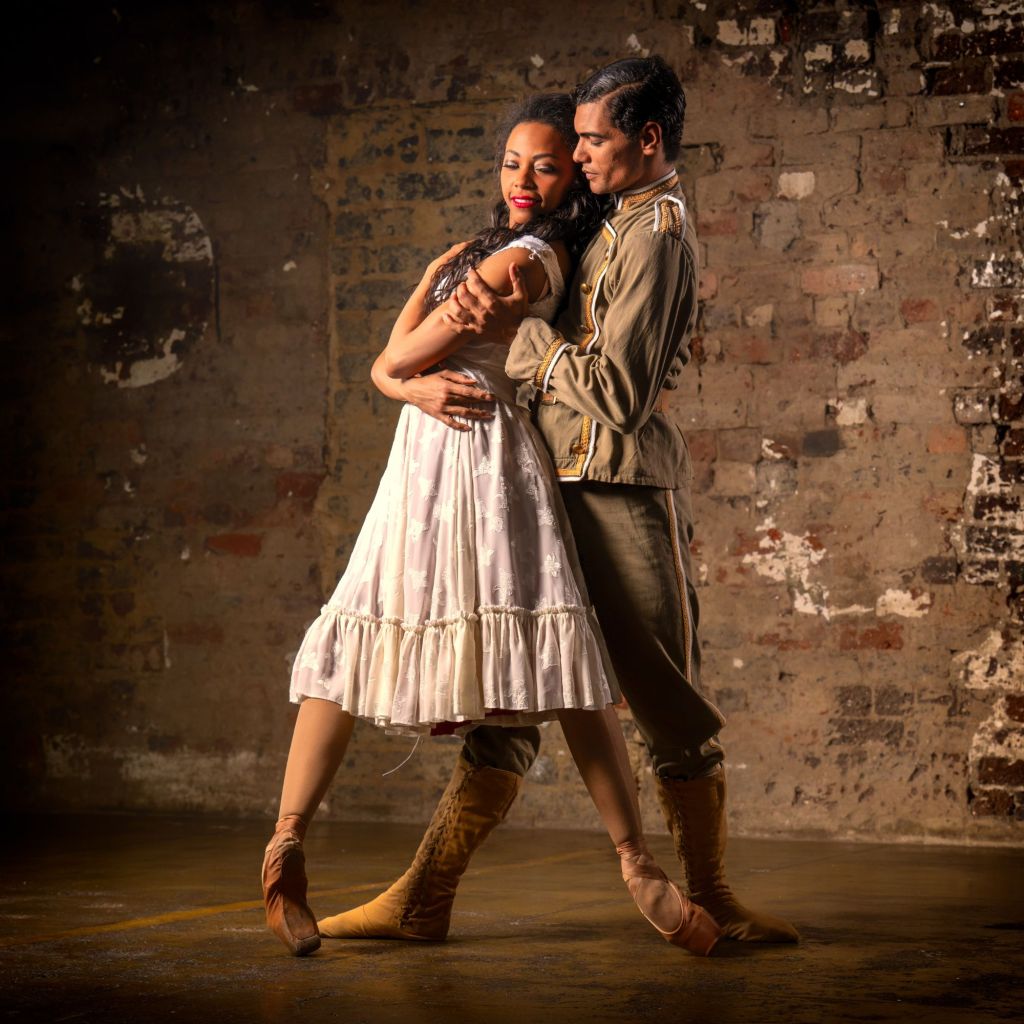
Monike Cristina: The Art of Being Irresistible
Watching Monike Cristina dance Carmen is almost unfair because she makes the extraordinary appear ordinary.
Her balances are exquisite. Her extensions are beautifully controlled. Her lines are magnificent. Her musicality is alive. Her transitions are fluid. Her épaulement carries character. Her use of the upper body gives Carmen a sensuality that goes beyond steps and positions.
And then there are the expressions.
Golden.
Perfect.
A smile appears and suddenly you understand Carmen.
A glance changes and suddenly the atmosphere shifts.
She can look playful in one instant and dangerous in the next.
That is the magic of an exceptional dramatic dancer: you don’t see the technique first. You see the person.
Monike makes Carmen feel completely alive.
There is a freedom in her movement that is almost intoxicating. Her body seems to understand the music before the music has finished speaking. Her phrasing is confident, her footwork precise, her balances assured, and her physicality allows the choreography to breathe.
There are moments when she performs feats that make you wonder how the human body is capable of doing what you have just witnessed.
And yet she smiles.
That is the extraordinary part.
Nothing looks laboured.
Nothing looks forced.
It simply happens.
Carmen walks into the room and owns it.
Monike walks onto the stage and does the same.
I am convinced there is nothing better in the world than watching Monike Cristina as Carmen.
She made me fall in love with ballet again.
Or perhaps she reminded me why I fell in love with it in the first place.
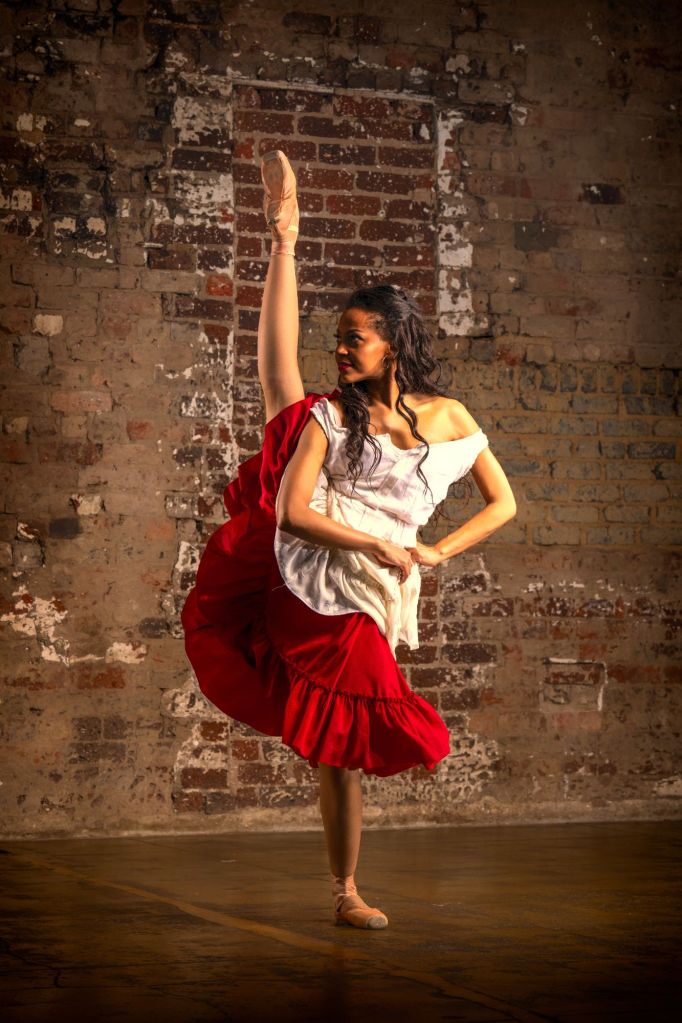
Act II — The Tavern of Lilas Pastia
A month has passed.
We move to the Tavern of Lilas Pastia, and the temperature rises.
Captain Zuniga has fallen under Carmen’s spell and dances with her. Then Escamillo, the famous Toreador, enters.
He too is immediately attracted to Carmen.
Of course he is.
How could he not be?
But Carmen’s heart and mind remain consumed by Don José.
The smugglers arrive and Carmen becomes involved in their conspiracy. When Don José arrives, she attempts to seduce him, but a bugle call summons him back to duty.
And Carmen is furious.
This is where the central conflict becomes even more apparent. For Carmen, love means freedom, instinct and surrender to desire. For Don José, duty still pulls at him. Carmen taunts him for placing his obligations above his love for her.
Captain Zuniga returns and orders Don José back to the barracks.
But jealousy has already taken over.
When Zuniga attempts to take Carmen into his arms, Don José attacks his own officer and wounds him.
There is no going back.
Don José is now hopelessly compromised and has no choice but to join the smugglers.
This is where Monike’s Carmen becomes particularly fascinating. She is not simply the object of everyone’s desire. She is the force that exposes everyone else’s weakness.
Men enter her orbit and begin revealing themselves.
Zuniga reveals his desire.
Escamillo reveals his attraction.
Don José reveals his obsession.
Carmen simply remains Carmen.
And that is her power.

Ballet That Fights
One of the most visually striking moments of the production is the fight involving the cigarette girls.
It is beautiful.
That sentence sounds contradictory until you see it.
The dancers kick.
They drag.
They pull hair.
They clash.
They attack.
And somehow, through the discipline of ballet, violence becomes choreography.
It is a remarkable demonstration of control.
Every movement has to be precise. Every kick must land safely. Every pull must be performed with trust. Every fall must be choreographed. The dancers have to create the illusion of chaos while maintaining absolute technical awareness.
And they do.
This is where ballet becomes something more than pretty movement.
The girls are fighting, but the lines remain beautiful.
The bodies remain coordinated.
The choreography remains musical.
The technique remains immaculate.
It is violence with épaulement.
It is aggression with musical phrasing.
It is theatrical conflict transformed into dance.
And Veronica Paeper deserves enormous credit for understanding that ballet does not have to remain trapped inside a world of delicate gestures and romantic idealism.
Her Carmen can be raw.
It can be sensual.
It can be funny.
It can be ugly.
It can be dangerous.
It can be vulgar.
It can be sexy.
It can be violent.
And it remains ballet.
Cigarettes, Attitude and the Unexpected
There were moments in this production that made me think: I have never seen ballet do this before.
There is smoking on stage.
There are gestures and attitudes that feel deliberately contemporary and confrontational.
And at one point Carmen appears to flip somebody off.
In ballet.
I have never seen that in ballet. Period.
And I loved it.
Because it tells us exactly who Carmen is.
She is not interested in behaving according to somebody else’s expectations.
The gesture is funny, shocking and completely character-driven. It breaks the distance between the classical art form and the messy reality of human behaviour.
That is what makes Paeper’s choreography so exciting.
She doesn’t destroy ballet’s elegance.
She weaponises it.
The classical vocabulary remains visible, but it is placed inside a world of cigarette factories, taverns, smugglers, jealousy, desire, fighting, flirtation and death.
The result is a ballet that feels theatrical in the fullest sense of the word.

Act III — The Mountains and the Death Card
The third act moves into a cave in the mountains.
The relationship between Carmen and Don José is changing.
Carmen’s passion is fading.
Don José’s is not.
He remains desperately in love with her.
Mercedes and Frasquita tell their futures through the cards, and Carmen turns one herself.
The death card.
It is one of the most powerful images in the entire story because the audience already knows that Carmen is moving towards something from which there may be no escape.
Then Escamillo arrives.
He invites Carmen and the others to the bullfight.
Don José, furious and jealous, challenges him.
The two men fight.
The smugglers separate them, and Escamillo leaves.
Then Micaela is discovered in the cave.
She brings news that changes everything: Don José’s mother is dying.
Reluctantly, he leaves with her.
But Carmen remains.
And the cards have already spoken.
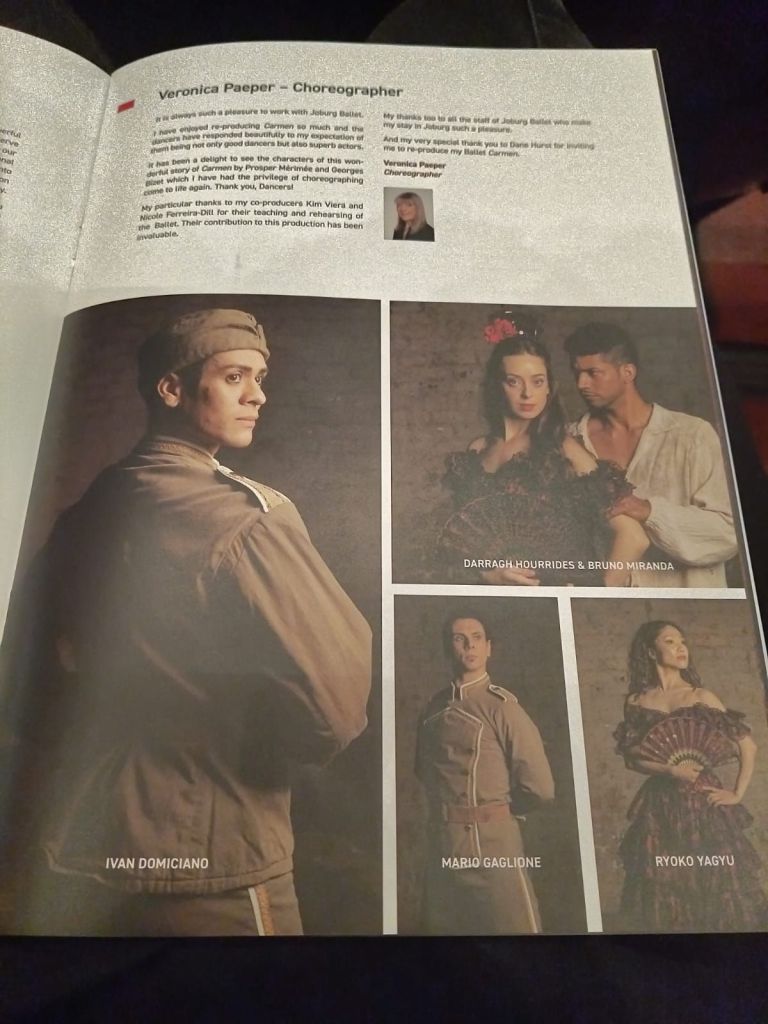
The Ensemble: Because Carmen Is Not a One-Woman Show
It would be easy to allow Monike Cristina’s performance to dominate the conversation.
But that would be unfair to the production.
Carmen works because the entire company creates its world.
Revil Yon as Don José brings the necessary emotional vulnerability to the central male character. His Don José is caught between duty and desire, between the life he is supposed to live and the woman who has completely destabilised it.
Bruno Miranda’s Escamillo arrives with the swagger and physical confidence of the Toreador. He is a different kind of masculine presence from Don José: confident, celebrated and immediately magnetic.
Chloe Blair’s Micaela provides a beautiful contrast to Carmen. Where Carmen is fire, Micaela carries warmth and sincerity. Her presence gives Don José another possible life, one rooted in loyalty and tenderness.
Ivan Domiciano’s Captain Zuniga carries the authority of the military world while becoming another victim of Carmen’s irresistible magnetism.
Latoya Mokoena as Pasquita and Darragh Hourrides as Mercedes contribute to the vibrant female ensemble, while Sue Kirkland’s Madame of the Factory helps establish the social world surrounding the cigarette girls.
Albertus Dreyer as Lilas Pastia, Creagan Martin as the Pickpocket, Mothobisi Molopa as the Captain of the Guard, Brayden Stackling as the Fiesta Man, and Miles Carrott as the Chief Smuggler all contribute to the theatrical machinery of the production.
This is an ensemble piece.
Every dancer adds texture.
Every entrance contributes to the atmosphere.
Every body on stage helps construct Seville.
That is the magic of a ballet company working as one organism.

Act IV — The Bullring
Then comes the final act.
Outside the bullring, the spectators gather for the arrival of the Toreadors.
The atmosphere is festive.
But beneath the celebration sits tragedy.
Don José is in the crowd.
The procession enters.
And Carmen and Don José confront one another for the final time.
Everything has led here.
The attraction.
The seduction.
The jealousy.
The fighting.
The betrayal.
The cards.
The obsession.
The freedom.
The refusal to possess and be possessed.
And finally, the confrontation.
Carmen has always understood that passion can be both intoxicating and destructive. Paeper’s production allows that contradiction to live inside the movement.
The same woman who can make an audience smile can also make an audience uncomfortable.
The same choreography that can look exquisite can suddenly become brutal.
The same body that can float through a beautiful adagio can become a weapon.
That is Carmen.
Veronica Paeper’s Genius
Veronica Paeper’s choreography and production are the beating heart of this interpretation.
There is a confidence in the way she moves between classical ballet, character dance, theatrical gesture and flamenco influence.
The choreography never feels like ballet pasted onto a story.
It feels like the story has been translated into ballet.
That distinction matters.
The flamenco choreography by Gillian Bonegio adds another layer of Spanish character and rhythmic energy, giving the production a vocabulary beyond the purely classical.
The music of Georges Bizet remains the emotional architecture of the ballet. It is dramatic, seductive, playful and ominous, allowing the dancers to inhabit a score that seems almost designed for movement.
The scenery and costumes after the originals by Peter Cazalet create the visual identity of the world, while Vanessa Nicolau’s adaptation helps shape the theatrical journey.
Simon King’s lighting design deserves recognition too. Lighting in ballet is not decoration. It is atmosphere, focus and storytelling. It tells us where to look, when to feel tension and when the stage itself should seem to transform.
Together, these elements create a world that feels larger than the stage.
Seville becomes a character.
The factory becomes a character.
The tavern becomes a character.
The mountains become a character.
The bullring becomes the final arena in which Carmen’s fate is sealed.
Joburg Ballet at Its Best
I am a big fan of Joburg Ballet.
And productions like this remind me why.
There is something extraordinary about watching a South African company take a canonical work and make it feel alive here, in Johannesburg, in 2026.
This is not a museum piece.
It is not ballet preserved behind glass.
It is living theatre.
It is classical technique meeting contemporary theatrical instinct.
It is dancers who understand that a perfectly executed movement is only half the job. The other half is making the audience feel something.
And I felt everything.
The excitement.
The humour.
The seduction.
The violence.
The jealousy.
The beauty.
The danger.
The heartbreak.
And, above all, the sheer joy of watching dancers perform at an exceptional level.

Thank You, Brazil
But I have to return to Monike Cristina.
Because sometimes an artist arrives on stage and changes your perception of the entire performance.
That is what she did.
She is beautiful, but beauty alone is not enough.
She is technically brilliant, but technique alone is not enough.
She is expressive, but expression alone is not enough.
She has the rare combination of technique, musicality, theatrical intelligence, charisma, physical confidence and emotional instinct that makes a dancer unforgettable.
She does not merely execute choreography.
She inhabits it.
She does not merely perform Carmen.
She breathes Carmen.
And somehow she makes impossible feats look effortless.
There is something irresistible about her.
You watch her and you understand why everyone in the story falls for Carmen.
Of course they do.
Look at her.
Watch her.
Listen to the movement.
Watch the smile.
Watch the eyes.
Watch the way she turns.
Watch the way she uses her shoulders, her torso, her hands, her head.
Watch the confidence.
Watch the danger underneath the beauty.
Monike Cristina is Carmen.
And Carmen is Monike Cristina.

A Ballet Worth Falling In Love With
Carmen is everything I want ballet to be.
It is technically extraordinary, visually sumptuous, emotionally charged and dramatically fearless.
It has beautiful lines and impossible feats.
It has exquisite choreography and explosive character.
It has grace and vulgarity.
It has romance and violence.
It has humour and tragedy.
It has the discipline of classical ballet and the untamed spirit of Carmen herself.
And that is perhaps the greatest achievement of Veronica Paeper’s production: she understands that ballet does not have to choose between beauty and brutality.
It can be both.
It can kick, pull hair and drag someone across the stage and still look beautiful.
It can smoke a cigarette.
It can flirt.
It can seduce.
It can give somebody the finger.
It can fall madly in love.
It can become consumed by jealousy.
It can die.
And it can do all of this through the language of dance.
That is theatre.
That is ballet.
That is Carmen.
And that is Joburg Ballet.
From Monike Cristina’s intoxicating Carmen to Revil Yon’s Don José, Bruno Miranda’s Escamillo and Chloe Blair’s Micaela, from the ensemble to the designers, choreographers, musicians and production team, this is a company operating with remarkable commitment and precision.
Veronica Paeper has created something magnificent.
Monike Cristina has created something unforgettable.
And Joburg Ballet has once again reminded me why I am such a fan.
Carmen is at the Joburg Theatre from 25 September to 3 October 2026.
You can’t miss this.
Thank you, Joburg Ballet.
Thank you, Veronica Paeper.
And above all—
Thank you, Brazil, for Monike Cristina.
The Goddess of Ballet has arrived.
And she is Carmen.
📸 : Lauge Sorensen

