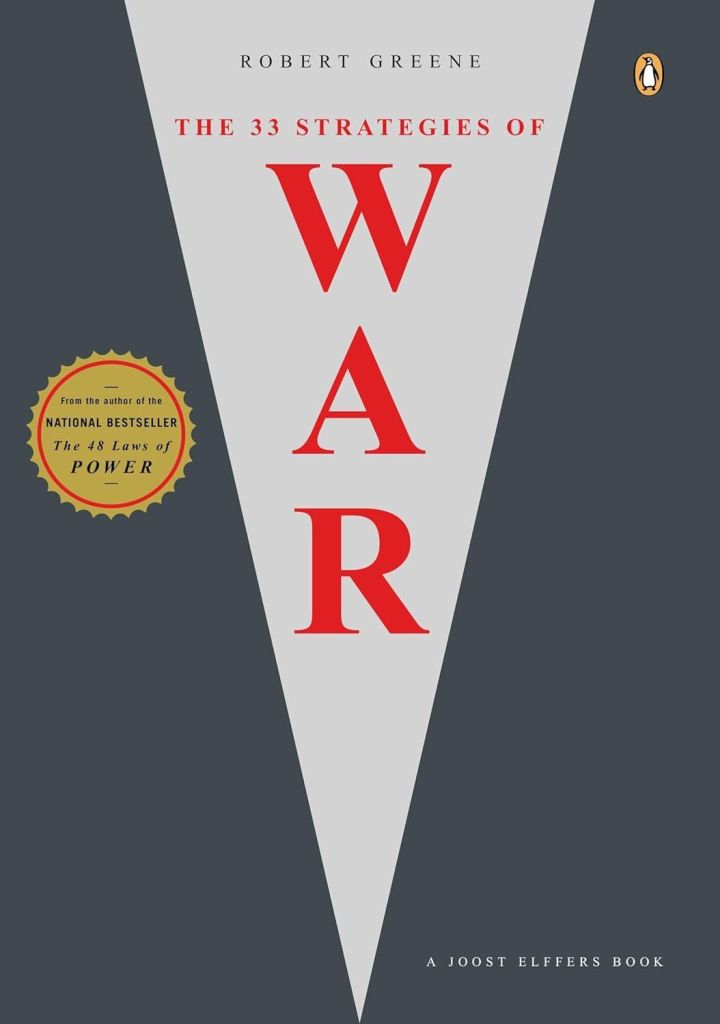
The 33 Strategies of War: Life as a Battlefield of Perception
Robert Greene’s The 33 Strategies of War is not truly about war. It is about conflict as a permanent condition of human life—in politics, love, work, art, and the inner self. Greene strips warfare of its romance and exposes it as an extension of psychology: fear, deception, timing, morale, and narrative. The battlefield may be literal or symbolic, but the principles remain the same. Those who fail to understand this reality are not spared by their innocence; they are simply defeated more easily.
Greene’s central premise is unsettling yet persuasive: we are always engaged in struggles, whether we acknowledge them or not. To deny this is not moral superiority—it is strategic blindness. The book does not advocate aggression; it advocates awareness. In a world shaped by power dynamics, misunderstanding conflict is itself a form of surrender.
I. The War Within: Mastering Emotional Terrain
Before confronting external enemies, Greene insists on an internal campaign. The first set of strategies concerns self-mastery, because emotional chaos is the most exploitable weakness.
At the heart of this section lies what Greene calls the Polarity Strategy: reason versus emotion. Anger, vanity, insecurity, and the desire for recognition distort perception. History’s greatest defeats, Greene argues, are rarely caused by lack of resources; they are caused by loss of emotional balance. Napoleon’s invasion of Russia was not a failure of logistics alone—it was hubris masquerading as destiny.
Greene draws heavily from Stoic philosophy here. The disciplined strategist learns to step outside immediate reactions and observe themselves as if from a distance. This detachment does not make one cold; it makes one accurate. To react emotionally is to fight the enemy on their terms.
The Self-Directed War Strategy is especially relevant in modern life. Many people imagine enemies where none exist, turning workplaces and relationships into paranoid battlegrounds. Greene warns against this inward spiral. When your identity depends on constant opposition, you create conflicts that drain your energy and cloud judgment. True strategic clarity comes not from perpetual hostility but from selective engagement.
II. The Psychology of the Enemy: Know Before You Strike
One of Greene’s most consistent themes—across The 48 Laws of Power and The Laws of Human Nature—is that people reveal themselves constantly, often without realizing it. The 33 Strategies of War refines this insight into tactical doctrine.
The Intelligence Strategy emphasizes deep observation over quick conclusions. Enemies are rarely as unified or confident as they appear. Most organizations and individuals are riddled with insecurity, factionalism, and self-interest. The strategist studies patterns of behavior, not stated intentions.
Greene repeatedly warns against underestimating irrationality. Humans do not act in accordance with logic; they act in accordance with self-image. A wounded ego will sabotage its own survival just to preserve pride. This insight explains why enemies often escalate conflicts unnecessarily, revealing openings to those patient enough to wait.
The Mirror Strategy is particularly elegant: reflect your opponent’s behavior back at them. People are deeply unsettled when confronted with their own tactics. Manipulators despise being manipulated; aggressors grow confused when met with calm neutrality. By withholding emotional response, you force the opponent to confront themselves—and they rarely like what they see.
III. Strategic Offense: Initiative, Momentum, and Shock
While Greene cautions against reckless aggression, he is equally critical of passivity. Conflict avoided at the wrong moment becomes conflict endured later—on worse terms.
The Death Ground Strategy is among the book’s most paradoxical ideas. Greene argues that placing yourself in a position where retreat is impossible can unlock extraordinary creativity and resolve. When safety nets disappear, excuses vanish with them. Historically, armies fighting with no avenue of escape often outperform superior forces, driven by necessity rather than hope.
Yet Greene is careful: this is not a strategy to adopt lightly. It is a transformational tactic, not a lifestyle. Used deliberately, it sharpens focus; used habitually, it leads to burnout.
The Blitzkrieg Strategy—rapid, overwhelming action—addresses modern environments where speed determines outcomes. In bureaucratic systems, decisiveness shocks opponents accustomed to hesitation. Momentum itself becomes a weapon. Once people perceive you as unstoppable, resistance collapses before contact is even made.
But Greene also notes that shock must be followed by consolidation. Many victories fail because the victor enjoys the disruption more than the aftermath. Strategy is not spectacle; it is sustainability.
IV. Defensive Warfare: Turning Weakness into Advantage
Defense, in Greene’s formulation, is not retreat—it is reframing the battlefield.
The Strategic Withdrawal is one of the most misunderstood ideas in human conflict. Pride frames retreat as failure, but Greene reframes it as preservation of force. To survive today is to retain the capacity to dominate tomorrow. History favors those who live to fight again.
Similarly, the Vacuum Strategy involves giving the enemy nothing to attack. In personal conflicts, this can be devastating. When insults meet silence, when provocation meets calm, the aggressor expends energy against emptiness. Their frustration grows; your position strengthens.
Greene’s admiration for guerrilla warfare reflects his belief in asymmetry. Power is never absolute; it is contextual. The weak who fight as if they were strong perish quickly. The weak who exploit mobility, unpredictability, and local knowledge outlast giants.
V. The War of Perception: Reality Is Not What Wins
Perhaps the book’s most unsettling lesson is that perception often matters more than truth.
The False Appearance Strategy teaches that seeming weak, disorganized, or distracted can lure opponents into fatal overconfidence. Conversely, projecting confidence—even when uncertain—can deter challenges altogether. Humans are narrative creatures; we believe what fits the story we already expect.
Greene repeatedly emphasizes morale. Armies collapse not when resources vanish, but when belief does. In modern life, confidence operates the same way. People follow certainty, even when it is illusory. Those who hesitate broadcast vulnerability.
This leads to the Divide and Conquer Strategy, which targets group psychology. Coalitions fracture easily when suspicion is introduced. Unity is fragile; mistrust spreads faster than loyalty. Greene does not moralize this insight—he simply observes its persistence across centuries.
VI. Ending Wars: Knowing When to Stop
One of Greene’s most mature insights is that the greatest strategists know when to conclude conflict.
Victory pursued without restraint turns into self-destruction. The Exit Strategy insists that every engagement must contain a vision of its conclusion. Endless conflict exhausts resources and breeds resentment. Even enemies must be allowed a face-saving retreat; humiliation guarantees revenge.
Greene’s admiration for leaders who showed restraint after victory—Lincoln, Mandela, Augustus—reveals an often overlooked truth: peace is the hardest campaign. It requires discipline, empathy, and long-term vision.
Conclusion: War as Awareness, Not Violence
The 33 Strategies of War is not a call to arms. It is a call to wakefulness.
Greene’s worldview is unsentimental but not nihilistic. Conflict exists whether we like it or not. The question is not whether we will face opposition, but whether we will face it blindly or intelligently. To understand strategy is not to become cruel; it is to become less naïve.
In a world that rewards appearances, punishes hesitation, and exploits emotional weakness, innocence is not protection—it is exposure. Greene offers no comfort, only clarity. And clarity, in the long run, is the most humane weapon of all.
If The 48 Laws of Power teaches us how influence operates, and The Laws of Human Nature reveals why people behave as they do, The 33 Strategies of War shows us how conflict unfolds over time—and how those who understand it best are often the ones who fight the least.
SHOCKWAVE: The Closet, the Church and the Cruelty of Conditional Love
Antakalipa | Consciousness of culture.
“I can’t change who I am. God made me this way. Love who you love, because life isn’t guaranteed.”
There are moments in theatre when the stage stops being a stage and becomes a mirror. You arrive expecting a story, perhaps a little entertainment, perhaps a few hours away from the demands of ordinary life. And then something happens. A line lands differently. An object on the stage begins to carry the weight of an entire lifetime. A character’s silence becomes louder than the words spoken around them. Suddenly, you are no longer simply watching somebody else’s life. You are confronting something about your own.
At the Market Theatre, SHOCKWAVE, written by Chantal Stanfield and directed by David Dennis, invites us into precisely this uncomfortable territory. Set in apartheid South Africa during P.W. Botha’s State of Emergency, the production explores sexuality, religion, identity, morality, prejudice and the desperate human desire to belong. Its central character, Larry, is a closeted gay librarian trying to survive in a society in which his sexuality could make him a target of discrimination, rejection and humiliation.
But the genius of this premise is that the closet is not merely a physical or psychological space. It is a social construction. It is the room society builds around you when it cannot accept the person you are. It is the silence imposed upon you by people who insist they love you, provided you never become too honest about yourself.
SHOCKWAVE asks a devastating question: what kind of love requires another human being to disappear?
A country at war with itself
To understand Larry, we must first understand the world that surrounds him.
The 1980s were a turbulent period in South Africa. Apartheid’s machinery of racial oppression was met with intensifying resistance, and the State of Emergency declared by P.W. Botha in 1986 brought extraordinary restrictions, police powers and repression. The political atmosphere was one of surveillance, uncertainty and fear. The state wanted to determine where people could go, how they could organise, what they could say and whether their bodies could be free.
Yet SHOCKWAVE looks beyond the familiar images of political resistance. It turns its attention to another kind of imprisonment: the restrictions placed upon private intimacy.
Larry is a gay man living in a society that already has an elaborate system for deciding who deserves dignity and who does not. Apartheid has organised human beings into racial categories and attached rights, privileges and humiliations to those classifications. Within this same society, religious and social conventions dictate which expressions of sexuality are considered acceptable. Freedom is discussed as a political ideal, but it remains frighteningly conditional when the subject is a man’s right to love another man.
The play’s historical setting is therefore not decorative. It is the pressure cooker in which its characters are forced to live.
The spectre of the so-called “gay plague” adds another layer of terror. The early AIDS crisis generated profound anxiety, misinformation and stigma, and gay men were frequently treated as symbols of a supposed moral catastrophe rather than as human beings facing a public-health crisis. Fear became a convenient weapon. It gave prejudice the appearance of public concern.
There is a particular cruelty in a society that can turn illness into an accusation and vulnerability into evidence of guilt.
Larry’s predicament is consequently larger than his individual circumstances. He is living through a period in which the country is struggling over the meaning of freedom, yet he cannot be certain that freedom will include him. The liberation of the nation and the liberation of the individual are not automatically the same thing.
That is one of the most important contributions of Stanfield’s writing. She brings South Africa’s queer history into a conversation too often dominated by the better-known narratives of political resistance. As director David Dennis has observed in discussing the production, liberation meant more than changing the political order; it also required dismantling discrimination in people’s personal lives.
History is never as simple as the photographs in our textbooks suggest. There are always people living in its margins, carrying stories that the dominant narrative has not made enough room to hear.
Trapped in the closet
Larry’s tragedy begins with the fact that he cannot safely be himself.
He is a librarian, a profession associated with knowledge, literature, learning and the preservation of stories. There is an irony in this character spending his life among books while being unable to tell the most important truth about himself. He works in a world of words, yet his own identity is governed by silence.
The closet becomes an exhausting performance. It demands vigilance. Every conversation becomes a calculation. Every friendship carries the possibility of exposure. Every expression of affection must be measured against the danger of being discovered.
What happens when a person must continually edit himself to remain acceptable to others? What happens when survival requires the suppression of joy?
The answer is that a person can become a stranger to himself.
The phrase “I can’t change who I am” is powerful because it rejects the assumption that identity is a moral defect requiring correction. Larry is not asking society for permission to become a different person. He is asking for the freedom to live as the person he already is.
And this is where the play becomes brutally relevant beyond its historical setting. The laws may change. The political climate may change. The language of public morality may change. Yet the pressure to conceal one’s identity can survive inside families, churches, workplaces and communities long after the official machinery of oppression has been dismantled.
A closet does not always have a door. Sometimes it is a congregation that makes you afraid to speak. Sometimes it is a parent whose love comes with conditions. Sometimes it is the knowledge that the people who embrace you in public would reject you if they knew the whole truth.
The most frightening thing about prejudice is not simply that it hates. It is that it can persuade its victims to participate in their own disappearance.
Sister Debbie: faith, loneliness and the human heart
Larry’s search for accommodation brings him into the home of Sister Debbie, a deeply religious widow living on the Cape Flats. Her husband, David, is dead, and his military jacket remains hanging on one of the hooks in the house.
The arrangement brings two lonely people together, but loneliness does not immediately make them understand one another.
Sister Debbie belongs to a world of religious convictions, familiar domestic routines and social expectations. Larry arrives carrying a truth that this world has taught him to hide. Each has something the other cannot fully understand: she has lost the person with whom she shared her life, while he is struggling to establish a life in which he can be loved without pretending.
It would be easy to make Sister Debbie a caricature of religious intolerance. It would also be easy to make Larry a flawless victim and everyone around him a villain. The more interesting possibility is that both characters are products of their circumstances, shaped by grief, inherited beliefs, fear and the communities to which they belong.
Religion can offer comfort, fellowship, ritual and the promise that suffering has meaning. For many people, faith is an indispensable source of strength. But faith can also become an instrument of punishment when human beings appoint themselves guardians of God’s supposed preferences.
The contradiction is glaring: a religion that preaches love can be used to justify the rejection of someone who needs love most.
When does religious conviction become cruelty? At what point does defending morality become an excuse for denying another person dignity?
These are not abstract questions for Larry. He has to live with the consequences.
The play’s strength lies in the possibility of transformation. Sister Debbie is not simply a symbol of the church or a representative of an older generation. She is a woman who has experienced loss and must confront another human being whose suffering does not fit neatly into her established understanding of the world.
Her loneliness matters because it allows us to recognise a shared vulnerability. Beneath the labels, the arguments and the fear, these are people who need companionship.
The challenge is whether companionship can survive the truth.
The military jacket: a small object carrying an enormous meaning
One of the most affecting images in SHOCKWAVE is David’s military jacket, left hanging in the house after his death.
A jacket is an ordinary object. It protects the body, carries the scent and shape of its wearer, and becomes familiar through years of use. When its owner dies, however, it can become something else entirely: a relic, a memory, a physical connection to somebody who can no longer return.
David is absent, but his jacket remains.
For Sister Debbie, the garment is tied to the life she shared with her husband and the world that existed before bereavement. It is a reminder of intimacy, companionship and the permanence of loss. For Larry, who is struggling to find a place where he can exist without fear, the possibility of receiving that jacket carries a different significance.
When Sister Debbie eventually relinquishes her husband’s military jacket to a homosexual man, the gesture becomes one of the production’s most eloquent statements.
A garment associated with a deceased husband is passed to someone whose sexuality might have made him an object of contempt in the world that garment represents.
What does it mean to inherit something from a person you never knew? What does it mean to receive a gift from someone who may not fully understand your life, but has begun to recognise your humanity?
The jacket becomes a bridge between two people whose experiences initially seem incompatible. It allows memory to move forward rather than remain locked in grief. It becomes an act of recognition: you may not be the person I expected to welcome into my home, but you are a person, and your life has value.
There is also a beautiful contradiction in the military symbolism. A military jacket evokes discipline, authority, masculinity and a world historically associated with rigid ideas about gender and sexuality. Yet here it can be offered as an expression of tenderness.
An object that might once have represented conformity becomes a gift that makes room for difference.
Perhaps this is what compassion looks like when it finally becomes practical. It is no longer a sermon delivered from a pulpit. It is something you take off a hook and place in another person’s hands.
The familiar house: old-school couches and the architecture of memory
The set design contributes significantly to the play’s emotional atmosphere. The old-school couches, familiar domestic furnishings and motherly costumes evoke a recognisable South African home, one that feels lived in rather than assembled for theatrical display.
There is nostalgia here, but it is not nostalgia without complications.
These furnishings evoke the domestic worlds many of us recognise: the sitting room where family gathers, the couch that has survived decades of conversations, the carefully maintained household in which routines provide a sense of order. They suggest a world in which respectability matters, appearances carry social meaning and the home is expected to be a sanctuary.
But what happens when the home becomes another place where a person must hide?
The domestic setting is important precisely because it is ordinary. The violence of prejudice does not always arrive with a uniform, a weapon or an official declaration. Sometimes it is expressed through a disapproving look, an uncomfortable silence or the withdrawal of affection. Sometimes it is concealed beneath the rituals of respectable family life.
The familiar furniture therefore does more than establish the period. It makes the audience feel how easily exclusion can inhabit ordinary spaces.
The home can shelter you, but it can also police you.
The motherly costumes and traditional domestic atmosphere similarly evoke a particular social order, one in which femininity, religious respectability and community belonging are intertwined. They give the characters a visual world of familiarity and social expectation, reinforcing the tension between the comfort of tradition and the harm that tradition can sometimes perpetuate.
The set is not merely a backdrop to the conflict. It is part of the conflict itself.
This is the unsettling achievement of grounding such a politically charged story in recognisable domestic surroundings. The audience is not invited to imagine prejudice as something practised only by distant, monstrous strangers. We are asked to recognise how it can live in places that feel like home.
“Moffie” and the policing of masculinity
The shadow of Moffie hangs over SHOCKWAVE, evoking the violence of a culture that equates masculinity with conformity and treats homosexuality as a threat to social order.
The term itself is loaded with humiliation. It reduces a human being to a derogatory label and suggests that his sexuality somehow disqualifies him from the respect granted to other men.
The military setting is particularly significant in this regard. The apartheid state demanded obedience and promoted a rigid social hierarchy. Within that broader system, expectations about masculinity could become another mechanism for disciplining bodies and behaviour.
To be a man was expected to mean a particular set of things. To depart from those expectations was to invite suspicion, ridicule or punishment.
Larry’s predicament exposes the absurdity of this arrangement. His sexuality does not erase his intelligence, his capacity for affection, his work or his humanity. Yet the society around him is prepared to make this one aspect of his identity the defining fact of his existence.
That is prejudice at its most destructive: it takes a person with an entire universe inside him and insists that he can be reduced to one word.
The play’s political force lies in showing how the struggle for dignity extends into these intimate definitions of who is allowed to count as a man, a believer, a citizen or a respectable member of society.
Music: the memories we share when words fail
Music is among the production’s most important emotional threads. The characters’ shared affection for the South African rock and soul band The Invaders brings warmth and humour into a story surrounded by political tension and personal anxiety. David Dennis has highlighted the music and comedy as important elements in making the production both entertaining and deeply human.
The music matters because it allows the characters to meet somewhere beyond their disagreements.
A song can take us back to a time, a place or a person with extraordinary speed. A melody heard after many years can bring an entire world back into focus: the room in which we first heard it, the people who were there, the hopes we carried and the things we did not yet know we would lose.
Music is memory made audible.
It also reminds us that people who disagree about religion, sexuality and morality can still share cultural experiences. They can remember the same songs, laugh at the same moments and recognise the same beauty. Their lives are not divided into entirely separate human universes.
This is where music becomes a quiet act of resistance. It refuses to let ideology account for everything a person is.
The music player Larry leaves behind at the end of the play is especially poignant. He leaves to pursue freedom, but he does not leave without a trace. The device remains, carrying the suggestion of a life that has occupied this home, disturbed its assumptions and changed the emotional landscape of the people who encountered him.
The object becomes a residue of presence. Larry may have departed, but the encounter cannot simply be erased.
There is something profoundly human about leaving music behind. Songs outlive particular moments, just as memories outlive the people who made them. And sometimes the things we leave behind become the only way others can understand what we meant to them.
The music player is not merely a prop. It is a small archive of connection.
Morality, sexuality and the hypocrisy of judgement
SHOCKWAVE is not afraid to place religion and sexuality in direct confrontation. Its questions are uncomfortable because they challenge the assumptions people often inherit without examining them.
Who decides what is moral? Is morality measured by conformity to social expectations, or by the way we treat other human beings? Can a person claim to defend goodness while participating in the humiliation of someone who has done nothing to deserve it?
The play does not require us to dismiss religion in order to recognise religious hypocrisy. Nor does it suggest that every religious person is prejudiced. Its more demanding proposition is that faith must be judged, at least in part, by the humanity it produces.
If a doctrine leads someone to deny another person shelter, dignity or companionship, the consequences deserve scrutiny. Good intentions cannot automatically absolve cruelty.
The same applies to society’s wider moral codes. Communities often present their expectations as natural, timeless and unquestionable. But history demonstrates that what one generation treats as an unquestionable truth may later be recognised as an injustice.
The criminalisation and stigmatisation of homosexuality in apartheid-era South Africa were not simply private opinions. They existed within a wider legal and political environment that reinforced exclusion. The shame Larry experiences is therefore not merely personal insecurity; it is produced by a society that has made his identity dangerous.
And yet the play also asks us to consider what happens when people begin to challenge the beliefs that have shaped them.
Change does not always arrive through a grand declaration. Sometimes it begins when somebody stays in a room they would previously have left, listens to a person they would previously have condemned or performs a small act of kindness that contradicts everything they have been taught to fear.
The old woman and the gay librarian are not required to have identical beliefs or histories. They are required to recognise one another as human beings.
That is a much more difficult task than simply agreeing to disagree.
The courage to leave
Larry’s eventual departure is one of the play’s most important decisions.
His elopement represents a movement towards freedom, away from a world in which his identity has been treated as a problem to be managed. It is an act of self-preservation, but also a refusal to accept that a life of permanent concealment is the only life available to him.
There is sadness in this decision because freedom comes at a cost. He cannot simply transform the society around him. He cannot guarantee that the people he leaves behind will understand him. He cannot recover the time spent living in fear.
But he can choose not to surrender the rest of his life.
This is where the play’s central ideas converge. Identity without freedom becomes a private prison. Love without acceptance becomes a conditional arrangement. Faith without compassion becomes judgement. Morality without empathy becomes punishment.
Larry’s departure does not magically resolve these contradictions. It exposes them.
And perhaps that is why the music player matters so much. He leaves an object behind, but he does not leave his entire self behind to satisfy the expectations of others. He chooses a future, however uncertain, in which he might finally live without having to apologise for existing.
There is courage in staying and attempting to change a hostile environment. There is also courage in recognising when staying means sacrificing too much of yourself.
Sometimes leaving is not an act of abandonment. Sometimes it is the first honest act of love a person can perform for himself.
The cast: bringing the human conflict to life
The production features Renate Stuurman and Trevor Lynch, with Lois du Plessis and Duane Behrens in supporting roles. Together, they bring to the stage a story that depends on the friction between private feeling and public expectation.
Stuurman’s presence is central to the production’s exploration of domestic life, grief, religious conviction and the possibility of change. The character of Sister Debbie must be more than an emblem of intolerance: she must remain a woman with a history, a home and an emotional life of her own. Her eventual gesture with David’s jacket carries its meaning because it emerges from a human relationship rather than from an abstract argument.
Lynch’s Larry embodies the exhausting contradiction of being compelled to conceal an essential part of oneself while continuing to live, work and seek companionship. His character is not simply a representative of queer suffering. He is a man with a future to imagine, music to love and a life that cannot be reduced to the prejudices surrounding him.
Du Plessis and Behrens contribute to the broader social world of the play, helping to give shape to the religious and cultural environment in which Larry’s story unfolds.
What makes the ensemble’s task particularly demanding is the need to balance the drama’s serious historical subject matter with its humour, nostalgia and moments of ordinary connection. A play like this cannot survive on misery alone. It must show us what makes life worth protecting in the first place.
That means allowing its characters to be funny, contradictory, frustrating, vulnerable and recognisably human.
The production’s creative leadership is equally important. Stanfield’s writing brings a personal and historical perspective to a subject that has too often been silenced. Dennis’s direction situates the story within the politics of the 1980s while keeping its emotional focus on the people living through that history. Greg Homann, Artistic Director of the Market Theatre Foundation, was involved in the play’s development as dramaturg during Stanfield’s work with How Now Brown Cow’s Writers Collective in 2021.
That developmental history matters. It places SHOCKWAVE within a process of South African playwriting that takes time to interrogate the stories we tell about ourselves and the stories we have neglected.
The Market Theatre has long been associated with work that confronts South Africa’s political and social realities. This production continues that tradition by expanding the frame of historical memory to include the intimate lives of people whose experiences were not always acknowledged in the dominant narrative of liberation.
Why SHOCKWAVE matters now
South Africa has travelled a considerable distance from the period depicted in the play. The country adopted a Constitution that explicitly protects equality and prohibits discrimination on the grounds of sexual orientation. In 2006, it became the first country in Africa to legalise same-sex marriage.
These milestones matter. They represent the hard-won recognition that a person’s sexuality should not determine whether they can participate in the life of a nation with dignity.
But legislation cannot, on its own, eliminate prejudice. A constitutional right does not guarantee acceptance at the family dinner table. Legal equality does not automatically dissolve religious condemnation, social exclusion or the fear of being rejected by the people whose love matters most.
This is why historical theatre remains essential. It helps us understand that rights are not abstract privileges. They shape the everyday experiences of people trying to find somewhere to live, someone to love and a community in which they can feel safe.
It also prevents us from congratulating ourselves too easily. We cannot simply look backwards, declare the past terrible and assume that the present has resolved all its contradictions.
The question is not only whether we have changed our laws. It is whether we have changed the ways we recognise one another.
SHOCKWAVE asks us to consider the distance between tolerating somebody and accepting them. Tolerance can be an arrangement in which the powerful agree not to interfere, provided the person they dislike remains discreet. Acceptance requires something more generous: a willingness to recognise another person’s humanity without demanding that they become smaller to accommodate our comfort.
That distinction remains urgent.
Final thoughts: Love who you love
There is something beautifully ordinary about the world of SHOCKWAVE. The couches, the costumes, the music, the memories and the jacket hanging in the house all evoke the familiar details through which human beings construct their lives. This is not a story taking place in some distant, incomprehensible universe. It is a story about people trying to live in a home, find companionship, hold on to their beliefs and make sense of a world that can be cruel.
And that ordinariness is precisely what gives the play its force.
The closet is not simply Larry’s problem. It is a reflection of the society that has made honesty dangerous. The religious household is not merely a place of judgement. It is also a space where grief, loneliness and the possibility of compassion coexist. The military jacket is not merely a memory of a dead husband. It becomes a gesture towards a future in which kindness can cross the boundaries that prejudice has constructed.
The music reminds us that we are capable of sharing joy even when our beliefs differ. The ending reminds us that a person cannot spend an entire lifetime waiting for the world to give permission to be free.
And the play’s most profound challenge is directed at those who believe themselves to be on the right side of morality: what good is your righteousness if it leaves another person feeling unworthy of love?
There is no virtue in making somebody suffer for a truth they did not choose and cannot simply change. There is no greatness in demanding that another person live a lie so that the rest of us can remain comfortable. And there is no meaningful freedom in a society that celebrates liberation while leaving certain people afraid to be themselves.
We are all temporary visitors in this world. The people we love will not be here forever. The rooms in which we gather will eventually hold different memories. The music will continue playing long after some of the people who first heard it are gone.
Life is not guaranteed.
So love who you love. Give people the dignity of being known. Question the convictions that make cruelty seem respectable. Let grief soften you rather than close you off. And when somebody trusts you enough to reveal the truth of who they are, do not make them regret it.
Sometimes the most revolutionary thing we can offer another human being is a place to sit, a song to remember and the assurance that they do not have to disappear to deserve a home.
At the Market Theatre, SHOCKWAVE reminds us that the struggle for freedom is never complete while somebody is still trapped in a closet built by the fears of others.
Because the ultimate measure of our humanity is not whom we condemn, but whom we allow ourselves to love.
Catch SHOCKWAVE at the Market Theatre
Written by: Chantal Stanfield Directed by: David Dennis Cast: Renate Stuurman, Trevor Lynch, Lois du Plessis and Duane Behrens Venue: Mannie Manim Theatre, Market Theatre, Newtown, Johannesburg Dates: 15 October – 8 November 2026 Tickets: Advertised prices range from R110 to R220, subject to the available booking options.
SHOCKWAVE is the kind of theatre that asks us to look at the past without forgetting the people who are still living with its consequences. Go and see it. Listen to its music. Sit with its uncomfortable questions. And remember that every person deserves the freedom to live a life that is genuinely their own.
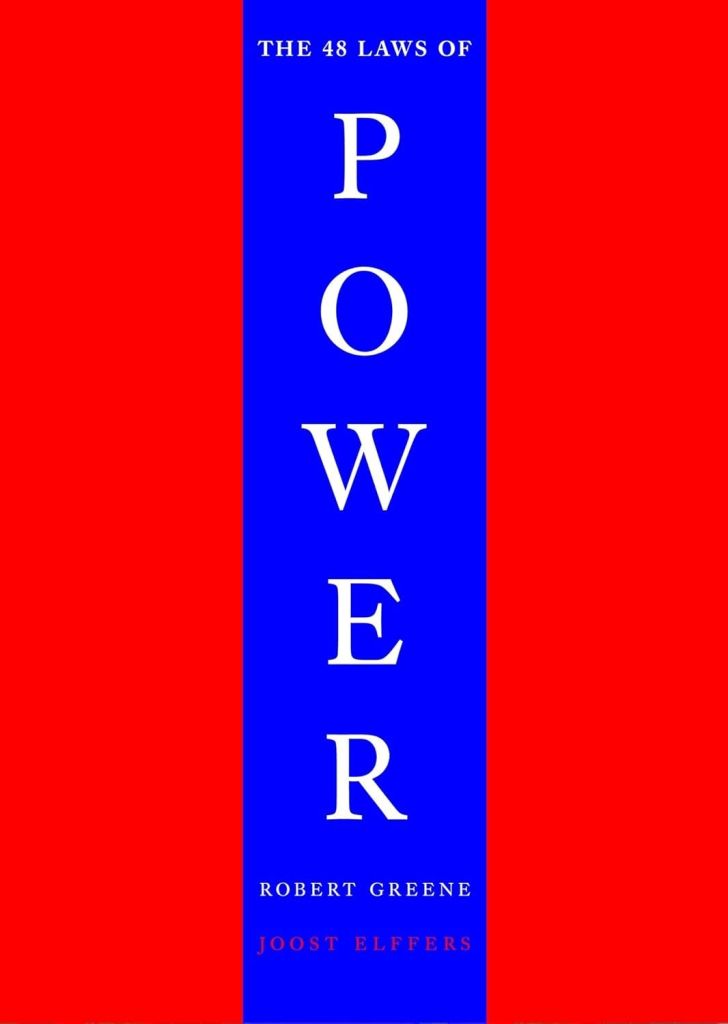
The 48 Laws of Power: A Moral Anatomy of Power, Illusion, and Human Nature
Power is one of the last great taboos of moral discourse. We speak endlessly about justice, virtue, and empathy, yet shy away from the raw mechanisms by which influence is gained, maintained, and lost. Robert Greene’s The 48 Laws of Power enters this forbidden territory unapologetically. It does not ask how humans should behave, but how they do behave when status, survival, and dominance are at stake. This distinction explains both the book’s enduring popularity and the moral outrage it provokes.
Greene’s work is not a handbook for villains so much as a mirror held up to civilization. The laws are drawn from courts, empires, revolutions, and corporate boardrooms, revealing power as a theatrical, psychological, and deeply irrational force. Like Machiavelli before him, Greene understands that morality often dissolves under pressure—and that ignorance of power dynamics is itself a form of vulnerability.
The Illusion of Morality in Power Games
The first and perhaps most unsettling lesson Greene offers is this: power does not operate according to moral logic. Law 1—Never outshine the master—immediately contradicts meritocratic ideals. Talent, intelligence, and effort do not guarantee safety. In fact, they may provoke envy and retaliation. This is echoed later in Law 46—Never appear too perfect—a reminder that excellence can be as dangerous as incompetence.
Power thrives on appearances, not truths. Law 5—So much depends on reputation—guard it with your life—underscores how perception precedes reality. A single scandal can undo decades of achievement, while a carefully cultivated myth can sustain authority long after competence fades. Greene repeatedly insists that image is power, a theme reinforced by Law 27—Play on people’s need to believe to create a cult-like following—and Law 34—Be royal in your own fashion: act like a king to be treated like one.
These laws reveal a disturbing insight: humans prefer symbols over substance, confidence over honesty, and certainty over truth.
Power as Psychological Warfare
Many of the laws operate less on strategy than on psychology. Law 6—Court attention at all costs—anticipates the modern attention economy, where visibility often outweighs value. Law 13—When asking for help, appeal to people’s self-interest, never to their mercy—dispels the comforting illusion that altruism governs human behavior. Greene argues that even generosity is often transactional, an expression of power rather than kindness.
Manipulation becomes explicit in Law 14—Pose as a friend, work as a spy—and Law 33—Discover each man’s thumbscrew.
These laws strip away romantic notions of trust, portraying social life as a battlefield of hidden motives. Yet Greene does not present this cynically; he presents it diagnostically. To ignore these dynamics is to be naïve, not noble.
Silence, too, is a weapon. Law 4—Always say less than necessary—and Law 38—Think as you like but behave like others—emphasize restraint, concealment, and adaptability. Power rarely announces itself; it insinuates. Those who reveal too much lose control over interpretation.
Envy, Fear, and the Fragility of Authority
At the heart of Greene’s philosophy lies a dark truth Dostoevsky understood well: envy is more dangerous than hatred. Law 2—Never put too much trust in friends, learn how to use enemies—warns that familiarity breeds resentment. Friends compare themselves to you; enemies are predictable. This logic resurfaces in Law 19—Know who you’re dealing with—do not offend the wrong person—a reminder that misjudging pride can be fatal.
Power is fragile precisely because it provokes desire. Law 15—Crush your enemy totally—is perhaps the most controversial, yet Greene argues that partial victories invite revenge. Mercy, in power politics, is often mistaken for weakness. History, from Caesar to Napoleon, confirms this brutal consistency.
Fear, however, must be calibrated. Law 36—Disdain things you cannot have—teaches detachment as a form of dominance, while Law 39—Stir up waters to catch fish—encourages controlled chaos to destabilize rivals. Yet too much unpredictability leads to collapse, which is why Law 48—Assume formlessness—concludes the book. Power must adapt or die.
The Seduction of Strategy and the Cost of Power
Greene does not pretend power is free. Laws like 18—Do not build fortresses to protect yourself— isolation is dangerous—and 25—Re-create yourself—highlight the emotional toll of constant vigilance. Power demands performance. One must always be watching, adjusting, and calculating.
Law 10—Infection: avoid the unhappy and unlucky—and Law 24—Play the perfect courtier—expose the emotional discipline required to survive hierarchies.
Authenticity, so prized in modern discourse, is treated here as a liability. Instead, Greene champions adaptability, a theme echoed in Law 31—Control the options—and Law 35—Master the art of timing.
Perhaps the most psychologically revealing law is Law 47—Do not go past the mark you aimed for; in victory, learn when to stop. Power intoxicates. Success breeds overreach. Greene repeatedly returns to this tragic arc, reminding readers that downfall is often self-inflicted.
Power, Freedom, and the Reader’s Responsibility
Critics accuse Greene of promoting amorality, but this misunderstands his project. The 48 Laws of Power is descriptive before it is prescriptive. Greene offers no commandments, only patterns. Like Nietzsche, he forces the reader to confront uncomfortable truths about domination, desire, and fear.
The real danger is not reading Greene, but reading him uncritically—or not reading him at all. Those unaware of power dynamics are most easily exploited by them. Law 12—Use selective honesty and generosity to disarm your victim—is unsettling precisely because it works. Ignoring this does not make one virtuous; it makes one vulnerable.
Yet Greene also embeds warnings. Law 41—Avoid stepping into a great man’s shoes—and Law 42—Strike the shepherd and the sheep will scatter—illustrate how power systems devour individuals. Law 21—Play a sucker to catch a sucker—and Law 44—Disarm and infuriate with the mirror effect—reveal how easily manipulation escalates into paranoia.
Conclusion: Power as a Human Constant
In the end, The 48 Laws of Power is not a celebration of domination but an anatomy of it. Greene forces us to confront a sobering reality: power is not an aberration of human nature—it is an expression of it. Envy, fear, ambition, and insecurity shape our institutions as much as our ideals.
To reject this knowledge is comforting. To accept it is unsettling—and necessary.
Greene does not ask us to become tyrants. He asks us to wake up. In a world where appearances triumph over truth, where silence often speaks louder than honesty, and where innocence is frequently punished, understanding power is not a moral failure. It is a form of self-defense.
Power will exist whether we acknowledge it or not. The only question Greene leaves us with is this: will we remain blind to its laws—or learn to see clearly, and choose our battles wisely?
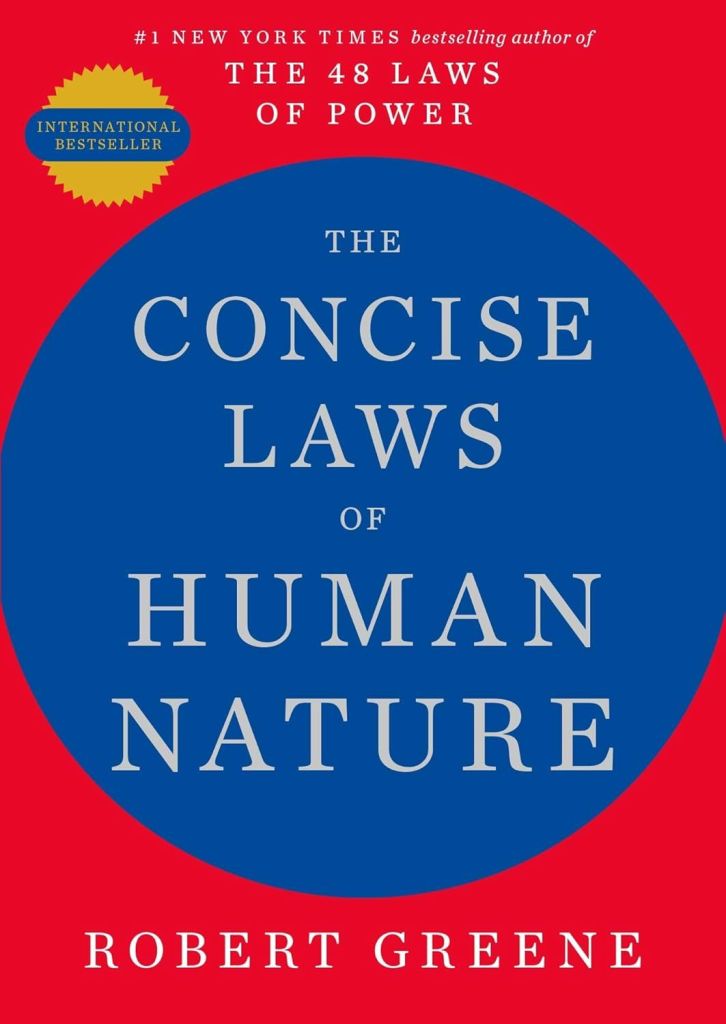
The Laws of Human Nature: Narcissism, Envy, and the Illusion of Reason
Robert Greene’s The Laws of Human Nature is often misread as a guide to manipulation or personal advantage. In truth, it is something more unsettling: a diagnosis of the psychological forces that quietly govern human behavior while we insist—often passionately—on our own rationality and moral clarity. Greene’s central claim is not that people are evil, but that they are profoundly self-deceived. The greatest danger does not come from cruelty or malice, but from unconscious patterns masquerading as reason.
At the core of Greene’s psychological framework lie three forces that shape nearly all human interaction: narcissism, envy, and irrationality. These are not pathological exceptions; they are the default conditions of the human psyche. Civilization merely teaches us how to disguise them.
The Myth of the Rational Human Being
Greene begins by dismantling one of modernity’s most cherished illusions: that humans are fundamentally rational actors. We imagine ourselves as thinking creatures who occasionally feel too much. Greene reverses this assumption. We are emotional beings who occasionally think—and mostly think in service of our emotions.
Reason, in this view, is not a guiding faculty but a post-hoc narrator. We feel first, act second, and explain ourselves third. The explanations sound coherent, ethical, even logical—but they are stories we tell to protect our self-image. This illusion of rationality is especially dangerous because it blinds us to our own motives while sharpening our judgment of others.
Greene’s insight echoes Freud’s model of the ego as a mediator rather than a ruler, but he strips away clinical neutrality and replaces it with social consequence. Irrationality is not merely an inner problem; it is the engine of conflict, misunderstanding, and power struggles. The more convinced people are of their rationality, the less control they have over themselves.
Narcissism: The Hidden Center of the Self
Among Greene’s most penetrating contributions is his treatment of narcissism, which he reframes not as a personality disorder but as a spectrum on which nearly everyone falls. Narcissism, in Greene’s definition, is not vanity—it is emotional self-absorption. The narcissist is not someone who loves themselves too much, but someone who cannot see beyond themselves clearly enough to love others at all.
Healthy narcissism allows for self-cohesion and ambition. Unhealthy narcissism, however, emerges when early emotional needs go unmet, producing adults who constantly seek validation, control, or admiration to stabilize a fragile inner world. Such individuals are hypersensitive to slights, obsessed with status, and incapable of genuine empathy—not because they are cruel, but because they are perpetually defending themselves.
Greene’s warning is subtle: narcissists are not always loud, charismatic, or obvious. Some appear selfless, moral, even sacrificial. What defines them is not ego display but emotional hunger. They take more than they give, drain energy from relationships, and unconsciously bend reality to serve their needs.
More disturbingly, Greene insists that narcissism is contagious. People orbit narcissists hoping for approval, meaning, or reflected importance, slowly surrendering their own emotional autonomy. In this sense, narcissism is not merely an individual flaw but a social phenomenon—one that shapes institutions, movements, and even moral crusades.
Envy: The Emotion We Refuse to Name
If narcissism is the gravitational center of the self, envy is the emotion that corrodes it from within. Greene treats envy as the most denied, most dangerous of human emotions precisely because it is so socially unacceptable. Anger can be justified. Fear can be admitted. Sadness can be shared. Envy, however, must be disguised—usually as moral judgment.
Envy arises not from lack, but from comparison. It flares most intensely among peers—friends, colleagues, siblings—where differences feel personal rather than abstract. The success of someone close threatens not only status, but identity. It raises the unbearable question: Why them, and not me?
Greene’s insight is that envy rarely announces itself. Instead, it mutates into criticism, passive aggression, false concern, or sudden moral outrage. We do not say, “I envy you.” We say, “You’ve changed,” or “You don’t deserve this,” or “I’m just worried about you.”
In Greene’s psychological universe, envy explains betrayals that seem disproportionate, conflicts that erupt without clear cause, and the peculiar pleasure people take in the downfall of those they once admired. Envy is not loud; it is patient. It waits for weakness.
What makes envy so corrosive is that it operates beneath conscious awareness. People sincerely believe in the justifications they invent. The moral mask is not strategic—it is self-protective. To admit envy would collapse the self-image of fairness, generosity, and rational judgment.
Irrationality and the Tyranny of Emotion
Narcissism and envy feed into a broader force Greene sees as inescapable: irrationality. Human beings are pattern-bound, emotionally reactive, and deeply resistant to change. We mistake consistency for character and habit for truth.
Greene identifies recurring emotional traps: compulsive behavior, confirmation bias, emotional contagion, and the tendency to repeat unresolved childhood dynamics in adult relationships. These patterns persist not because people are foolish, but because the psyche seeks familiarity over growth. Pain we recognize feels safer than uncertainty.
Irrationality also explains why intelligence offers no immunity. Highly educated individuals often rationalize more skillfully, constructing elaborate frameworks to justify impulses they do not understand. In this sense, intelligence can deepen irrationality rather than dissolve it.
The tragedy is not that humans are irrational, but that they refuse to accept it. This refusal produces moral arrogance, political extremism, and personal blind spots. Greene’s realism is bleak but consistent: self-deception is not a flaw we overcome—it is a condition we manage.
Empathy Without Illusion
Greene proposes empathy as both remedy and risk. True empathy requires seeing others as emotionally driven, wounded, and inconsistent—not as villains or heroes. This kind of empathy is demanding because it strips away comforting narratives. It requires patience, restraint, and emotional distance.
Yet Greene’s empathy is not sentimental. It does not ask us to excuse destructive behavior or sacrifice ourselves to it. Instead, it asks us to understand patterns so we are not unconsciously drawn into them. Empathy becomes a form of self-defense.
This approach introduces an ethical tension that Greene never fully resolves: does understanding people make us kinder, or simply more effective at navigating them? The answer depends less on Greene’s framework than on the moral maturity of the reader.
Power, Freedom, and the Cost of Clarity
Ultimately, The Laws of Human Nature is not about domination, but freedom from illusion. Greene does not promise happiness, harmony, or moral purity. He offers something more austere: the ability to see clearly.
But clarity has a cost. To recognize narcissism in oneself is unsettling. To detect envy in one’s judgments is humiliating. To accept irrationality as permanent rather than temporary is destabilizing. Greene’s realism dismantles comforting myths about progress, virtue, and self-knowledge.
In contrast to romantic literature, where suffering deepens the soul, Greene suggests that suffering more often entrenches patterns. Trauma does not ennoble; it conditions. Without awareness, people repeat what they hate.
A Psychology for a Disenchanted World
Greene’s work resonates because it speaks to a cultural moment defined by performative virtue, emotional reactivity, and moral certainty. In such an environment, the refusal to acknowledge narcissism, envy, and irrationality becomes socially rewarded. Outrage replaces introspection; identity replaces self-examination.
The Laws of Human Nature stands apart by insisting that the most dangerous lies are the ones we tell ourselves. It offers no redemption narrative, only responsibility. To understand human nature is not to transcend it, but to move through it with humility, restraint, and awareness.
Greene does not ask us to be better than others. He asks us to stop pretending we already are.
The Discipline of Freedom: Nelson Mandela and the Making of a Moral Self
On Long Walk to Freedom
Freedom, in Long Walk to Freedom, is not an emotional breakthrough or a sudden awakening. It is not romantic, not impulsive, and certainly not easy. Nelson Mandela presents freedom as a practice—something learned slowly, through sacrifice, self-restraint, and moral clarity forged under pressure. What makes the autobiography remarkable is not simply the historical scope of Mandela’s life, but the way he narrates the construction of character under conditions designed to destroy it.
This is not a story of a saint born virtuous, nor of a rebel intoxicated by rage. It is the story of a man who learns—again and again—how much of himself must be surrendered so that something larger might survive.
From Tribal Belonging to Moral Consciousness
Mandela begins his story rooted in the Xhosa world of Thembuland, where identity is communal, hierarchical, and bound by custom. His early understanding of freedom is modest: the ability to tend cattle, to belong, to fulfill expected roles. What is striking is how unabstract this freedom is. It is not ideological; it is lived.
Yet education—first at missionary schools, then at Fort Hare—introduces a fracture. Mandela encounters Western ideas of justice, law, and individual rights, but he does not romanticize them. Instead, he experiences contradiction: a legal system that speaks the language of equality while practicing domination.
This tension becomes formative. Mandela does not reject tradition in favor of modernity, nor does he cling nostalgically to the past. Instead, he begins assembling a hybrid moral framework—one capable of holding both communal responsibility and universal justice.
Freedom, at this stage, becomes awareness: the recognition that the world one has inherited is unjust, and that obedience is no longer morally neutral.
The Law as Both Weapon and Illusion
Mandela’s decision to become a lawyer is often read as strategic, but it is also deeply symbolic. Law represents order, rationality, and the promise of fairness. Yet apartheid law exposes itself as a grotesque parody of justice.
What emerges in Long Walk to Freedom is Mandela’s growing realism. He understands that legality and morality have diverged. The courts may punish resistance, but they cannot confer legitimacy on injustice. This realization marks a crucial ethical shift: obedience ceases to be a virtue.
Still, Mandela is not reckless. He resists violence longer than many of his contemporaries, not out of fear but out of moral caution. The turn toward armed struggle is portrayed not as liberation, but as tragedy—an acknowledgment that peaceful avenues have been exhausted.
This is one of the book’s most important achievements: it refuses to glamorize militancy. Violence is framed as a grim necessity, not a moral triumph.
Prison as a School of the Self
Robben Island is the crucible of the autobiography. Stripped of movement, privacy, and dignity, Mandela confronts the central question of the book: What remains of freedom when the body is unfree?
The answer is not stoic detachment, but discipline.
Mandela learns that rage corrodes judgment, that impulsiveness invites manipulation, and that dignity must be enacted even when it is denied. He studies his jailers, learns their language, understands their fears. This is not submission—it is strategy. But it is also something deeper: a refusal to become morally smaller than one’s oppressor.
Unlike Dostoevsky’s underground figures, Mandela does not retreat into ressentiment. Unlike romantic revolutionaries, he does not cultivate martyrdom. He practices restraint as a form of power.
Prison teaches him that freedom without self-mastery is fragile. True authority, he discovers, comes from the ability to govern oneself under extreme conditions.
The Refusal of Hatred
Perhaps the most radical element of Long Walk to Freedom is Mandela’s rejection of hatred as a political resource. Hatred promises clarity and energy, but it narrows the future. Mandela understands that if South Africa is to survive, it must be built not on vengeance but on moral imagination—the ability to see the enemy as a future citizen.
This is not sentimental forgiveness. It is hard-earned realism. Hatred would imprison the victors just as surely as apartheid imprisoned the oppressed.
Mandela’s genius lies in recognizing that reconciliation is not weakness, but foresight. A nation emerging from systemic cruelty cannot afford the luxury of moral absolutism. Compromise, in this context, becomes an ethical achievement rather than a failure.
Freedom as an Unfinished Task
The autobiography ends not with triumph, but with sobriety. Mandela is free, apartheid has fallen, yet the work remains incomplete. Poverty, inequality, and historical trauma persist. Freedom, once again, reveals itself not as a destination but as a responsibility.
The final insight of Long Walk to Freedom is quietly devastating: liberation creates new obligations. To be free is to accept the burden of choice, restraint, and continued struggle—not against an external enemy, but against despair, corruption, and moral fatigue.
Mandela refuses the role of savior. He presents himself instead as a custodian—one participant in a collective effort that transcends any individual life.
Conclusion: Against Romanticism, For Character
In a literary landscape crowded with tragic heroes and existential rebels, Long Walk to Freedom stands apart. It is not a book about the beauty of suffering, nor about the ecstasy of rebellion. It is a book about character forged slowly, through patience, sacrifice, and ethical clarity.
Mandela’s life challenges the romantic notion that authenticity lies in impulse. Instead, he proposes a more difficult truth: that freedom requires discipline, and that dignity must be practiced daily, especially when it seems futile.
This is why Long Walk to Freedom endures—not as propaganda, but as a profound meditation on what it means to remain human in an inhuman system, and to emerge without surrendering one’s moral future.
Carmen — When Ballet Becomes Seduction, Violence and Pure Theatre
There are moments when you leave a theatre having watched a performance, and there are moments when you leave having been reminded why you fell in love with the art form in the first place.
My visit to the Joburg Theatre for the opening night of Carmen, presented by Joburg Ballet from 25 September to 3 October 2026, was one of those moments.
This is ballet with heat in its veins.
This is ballet that seduces, teases, fights, laughs, smokes, flirts, threatens and ultimately breaks your heart. It is beautiful without being polite about it. It is classical technique meeting human instinct. And at its centre is Carmen herself, brought magnificently to life by Brazil’s Monike Cristina.
Thank you, Brazil.
Because Monike Cristina is something else.
She is not simply dancing Carmen. She becomes Carmen.
Veronica Paeper’s Carmen is a production that understands something fundamental about ballet: the human body can communicate what words cannot. A tilt of the head can be an invitation. A smile can be a weapon. A port de bras can become seduction. A sudden change in épaulement can expose jealousy, fear or desire. The choreography turns the vocabulary of ballet into the vocabulary of human behaviour.
And Monike Cristina understands every syllable.
She is the Goddess of Ballet.
There is an almost dangerous effortlessness to her performance. She moves through the stage with a smile, with musicality, with extraordinary control, and yet nothing about her feels mechanical. Her technique is immense, but technique never becomes the point. It is the foundation upon which personality is built.
Carmen is playful.
She is seductive.
She is alluring.
She is tempting.
She is mischievous.
She is dark.
She is violent.
She is vulgar.
She is unpredictable.
She is a femme fatale.
And Monike gives us every shade of her.
That is what makes her performance so intoxicating.
Seville Comes Alive
The story begins outside a cigarette factory in Seville, where the residents gather in the town square to watch the changing of the guard. Don José arrives with the new guard under the command of Captain Zuniga, immediately establishing the military order that will eventually collide with Carmen’s wild, untameable spirit.
Then comes midday.
The cigarette girls emerge from the factory.
And among them is Carmen.
She sees Don José and, almost immediately, there is attraction.
But this is not a conventional romantic encounter. Carmen does not wait for love to find her. She hunts it. She plays with it. She tests it.
The cigarette girls are summoned back into the factory, while Micaela arrives carrying a gift from Don José’s mother. She is his fiancée, gentle and sincere, but Don José is distracted. Something has already shifted. Carmen has entered the picture, and suddenly the safe future represented by Micaela feels very far away.
Then violence erupts.
Carmen becomes involved in a fight and is arrested. Don José is ordered to guard her.
It should be simple.
It isn’t.
Carmen persuades him to release her, and in doing so Don José finds himself imprisoned instead.
The curtain falls.
And already the spell has been cast.
What Paeper understands so beautifully is that Carmen is not simply a story about a woman who destroys a man’s life. It is a story about desire colliding with control. Carmen refuses to belong to anyone. Don José wants to possess what he cannot control. The tragedy begins long before the final confrontation.
Monike Cristina: The Art of Being Irresistible
Watching Monike Cristina dance Carmen is almost unfair because she makes the extraordinary appear ordinary.
Her balances are exquisite. Her extensions are beautifully controlled. Her lines are magnificent. Her musicality is alive. Her transitions are fluid. Her épaulement carries character. Her use of the upper body gives Carmen a sensuality that goes beyond steps and positions.
And then there are the expressions.
Golden.
Perfect.
A smile appears and suddenly you understand Carmen.
A glance changes and suddenly the atmosphere shifts.
She can look playful in one instant and dangerous in the next.
That is the magic of an exceptional dramatic dancer: you don’t see the technique first. You see the person.
Monike makes Carmen feel completely alive.
There is a freedom in her movement that is almost intoxicating. Her body seems to understand the music before the music has finished speaking. Her phrasing is confident, her footwork precise, her balances assured, and her physicality allows the choreography to breathe.
There are moments when she performs feats that make you wonder how the human body is capable of doing what you have just witnessed.
And yet she smiles.
That is the extraordinary part.
Nothing looks laboured.
Nothing looks forced.
It simply happens.
Carmen walks into the room and owns it.
Monike walks onto the stage and does the same.
I am convinced there is nothing better in the world than watching Monike Cristina as Carmen.
She made me fall in love with ballet again.
Or perhaps she reminded me why I fell in love with it in the first place.
Act II — The Tavern of Lilas Pastia
A month has passed.
We move to the Tavern of Lilas Pastia, and the temperature rises.
Captain Zuniga has fallen under Carmen’s spell and dances with her. Then Escamillo, the famous Toreador, enters.
He too is immediately attracted to Carmen.
Of course he is.
How could he not be?
But Carmen’s heart and mind remain consumed by Don José.
The smugglers arrive and Carmen becomes involved in their conspiracy. When Don José arrives, she attempts to seduce him, but a bugle call summons him back to duty.
And Carmen is furious.
This is where the central conflict becomes even more apparent. For Carmen, love means freedom, instinct and surrender to desire. For Don José, duty still pulls at him. Carmen taunts him for placing his obligations above his love for her.
Captain Zuniga returns and orders Don José back to the barracks.
But jealousy has already taken over.
When Zuniga attempts to take Carmen into his arms, Don José attacks his own officer and wounds him.
There is no going back.
Don José is now hopelessly compromised and has no choice but to join the smugglers.
This is where Monike’s Carmen becomes particularly fascinating. She is not simply the object of everyone’s desire. She is the force that exposes everyone else’s weakness.
Men enter her orbit and begin revealing themselves.
Zuniga reveals his desire.
Escamillo reveals his attraction.
Don José reveals his obsession.
Carmen simply remains Carmen.
And that is her power.
Ballet That Fights
One of the most visually striking moments of the production is the fight involving the cigarette girls.
It is beautiful.
That sentence sounds contradictory until you see it.
The dancers kick.
They drag.
They pull hair.
They clash.
They attack.
And somehow, through the discipline of ballet, violence becomes choreography.
It is a remarkable demonstration of control.
Every movement has to be precise. Every kick must land safely. Every pull must be performed with trust. Every fall must be choreographed. The dancers have to create the illusion of chaos while maintaining absolute technical awareness.
And they do.
This is where ballet becomes something more than pretty movement.
The girls are fighting, but the lines remain beautiful.
The bodies remain coordinated.
The choreography remains musical.
The technique remains immaculate.
It is violence with épaulement.
It is aggression with musical phrasing.
It is theatrical conflict transformed into dance.
And Veronica Paeper deserves enormous credit for understanding that ballet does not have to remain trapped inside a world of delicate gestures and romantic idealism.
Her Carmen can be raw.
It can be sensual.
It can be funny.
It can be ugly.
It can be dangerous.
It can be vulgar.
It can be sexy.
It can be violent.
And it remains ballet.
Cigarettes, Attitude and the Unexpected
There were moments in this production that made me think: I have never seen ballet do this before.
There is smoking on stage.
There are gestures and attitudes that feel deliberately contemporary and confrontational.
And at one point Carmen appears to flip somebody off.
In ballet.
I have never seen that in ballet. Period.
And I loved it.
Because it tells us exactly who Carmen is.
She is not interested in behaving according to somebody else’s expectations.
The gesture is funny, shocking and completely character-driven. It breaks the distance between the classical art form and the messy reality of human behaviour.
That is what makes Paeper’s choreography so exciting.
She doesn’t destroy ballet’s elegance.
She weaponises it.
The classical vocabulary remains visible, but it is placed inside a world of cigarette factories, taverns, smugglers, jealousy, desire, fighting, flirtation and death.
The result is a ballet that feels theatrical in the fullest sense of the word.
Act III — The Mountains and the Death Card
The third act moves into a cave in the mountains.
The relationship between Carmen and Don José is changing.
Carmen’s passion is fading.
Don José’s is not.
He remains desperately in love with her.
Mercedes and Frasquita tell their futures through the cards, and Carmen turns one herself.
The death card.
It is one of the most powerful images in the entire story because the audience already knows that Carmen is moving towards something from which there may be no escape.
Then Escamillo arrives.
He invites Carmen and the others to the bullfight.
Don José, furious and jealous, challenges him.
The two men fight.
The smugglers separate them, and Escamillo leaves.
Then Micaela is discovered in the cave.
She brings news that changes everything: Don José’s mother is dying.
Reluctantly, he leaves with her.
But Carmen remains.
And the cards have already spoken.
The Ensemble: Because Carmen Is Not a One-Woman Show
It would be easy to allow Monike Cristina’s performance to dominate the conversation.
But that would be unfair to the production.
Carmen works because the entire company creates its world.
Revil Yon as Don José brings the necessary emotional vulnerability to the central male character. His Don José is caught between duty and desire, between the life he is supposed to live and the woman who has completely destabilised it.
Bruno Miranda’s Escamillo arrives with the swagger and physical confidence of the Toreador. He is a different kind of masculine presence from Don José: confident, celebrated and immediately magnetic.
Chloe Blair’s Micaela provides a beautiful contrast to Carmen. Where Carmen is fire, Micaela carries warmth and sincerity. Her presence gives Don José another possible life, one rooted in loyalty and tenderness.
Ivan Domiciano’s Captain Zuniga carries the authority of the military world while becoming another victim of Carmen’s irresistible magnetism.
Latoya Mokoena as Pasquita and Darragh Hourrides as Mercedes contribute to the vibrant female ensemble, while Sue Kirkland’s Madame of the Factory helps establish the social world surrounding the cigarette girls.
Albertus Dreyer as Lilas Pastia, Creagan Martin as the Pickpocket, Mothobisi Molopa as the Captain of the Guard, Brayden Stackling as the Fiesta Man, and Miles Carrott as the Chief Smuggler all contribute to the theatrical machinery of the production.
This is an ensemble piece.
Every dancer adds texture.
Every entrance contributes to the atmosphere.
Every body on stage helps construct Seville.
That is the magic of a ballet company working as one organism.
Act IV — The Bullring
Then comes the final act.
Outside the bullring, the spectators gather for the arrival of the Toreadors.
The atmosphere is festive.
But beneath the celebration sits tragedy.
Don José is in the crowd.
The procession enters.
And Carmen and Don José confront one another for the final time.
Everything has led here.
The attraction.
The seduction.
The jealousy.
The fighting.
The betrayal.
The cards.
The obsession.
The freedom.
The refusal to possess and be possessed.
And finally, the confrontation.
Carmen has always understood that passion can be both intoxicating and destructive. Paeper’s production allows that contradiction to live inside the movement.
The same woman who can make an audience smile can also make an audience uncomfortable.
The same choreography that can look exquisite can suddenly become brutal.
The same body that can float through a beautiful adagio can become a weapon.
That is Carmen.
Veronica Paeper’s Genius
Veronica Paeper’s choreography and production are the beating heart of this interpretation.
There is a confidence in the way she moves between classical ballet, character dance, theatrical gesture and flamenco influence.
The choreography never feels like ballet pasted onto a story.
It feels like the story has been translated into ballet.
That distinction matters.
The flamenco choreography by Gillian Bonegio adds another layer of Spanish character and rhythmic energy, giving the production a vocabulary beyond the purely classical.
The music of Georges Bizet remains the emotional architecture of the ballet. It is dramatic, seductive, playful and ominous, allowing the dancers to inhabit a score that seems almost designed for movement.
The scenery and costumes after the originals by Peter Cazalet create the visual identity of the world, while Vanessa Nicolau’s adaptation helps shape the theatrical journey.
Simon King’s lighting design deserves recognition too. Lighting in ballet is not decoration. It is atmosphere, focus and storytelling. It tells us where to look, when to feel tension and when the stage itself should seem to transform.
Together, these elements create a world that feels larger than the stage.
Seville becomes a character.
The factory becomes a character.
The tavern becomes a character.
The mountains become a character.
The bullring becomes the final arena in which Carmen’s fate is sealed.
Joburg Ballet at Its Best
I am a big fan of Joburg Ballet.
And productions like this remind me why.
There is something extraordinary about watching a South African company take a canonical work and make it feel alive here, in Johannesburg, in 2026.
This is not a museum piece.
It is not ballet preserved behind glass.
It is living theatre.
It is classical technique meeting contemporary theatrical instinct.
It is dancers who understand that a perfectly executed movement is only half the job. The other half is making the audience feel something.
And I felt everything.
The excitement.
The humour.
The seduction.
The violence.
The jealousy.
The beauty.
The danger.
The heartbreak.
And, above all, the sheer joy of watching dancers perform at an exceptional level.
Thank You, Brazil
But I have to return to Monike Cristina.
Because sometimes an artist arrives on stage and changes your perception of the entire performance.
That is what she did.
She is beautiful, but beauty alone is not enough.
She is technically brilliant, but technique alone is not enough.
She is expressive, but expression alone is not enough.
She has the rare combination of technique, musicality, theatrical intelligence, charisma, physical confidence and emotional instinct that makes a dancer unforgettable.
She does not merely execute choreography.
She inhabits it.
She does not merely perform Carmen.
She breathes Carmen.
And somehow she makes impossible feats look effortless.
There is something irresistible about her.
You watch her and you understand why everyone in the story falls for Carmen.
Of course they do.
Look at her.
Watch her.
Listen to the movement.
Watch the smile.
Watch the eyes.
Watch the way she turns.
Watch the way she uses her shoulders, her torso, her hands, her head.
Watch the confidence.
Watch the danger underneath the beauty.
Monike Cristina is Carmen.
And Carmen is Monike Cristina.
A Ballet Worth Falling In Love With
Carmen is everything I want ballet to be.
It is technically extraordinary, visually sumptuous, emotionally charged and dramatically fearless.
It has beautiful lines and impossible feats.
It has exquisite choreography and explosive character.
It has grace and vulgarity.
It has romance and violence.
It has humour and tragedy.
It has the discipline of classical ballet and the untamed spirit of Carmen herself.
And that is perhaps the greatest achievement of Veronica Paeper’s production: she understands that ballet does not have to choose between beauty and brutality.
It can be both.
It can kick, pull hair and drag someone across the stage and still look beautiful.
It can smoke a cigarette.
It can flirt.
It can seduce.
It can give somebody the finger.
It can fall madly in love.
It can become consumed by jealousy.
It can die.
And it can do all of this through the language of dance.
That is theatre.
That is ballet.
That is Carmen.
And that is Joburg Ballet.
From Monike Cristina’s intoxicating Carmen to Revil Yon’s Don José, Bruno Miranda’s Escamillo and Chloe Blair’s Micaela, from the ensemble to the designers, choreographers, musicians and production team, this is a company operating with remarkable commitment and precision.
Veronica Paeper has created something magnificent.
Monike Cristina has created something unforgettable.
And Joburg Ballet has once again reminded me why I am such a fan.
Carmen is at the Joburg Theatre from 25 September to 3 October 2026.
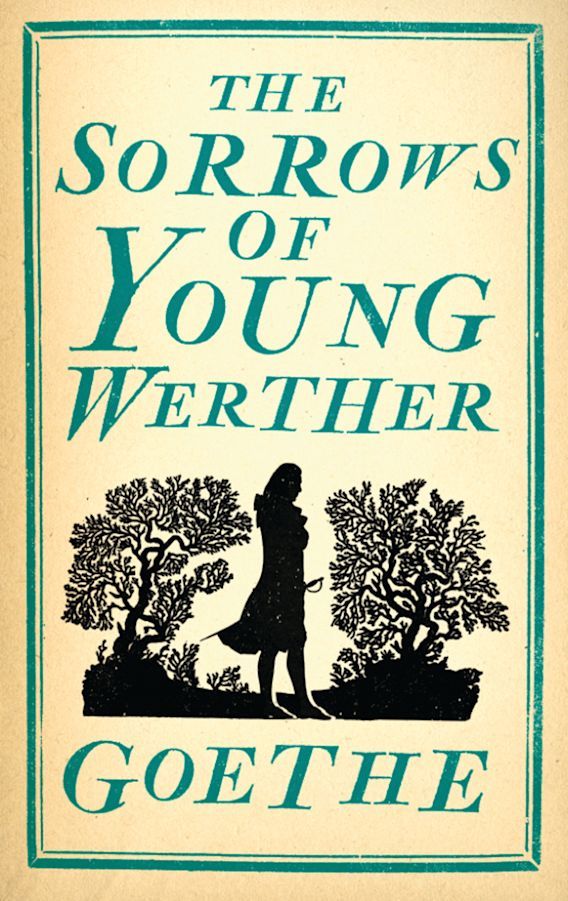
The Sorrows of Young Werther: Love, Impracticality, and the Romance That Could Never Survive
From the moment Werther begins to write, his fate is already sealed. Not because Charlotte belongs to another man, nor because society is cruel, but because Werther mistakes intensity for truth and feeling for destiny.
The Sorrows of Young Werther presents itself as a love story, but it is, more precisely, a story about what happens when love is entrusted to someone who cannot live in the world as it is.
Goethe wants us to feel with Werther. He succeeds brilliantly. But whether Werther deserves our full sympathy is another matter entirely.
A Heart Too Open for Its Own Good
Werther arrives in Wahlheim emotionally unguarded. He does not observe life; he absorbs it whole. Early diary entries pulse with delight:
“I am so happy, my dear friend, so absorbed in the exquisite sense of mere tranquil existence, that I neglect my talents.”
This line is charming — and already alarming. Werther abandons usefulness without hesitation. He does not seek balance. He seeks immersion.
His love story does not begin with Charlotte. It begins with a philosophy: life is meant to be felt, not managed.
That belief makes him magnetic. It also makes him unlivable.
Charlotte Appears — and Reality Quietly Enters
Charlotte is introduced not as a dream, but as a figure of action: feeding her siblings, organizing the household, moving easily between affection and responsibility. She is warmth anchored by duty.
Werther falls instantly. But crucially, Charlotte does not change her life to accommodate this love.
Albert exists from the beginning. Charlotte never hides this fact. Werther simply refuses to accept its implications.
What he loves in Charlotte is not merely her tenderness — it is her order. Yet he has no intention of sharing that order. He wants to orbit it, admire it, be transformed by it — without adopting its discipline.
This asymmetry dooms the romance before it fully begins.
Love Without Practicality
Werther’s letters soon reveal a dangerous pattern: emotion escalates, but action stagnates.
“Why must that which makes a man happy also become the source of his misery?”
The question is poetic — and evasive.
Werther never asks what he might do differently. He does not seek distance, redirection, or restraint. He seeks justification.
Charlotte asks for boundaries. Werther experiences boundaries as violence.
Albert, by contrast, is quietly practical. He builds a life. He plans. He commits. Goethe does not portray him as cruel or small-minded — only unromantic.
Werther’s tragedy is not that Charlotte chooses Albert. It is that Werther could never be Albert — nor would he want to be.
Goethe’s Seduction of the Reader
This is where Goethe’s genius — and manipulation — becomes evident.
We read only Werther’s voice. We feel his anguish without interruption. His despair sounds noble because it is beautifully phrased.
“I have so much, and yet without her all is nothing.”
It is devastating. It is also untrue.
Werther has options: work, distance, friendship, change. But Goethe ensures we do not feel them emotionally, because Werther does not feel them himself.
Our sympathy is engineered.
Charlotte’s silence grows. Albert recedes into the background. The world narrows until only feeling remains.
The Return — and the Collapse
When Werther returns to Wahlheim after his failed attempt at professional life, something has hardened. His love has lost its innocence. It has become insistence.
Charlotte now actively resists. She asks him to stop visiting. She fears what his presence does to them both.
This is not romantic tension — it is danger.
Werther reads Ossian aloud, flooding the room with tragic longing, pushing emotion past the point of beauty into excess.
Charlotte weeps. She begs him to leave.
And still, Werther does not choose withdrawal.
Werther’s Fate
Werther’s suicide is not impulsive. It is prepared, deliberate, almost ceremonious.
“I shall go before you… I shall see you again, and without the veil.”
Goethe frames the act as a final gesture of consistency. Werther remains true to himself — and that is precisely the problem.
He chooses death not because love was impossible, but because he could not imagine a version of himself that survived disappointment.
This is where sympathy must break.
Werther does not die for Charlotte. He dies for his idea of love — one that allows no compromise, no endurance, no growth beyond intensity.
A Romance Doomed from the Start
The love affair was never viable because it required Charlotte to abandon responsibility and Werther to acquire it.
Neither happens.
Charlotte chooses life as it must be lived. Werther chooses feeling as it wishes to be felt.
Goethe may invite us to weep for Werther, but he also leaves us with an uncomfortable realization: romantic excess can be as selfish as it is sincere.
Werther does not ask what love demands of him — only what it entitles him to feel.
Conclusion: Loving Too Much, Living Too Little
The Sorrows of Young Werther endures not because it celebrates romanticism, but because it exposes its limits. Goethe captures the intoxication of loving without restraint — and then follows it to its logical end.
Werther’s fate is tragic, yes. But it is also avoidable.
To read Werther honestly is to feel his pain — and then to step back and ask whether love that cannot survive reality deserves to be immortalized.
Perhaps Goethe’s true achievement is this tension: he lets us fall in love with Werther’s heart, even as he quietly reveals why such a heart cannot last.
Suzie Miller’s Prima Facie at The Market Theatre 17 September – 4 October 2026 How Now Brown Cow in association with The Market Theatre Directed by Neil Coppen Featuring Danica De La Rey Jones
There are performances you applaud.
There are performances you admire.
There are performances you discuss on the way home.
And then there are performances that seem to cast a spell over the room.
Danica De La Rey Jones’ performance in Suzie Miller’s Prima Facie belongs to the last category.
Magic.
Juju.
Pure, unexplainable theatrical magic.
I walked into The Market Theatre knowing I was about to watch a one-woman play. I walked out wondering how one human being could possibly have inhabited so many people, emotions, rooms, memories and realities for more than two hours without ever allowing the spell to break.
I have never experienced anything quite like it.
Prima Facie, presented by How Now Brown Cow in association with The Market Theatre and directed by Neil Coppen, is an extraordinarily demanding piece of theatre. It is intellectually sharp, emotionally brutal and structurally ingenious. It deals with rape, sexual violence, consent, evidence, trauma, the law, gender, class, power and the enormous distance between what happened to a person and what a legal system can actually prove happened.
But for all its difficult subject matter, this production never feels like a lecture.
It feels alive.
And at the centre of that life is Danica De La Rey Jones.
She is phenomenal.
THE MAGIC OF DANICA
I have a new favourite performer.
There is simply no other way to say it.
Danica De La Rey Jones is magic.
Watching her perform Tessa is like watching someone manipulate reality in front of you. She moves between characters without missing a beat. A change in posture, a shift in her eyes, a slight alteration in her voice, the smallest movement of her mouth—and suddenly we are somewhere else.
A different person is in the room.
A different memory.
A different emotional temperature.
A different world.
Her facial expressions are extraordinary. More than that, her microexpressions are extraordinary. The smallest movements communicate enormous amounts of information. Her eyes are constantly alive. They observe, calculate, remember, fear, seduce, challenge, laugh and break.
And that is perhaps what makes her performance so human.
Tessa is brilliant, but Danica never allows brilliance to become coldness.
She has personality.
She is funny.
She is animated.
She is vulnerable.
She is occasionally ridiculous.
She is ambitious.
She is angry.
She is frightened.
She is compassionate.
She is human.
That humanity is essential because Prima Facie is not simply the story of a lawyer discovering that the legal system has flaws. It is the story of a human being discovering that the intellectual architecture she has trusted her entire adult life cannot necessarily accommodate the reality of what has happened to her.
Danica understands that distinction.
She does not merely tell us Tessa’s story.
She makes us live inside Tessa’s mind.
For approximately two hours and ten minutes, she holds the entire room in the palm of her hand.
Alone.
No conventional ensemble.
No co-star waiting backstage to take over.
No safety net of another performer carrying the emotional weight.
Just Danica, the text, the space, the lighting, the sound and an audience.
And somehow, it is enough to fill the entire theatre.
More than enough.
TESSA: THE WOMAN WHO BELIEVED IN THE GAME
Suzie Miller introduces us to Tessa as a woman who has learned how to win.
Tessa comes from working-class origins and has climbed her way into a profession populated by people who did not necessarily begin where she did. She has fought her way upward and mastered the rules of the world she entered.
She is a criminal defence barrister.
And she is brilliant.
Tessa knows the law.
She understands the courtroom.
She understands witnesses.
She understands doubt.
She knows how to cross-examine.
She knows how to find weakness in an argument.
She knows how to manipulate a room.
She knows that emotion can become dangerous inside a courtroom and that the rules demand something more precise: evidence.
Facts.
Consistency.
Proof.
She believes in the system because the system has rewarded her.
The law is a game, and Tessa is exceptionally good at playing it.
There is something intoxicating about watching her at work.
She is fast.
Confident.
Witty.
Fearless.
She understands performance because the courtroom itself is a theatre.
There are roles.
There are costumes.
There are rituals.
There is an audience.
There is a person speaking and a person listening.
There are rules governing who gets to speak, what can be said, what can be challenged and what can be believed.
Tessa understands all of this instinctively.
And then the game becomes personal.
A brutal sexual assault tears through the architecture of her life.
Suddenly Tessa is no longer standing beside the accused.
She is on the other side.
She is the complainant.
The lawyer who understood the machinery of the justice system now has to place herself inside it.
That is where Miller’s central contradiction becomes devastating.
Tessa has spent her career understanding why a case must be proved.
Now she has to understand what it means when the thing that happened to you is real—but proving it is another matter entirely.
THE TITLE
Prima facie is a legal expression meaning, broadly, “at first sight” or “on the face of it.”
The title is devastatingly appropriate.
Because what does a legal system see?
What does a courtroom see?
What does a witness appear to be?
What does a victim look like?
What does a credible woman sound like?
What does trauma look like when translated into testimony?
The title becomes a question about appearances and assumptions.
At first sight, Tessa is successful.
At first sight, she is strong.
At first sight, she understands the law.
At first sight, she knows how the system works.
At first sight, perhaps she should be the perfect person to navigate it.
But human experience does not always present itself in a form that a courtroom can comfortably process.
That is the wound at the centre of Prima Facie.
WHEN THE DEFENCE LAWYER BECOMES THE ACCUSED
One of the most powerful aspects of Miller’s writing is the reversal.
Tessa has spent her career defending people accused of sexual violence.
She has cross-examined women.
She has challenged inconsistencies.
She has exposed uncertainty.
She has used the machinery of reasonable doubt.
She has participated in a system that demands evidence capable of surviving the adversarial process.
Then she becomes the woman sitting on the other side of the room.
And suddenly she understands the violence of the questions differently.
This is not simply hypocrisy.
That would be too easy.
Miller gives us something more uncomfortable.
Tessa believed in the rules.
She believed that applying them fairly was justice.
Her crisis comes when her own experience collides with the limitations of those rules.
The woman who once understood the courtroom as a place where truth could be tested discovers that truth and proof are not necessarily the same thing.
And this distinction becomes devastating when the person who has experienced trauma is expected to recount that trauma with perfect clarity.
Trauma is messy.
Memory is complicated.
Fear is irrational.
Human beings do not necessarily behave according to the neat logic expected of legal testimony.
And yet the courtroom demands coherence.
That tension is one of the central engines of Prima Facie.
THE COURTROOM AS THEATRE
There is something almost beautifully cruel about making this a one-person play.
Because Tessa’s world is already about performance.
She performs in court.
She performs professionally.
She performs confidence.
She performs competence.
She performs control.
Then Danica De La Rey Jones performs Tessa performing all of those things.
And beneath it all is the private person.
That creates layers upon layers of theatricality.
Danica can become Tessa.
Tessa can become the barrister.
The barrister can become the performer.
The performer can become the storyteller.
And the storyteller can suddenly break the illusion and speak directly into the emotional centre of the room.
This is why Danica’s performance feels almost supernatural.
She is not simply changing characters.
She is changing the audience’s perception of space.
One moment the theatre is a courtroom.
The next it is a law office.
Then a memory.
Then a private room.
Then a place of safety.
Then a place of terror.
Then a courtroom again.
And all of it is being created by one performer.
THE BODY REMEMBERS
One of the most difficult ideas in Prima Facie is that sexual violence does not end when the physical event ends.
The body remembers.
The mind remembers.
The environment remembers.
Language remembers.
And the legal process can become another site of trauma.
Tessa’s re-traumatisation through cross-examination is especially powerful because she knows exactly what is happening.
She knows the techniques.
She knows the strategy.
She understands why the questions are being asked.
She knows how a barrister thinks.
And that makes it worse.
There is no ignorance to protect her.
Her professional knowledge becomes part of her suffering.
The system she mastered becomes the system she must survive.
That is an extraordinary dramatic reversal.
CLASS, GENDER AND POWER
Tessa’s working-class origins matter.
Her journey into the upper reaches of the legal profession is not merely a motivational backstory. It tells us something about how she sees power.
She has entered a world that was not originally built around people like her.
She has succeeded by learning its language.
Its rules.
Its rituals.
Its codes.
She has become excellent at the game.
But Prima Facie asks whether entering a system and succeeding within it necessarily means the system has changed.
Tessa’s individual success cannot automatically dismantle the structures around her.
She can become powerful without becoming free from the structures that produced that power.
That is one of the play’s most uncomfortable ideas.
And when gender enters the equation, the discomfort deepens.
The legal system presents itself as neutral.
But the experiences of women entering that system do not always feel neutral.
Miller’s play interrogates the relationship between law and patriarchal power, particularly the ways evidentiary rules and the burden of proof can collide with the realities of sexual violence. The South African production itself describes the play as an examination of the “patriarchal power of the law.”
This is not an argument that every individual working within the law is malicious.
It is an examination of the machinery itself.
What happens when a system designed around particular assumptions about evidence encounters an experience that does not conform neatly to those assumptions?
DANICA’S EYES
I keep coming back to Danica’s eyes.
Because they are doing so much of the work.
There is life in them.
At one moment they sparkle with the confidence of a woman who knows she is the smartest person in the room.
Then they become playful.
Then suspicious.
Then frightened.
Then devastated.
Then furious.
Then empty.
Then alive again.
Those transitions are microscopic and enormous at the same time.
A lesser performer might announce every emotional transition.
Danica allows us to discover them.
That is the difference between acting and storytelling.
She trusts the audience.
She does not need to shout every emotion.
Sometimes she simply looks.
And the room understands.
NEIL COPPEN’S DIRECTION
Neil Coppen’s direction deserves enormous credit because a one-person production can easily become visually static.
This does not.
The stage has movement even when Danica is standing still.
The direction understands that the performer is the centre of the production, but not the only instrument.
Everything works around her.
The staging creates transitions without destroying the momentum of the storytelling.
The production understands that Prima Facie must feel like a journey rather than a speech.
Coppen allows Danica to move through the emotional architecture of the play with remarkable precision.
There is humour.
There is confidence.
There is acceleration.
Then the temperature changes.
The laughter disappears.
The room becomes heavier.
The silence becomes part of the storytelling.
And the production refuses to give us an easy escape.
There is no interval.
Julie-Anne McDowell even gave us some excellent advice before the performance: go to the bathroom beforehand, because once you leave the auditorium, you will not be allowed back in.
It sounds funny.
But artistically, it makes sense.
Prima Facie is not a show that wants to release you halfway through.
Once it begins, you are inside it.
And you stay there.
THE SET: A WORLD THAT CAN BECOME ANYTHING
The set design by Neil Coppen and Patrick Curtis, with set construction by Patrick Curtis and The Baxter Theatre, works in harmony with the production’s fundamental challenge: how do you create an entire world around one performer?
The answer is restraint.
Rather than overwhelming Danica, the environment gives her room.
The space can become courtroom, office, memory and psychological landscape.
That flexibility is crucial.
The set is not simply decoration.
It becomes part of the transformation.
The physical environment changes meaning depending on where Tessa is emotionally.
The same space can feel professional at one moment and threatening at another.
That is precisely what theatre can do better than almost any other medium.
A stage does not have to become a literal location.
It only has to make us believe.
And Prima Facie understands that.
LIGHTING THAT TELLS THE STORY
Tina Le Roux’s lighting design is irresistible.
It does not merely illuminate Danica.
It participates in the storytelling.
The lighting moves.
It breathes.
It changes the emotional geography of the stage.
It tells us where we are.
More importantly, it tells us how we should feel about where we are.
That is an important distinction.
Good lighting makes actors visible.
Great lighting becomes dramaturgy.
Here, light can create intimacy, tension, exposure, isolation and transformation.
The courtroom can feel clinical.
Memory can feel different.
Trauma can alter the atmosphere without requiring a literal change of scenery.
The lighting becomes another character.
And in a one-person production, that is invaluable.
COSTUME AS CHARACTER
Noluthando “Texture” Lobese’s costume design contributes another layer to Tessa’s transformation.
Costume is particularly important in a play where one performer must inhabit an entire world.
Tessa’s professional identity is inseparable from how she presents herself.
She is a barrister.
She understands presentation.
Appearance matters.
Authority matters.
Control matters.
Clothing becomes part of the armour.
But Prima Facie gradually exposes the human being underneath that armour.
The costume therefore becomes part of the larger visual language of the play: the public Tessa versus the private Tessa.
The professional identity versus the woman underneath it.
The person who knows what to do versus the person who has no idea what to do next.
SOUND, MUSIC AND THE INVISIBLE WORLD
Carl-Johan Lingenfelder’s sound design and original music are equally important.
Sound can be particularly powerful in a production about memory and trauma because sound does not always behave rationally.
A sound can transport us.
It can trigger memory.
It can create anticipation.
It can make an empty stage feel enormous.
In Prima Facie, sound helps prevent the one-person structure from feeling like a vacuum.
The world exists beyond the visible stage.
People exist beyond Danica.
Rooms exist beyond the physical set.
And memories exist beyond the present moment.
The soundscape therefore expands the production without overcrowding it.
THE WRITING: SUZIE MILLER’S TRAPDOOR
Suzie Miller’s writing is clever because she gives us Tessa before she gives us the catastrophe.
We get to know the woman who believes.
The woman who wins.
The woman who understands the rules.
The woman who thinks she understands justice.
That matters because when Tessa’s worldview collapses, ours does too.
Miller, herself a former lawyer, built the play around questions concerning the legal treatment of sexual assault and the collision between legal procedure and lived experience. The play emerged from her engagement with criminal law and her concern that something about how sexual assault is handled within the system did not adequately account for survivors’ realities.
The brilliance is in the structure.
The woman who knows how to dismantle someone else’s testimony is forced to experience the machinery from the opposite side.
The woman who believes in evidence discovers how difficult it can be to translate lived experience into evidence.
The woman who believes in justice discovers that justice is not necessarily synonymous with procedure.
And the woman who has spent her career mastering the rules is finally forced to ask whether the rules themselves are enough.
WHAT DOES JUSTICE ACTUALLY MEAN?
That may be the largest question Prima Facie leaves hanging over the audience.
Is justice simply the correct application of rules?
Is justice the discovery of truth?
Is justice punishment?
Is justice belief?
Is justice being heard?
Is justice surviving?
And what happens when those definitions contradict each other?
The play does not offer the comfort of an easy answer.
Instead, it leaves Tessa—and us—with the uncomfortable realisation that a system can be constructed around principles of fairness and still produce experiences that feel profoundly unfair.
That is the paradox.
And that paradox is what makes the play so powerful.
THE HEAVINESS
This is not an easy production.
It explores rape.
Sexual violence.
Trauma.
The interrogation of victims.
The burden of proof.
The adversarial legal process.
Gendered power.
Institutional structures.
The psychological consequences of being forced to repeatedly revisit an experience that has already damaged you.
There are moments when the production becomes difficult to watch.
It should.
The subject matter demands seriousness.
But what makes this production remarkable is that it does not confuse heaviness with monotony.
There is humour.
There is personality.
There is wit.
There is life.
And that makes the darkness darker.
Because we have seen Tessa laugh.
We have seen her enjoy herself.
We have seen her confidence.
We have seen her humanity.
So when that person begins to fracture, we understand what is being lost.
A ONE-WOMAN SHOW THAT FEELS LIKE AN ENTIRE COMPANY
This is ultimately where Danica De La Rey Jones becomes extraordinary.
She makes the impossible look effortless.
She carries characters.
She carries memories.
She carries the legal system.
She carries the emotional history.
She carries the jokes.
She carries the terror.
She carries the silences.
She carries us.
And she never makes the audience feel as though we are watching someone desperately trying to remember the next line.
Everything feels immediate.
Everything feels alive.
Everything feels dangerous.
That is why her performance feels like magic.
Juju.
Spellbinding.
The kind of performance that makes you forget your phone exists.
Forget the outside world.
Forget the time.
Forget that you are watching an actor.
For a while, there is only Tessa.
And Tessa is in trouble.
THE MARKET THEATRE AS THE ROOM FOR THIS STORY
There is also something fitting about experiencing Prima Facie at The Market Theatre.
The Market has always been a place where theatre can confront difficult questions.
Where art can disturb.
Where artists can take complicated human realities and put them directly in front of an audience.
This production belongs in that tradition.
It is not entertainment designed to make us comfortable.
It is theatre designed to make us feel.
To make us think.
To make us question.
To make us sit with something long after the lights have gone down.
And that is precisely what happened.
SOMETHING HAS TO CHANGE
The great achievement of Prima Facie is that it does not reduce its subject to a simple story of good people and bad people.
It asks bigger questions.
What happens when institutions are built around assumptions that do not adequately accommodate lived experience?
What happens when evidence becomes more important than experience?
What happens when trauma is expected to speak the language of reason?
What happens when a woman who understands the system better than most still finds herself vulnerable to it?
What happens when the person who once defended the rules becomes the person harmed by their limitations?
And what happens after that?
These questions do not end when Tessa leaves the courtroom.
They follow the audience home.
That is the power of theatre.
It does not have to solve the problem.
Sometimes it only needs to make the problem impossible to ignore.
FINAL VERDICT
I have watched theatre for years.
I have watched performers disappear into characters.
I have watched actors transform themselves.
I have watched productions that made me laugh, cry, think, rage and dream.
But I have never experienced anything quite like Danica De La Rey Jones in Prima Facie.
She is extraordinary.
She is unbelievable.
She is alive in every centimetre of the performance.
Her eyes speak.
Her face speaks.
Her body speaks.
Her silence speaks.
Her voice carries an entire universe.
And somehow she makes Tessa feel not like a character written on a page, but like a person who walked into The Market Theatre and told us the story herself.
That is a phenomenal talent.
Neil Coppen’s direction gives the performance its architecture.
Suzie Miller’s writing gives it its intellectual and emotional ammunition.
Neil Coppen and Patrick Curtis give it a world.
Patrick Curtis and The Baxter Theatre give that world physical form.
Tina Le Roux gives it light.
Noluthando “Texture” Lobese gives it visual identity.
Carl-Johan Lingenfelder gives it sound and atmosphere.
And Danica De La Rey Jones gives it a soul.
Together, they have created something powerful.
Something uncomfortable.
Something beautiful.
Something difficult.
Something necessary.
Prima Facie is a story about the law.
But ultimately, it is a story about people.
People who believe.
People who hurt.
People who remember.
People who survive.
People who question.
And people who discover that justice is much more complicated than simply knowing the rules.
The final thought is not an easy one.
It is a challenge.
Something has to change.
And after watching Danica De La Rey Jones hold an entire theatre in the palm of her hand for more than two hours, I left The Market Theatre with another thought entirely:
Magic is real.
Sometimes it walks onto a stage.
Sometimes it looks you directly in the eyes.
And sometimes, for two hours and ten minutes, it is called Danica De La Rey Jones.
Mr. Duiker Sang the Blues: When Grief Takes the Stage
There are performances that entertain you.
There are performances that impress you.
And then there are performances that sit inside you.
They follow you out of the theatre. They occupy the silence of the drive home. They return to you when the lights are off and the world has become quiet enough for you to hear your own thoughts.
Mr. Duiker Sang the Blues is one of those performances.
At the Market Theatre, from 13 September to 4 October 2026, Dyondzo Kwinika’s award-winning short story has found a new life on stage. The work, winner of the inaugural 2025 DALRO Can Themba Merit Award, has been adapted for theatre by Kwinika and Greg Homann, with Homann directing. The production emerges from a literary tradition that places South African storytelling, memory and human complexity at the centre of the theatrical experience.
But describing Mr. Duiker Sang the Blues as simply a play about grief would be to make it smaller than it is.
This is a play about love.
It is about guilt.
It is about fathers and sons.
It is about the things people cannot say while there is still time to say them.
It is about mental health, suffering, masculinity, memory, shame and death.
And perhaps most painfully, it is about what happens when love arrives too late.
The Desmond Dube I Didn’t Know
I grew up watching Desmond Dube on Dube on 2 on SABC 2.
That Desmond Dube was funny.
He was light.
He was mischievous.
He understood the rhythm of a joke and the beautiful simplicity of making people laugh. He became familiar to generations of South Africans as an entertainer who could enter our living rooms and make the heaviness of the world disappear for a little while.
Then I sat in the Market Theatre and watched another Desmond Dube.
This Desmond Dube did not make me laugh.
He made me hurt.
He cried.
He mourned.
He felt.
He collapsed.
He sobbed uncontrollably.
And there was something almost startling about witnessing such a familiar entertainer stripped of the comedic armour through which so many of us had known him.
The actor disappears.
The character remains.
Desmond Dube becomes Ebenezer Duiker, a father carrying an unbearable weight. His performance is not built around grand theatrical declarations. It is built around emotional exposure. The body becomes an instrument of grief. The voice cracks. The face changes. The physicality deteriorates.
This is not the Desmond Dube of the television screen I grew up with.
This is a father who has been broken by loss.
And watching him break was devastating.
A Father, a Son and the Unbearable
At the heart of Mr. Duiker Sang the Blues is a family tragedy.
The story gradually brings us closer to these people until they cease being characters and become people we feel we know.
Ebenezer.
Evelyn.
Maru.
Josh.
The production allows us to understand them before it asks us to mourn them.
That distinction matters.
We are not simply told that something terrible has happened.
We are taken there.
We live inside the memories.
We encounter relationships.
We discover wounds.
We begin to understand the spaces between people.
And then the tragedy arrives with its full weight.
The father who crippled his son.
The son whose suffering becomes inseparable from the suffering of those around him.
The guilt that refuses to die.
The love that survives even when everything else has collapsed.
This is where Kwinika’s writing becomes particularly painful. The story does not make grief abstract. Grief has faces. It has names. It has history.
The people on stage are not symbols pretending to be human.
They are human beings carrying symbols of their own.
And by the time death becomes unavoidable, the audience has become invested.
We knew them.
Therefore, we mourned them.
The Cost of Silence
One of the most affecting elements of the play is its relationship with silence.
There are things that people say.
There are things that people leave unsaid.
And then there are things that become impossible to say because too much time has passed.
Kwinika’s original story was written from a place of guilt, silence and the unbearable, and the stage adaptation retains that emotional centre. The production’s official description similarly positions grief, memory, family and mental health at its core.
The silence in Mr. Duiker Sang the Blues therefore does not feel empty.
It feels occupied.
Occupied by regret.
Occupied by memory.
Occupied by everything that should have been said.
There is an uncomfortable truth buried within the play: sometimes the people closest to us are the people we understand least.
Sometimes love is present but poorly expressed.
Sometimes people hurt the people they love.
Sometimes suffering is hidden behind appearances.
Sometimes the person who appears strong is the person barely surviving.
And sometimes a family only begins to understand the full magnitude of someone’s pain after they are gone.
The Horned Animal
And then there is the animal.
The horned creature standing over the stage and looking into the performance space.
Looking at us.
Watching.
It is impossible not to notice it.
It almost feels divine.
A presence above the human drama.
An observer.
A witness.
God-like.
And yet there is something deeply significant about what this animal represents.
It is not a predator.
It eats grass.
It does not need to consume flesh to survive.
It exists in a completely different relationship with violence than the human beings whose story unfolds beneath its gaze.
That contrast becomes haunting.
Human beings carry violence within themselves.
We wound one another.
We carry resentment.
We punish.
We judge.
We misunderstand.
We destroy things we love.
And above all of this sits the animal.
Watching.
Perhaps the creature becomes a mirror.
Perhaps it becomes God.
Perhaps it becomes nature.
Perhaps it becomes the silent witness that human beings desperately want when their own lives have become too complicated to understand.
Or perhaps its meaning is deliberately left open.
That is the beauty of theatre.
A symbol does not always need to announce its answer.
Sometimes it simply needs to watch.
And the animal watches.
The stage watches.
The audience watches.
And suddenly we become aware that we too are witnesses.
Theatre Without Distance
The intimacy of the production is extraordinary.
The stage is positioned within the audience.
There is no enormous gulf separating performer from spectator.
No comfortable distance.
No great theatrical wall.
The performers are close.
They are almost eyeball to eyeball with us.
And that changes everything.
We are not merely watching these people.
We are in their space.
We are implicated in their pain.
The theatre becomes personal.
The room becomes smaller.
The story becomes closer.
Every breath matters.
Every movement matters.
Every silence becomes louder.
This is theatre stripped of unnecessary distance.
It is theatrical, poetic and deeply personal.
And because the audience is so close, performance becomes incredibly important.
There is nowhere to hide.
The actors cannot disappear behind spectacle.
The emotions have to be truthful.
The performances have to carry the room.
And they do.
Desmond Dube as Ebenezer
Desmond Dube’s Ebenezer is the emotional centre of the production.
His grief is physical.
It lives in his shoulders.
It lives in his voice.
It lives in his face.
It lives in the way his body seems to surrender to the enormity of what has happened.
There are moments when he appears to have no strength left to carry himself.
And then the tears come.
Not cinematic tears.
Not theatrical tears designed to tell the audience, this is the sad part.
These feel like tears from somewhere much deeper.
Dube allows Ebenezer to be ugly in his grief.
And that is important.
Grief is not always beautiful.
Sometimes it is embarrassing.
Sometimes it is violent.
Sometimes it is exhausting.
Sometimes it makes people behave in ways they never imagined possible.
Sometimes grief leaves a person lying on the floor because standing has become too difficult.
Dube gives us that man.
The broken man.
The father.
The human being.
And suddenly the actor I remember from comedy becomes an entirely different theatrical force.
Evelyn, Maru and Josh
Nomathamsanqa Ngoma brings Evelyn into the emotional architecture of the story with sensitivity and presence.
Tankiso Mamabolo’s Maru contributes to the complicated network of relationships through which the story unfolds, while William Harding’s Josh becomes part of the painful emotional landscape that the production gradually reveals.
Together, the four performers create something important: an ensemble.
Nobody exists merely to decorate another person’s story.
Everybody contributes to the emotional history of the room.
That is why the audience becomes invested.
We are not simply waiting for the plot to reach its conclusion.
We are discovering people.
And when you discover people, you become vulnerable to their loss.
Greg Homann and the Architecture of Grief
Greg Homann’s direction understands that this story does not need to be shouted.
The material already carries enormous weight.
The direction therefore allows the emotional power to emerge through proximity, movement, silence, music and performance.
The result is a production that feels intimate rather than excessive.
It trusts the audience.
It allows us to sit with uncomfortable moments.
It allows grief to breathe.
The adaptation by Dyondzo Kwinika and Greg Homann is particularly important because this is a story that began as literature.
The task of taking a short story from the page and placing it inside a room full of living bodies is enormous.
Words must become movement.
Memory must become theatrical action.
Description must become design.
Interior thought must become performance.
And Mr. Duiker Sang the Blues demonstrates what can happen when literature is allowed to become theatre rather than simply being transferred from one medium to another.
The Market Theatre has a long tradition of bringing significant literary works into theatrical form, and this production continues that relationship between South African writing and the stage.
The Poetry of Sound
The blues are not merely in the title.
They are in the atmosphere.
Yogin Sullaphen’s work as Sound Designer, Co-Composer and Musician, alongside Petunia Msani as Co-Composer and Chorus, gives the production an additional emotional language.
Music does not simply accompany the story.
It helps carry it.
There are moments when words cannot adequately express what the characters are experiencing.
Music enters that space.
The sound becomes memory.
The sound becomes mourning.
The sound becomes the emotional pulse underneath the dialogue.
And this is fitting for a story centred on an artist and the psychological price of artistic life.
The official production description calls the work a play-with-music and highlights its live, experimental and narrative-driven musical component.
There is something inherently blues-like about the emotional world of Mr. Duiker Sang the Blues.
The blues understands pain without requiring pain to become spectacle.
It understands longing.
It understands loss.
It understands the human need to turn suffering into sound.
In an intimate production such as this, lighting cannot simply illuminate actors.
It has to sculpt emotional space.
It has to determine where our eyes go.
It has to create transitions between memory and presence.
It has to make the stage feel different even when the physical space has barely changed.
And the lighting here contributes enormously to the atmosphere.
Hailey Chisholm’s set design works in harmony with that intimacy.
There is no need for an enormous physical world when the emotional world is already enormous.
The stage becomes a psychological landscape.
Nelisiwe Xaba’s movement direction further expands that language, allowing bodies to communicate things that words cannot.
This is why the production feels poetic.
Its poetry is not only in the dialogue.
It is in the bodies.
The light.
The music.
The silence.
The space.
The gaze of the animal.
The audience sitting close enough to see everything.
Costume as Character
Noluthando “Texture” Lobese’s costume design contributes another layer to the world of the play.
Costume can tell us where people belong.
It can tell us how they see themselves.
It can establish time, identity and social context.
But more importantly, in a character-driven production, costume helps actors inhabit people.
The performers do not simply wear clothes.
They enter another emotional reality.
Every element of the production therefore feels connected.
Nothing exists entirely on its own.
Sound speaks to movement.
Movement speaks to lighting.
Lighting speaks to space.
Costume speaks to character.
And performance brings all of it to life.
Mental Health Without the Mask
Perhaps the most important conversation within Mr. Duiker Sang the Blues is the conversation about mental health.
Especially because artists are often expected to perform happiness.
The world loves the entertainer.
It loves the musician when the musician is on stage.
It loves the actor when the actor is making people laugh.
It loves the artist when the artist gives.
But what happens when the artist is suffering?
What happens when the performer goes home?
What happens when applause disappears?
What happens when the person behind the public image cannot perform anymore?
The production asks difficult questions about the cost of living with inner demons while the outside world expects talent, productivity, charisma and perfection.
The Market Theatre itself describes the play as an exploration of the psychological cost of creative talent and the ways mental-health challenges within the creative community can be hidden beneath performative joy and the pursuit of perfection.
This is an important conversation.
Because the artist is still a person.
The comedian still has sadness.
The musician still has fear.
The actor still has wounds.
The celebrated person still needs love.
And perhaps the most dangerous thing society can do is mistake someone’s ability to entertain us for evidence that they are okay.
The Audience Becomes Family
By the end, something remarkable has happened.
The audience has become emotionally involved.
We have laughed where there was laughter.
We have listened.
We have watched people struggle.
We have witnessed relationships fracture.
We have watched a father carry an almost impossible burden.
And eventually, we mourn.
Not because the production tells us to mourn.
Because it has made us care.
That is the difference between witnessing tragedy and experiencing it theatrically.
The play earns its emotional ending.
It takes us from beginning to end.
It tells us who these people are.
It allows us to understand their relationships.
It reveals the wounds.
It gives us enough time to become invested.
And then it asks us to confront the consequences.
That is storytelling.
When the Blues Become a Language for Grief
There is a reason the title stays with you.
Mr. Duiker Sang the Blues.
The blues are often understood as music born from suffering, but suffering is not the whole story.
The blues is also survival.
It is the transformation of pain into expression.
It is the decision to give suffering a voice.
That is what this production does.
It takes grief and gives it bodies.
It takes guilt and gives it language.
It takes mental anguish and gives it movement.
It takes death and gives it memory.
It takes a short story and gives it a stage.
And perhaps most importantly, it takes people who could easily become statistics in a conversation about mental health and turns them back into human beings.
People with names.
People with histories.
People who loved.
People who failed.
People who suffered.
People who hurt one another.
People who wanted to be understood.
People who deserved more time.
The Legacy of a Story
There is something fitting about Mr. Duiker Sang the Blues arriving at the Market Theatre through the Can Themba legacy.
The DALRO Can Themba Merit Award was created to nurture South African short-story writing and connect literary creation with further opportunities for writers. Kwinika’s story was selected from more than 250 submissions and published in When Water Wants To, before being developed for the stage.
That journey matters.
A story begins on a page.
Then somebody reads it.
Someone believes in it.
An award gives it another life.
A theatre gives it bodies.
Actors give it voices.
Designers give it an environment.
Musicians give it rhythm.
A director gives it shape.
And eventually an audience sits in the dark.
And listens.
This is how culture survives.
This is how stories travel.
This is how one person’s imagination becomes part of the collective memory.
A Must-See
Mr. Duiker Sang the Blues is poetic.
It is intimate.
It is beautifully performed.
It is deeply moving.
It is painful without being gratuitous.
It is theatrical without losing the humanity of its characters.
It is a story about death, but it is ultimately concerned with life: how we love, how we fail, how we suffer, how we remember and how we carry the people we have lost.
Desmond Dube gives us a performance that challenges everything I thought I knew about his range.
Nomathamsanqa Ngoma, Tankiso Mamabolo and William Harding complete an ensemble that gives the story emotional depth and humanity.
Greg Homann’s direction understands the power of intimacy.
Dyondzo Kwinika’s writing gives the production its soul.
Hailey Chisholm, Yogin Sullaphen, Petunia Msani, Noluthando “Texture” Lobese, Nelisiwe Xaba and Thabo Pule build the world around that soul through set, sound, music, costume, movement and light.
And somewhere above them all, that horned animal continues to watch.
It eats grass.
It does not eat flesh.
It watches humanity wrestle with itself.
Perhaps that is God.
Perhaps it is nature.
Perhaps it is memory.
Perhaps it is simply a witness.
But it watches.
And we watch.
And for a little while, inside the intimate darkness of the Market Theatre, four actors become a family, a story becomes a wound, music becomes mourning, and grief becomes theatre.
I walked into Mr. Duiker Sang the Blues expecting a play.
I walked out having mourned people I had never met.
Meursault and Sisyphus: Living Without Appeal in an Absurd World
Albert Camus’s The Stranger and The Myth of Sisyphus are not merely companion texts; they are two expressions of the same philosophical act. One dramatizes the absurd through narrative, the other theorizes it through philosophy. Together, they offer Camus’s most uncompromising answer to the problem of meaning in a world stripped of transcendence, God, and final justification. If The Myth of Sisyphus asks whether life is worth living once meaning collapses, The Stranger shows us what such a life looks like when lived to its bitter end.
At the heart of both works lies Camus’s concept of the absurd: the confrontation between humanity’s desperate need for meaning and the silent indifference of the universe. The absurd is not a feeling, nor a property of the world alone, but a relationship—a tension that cannot be resolved without either intellectual dishonesty or self-destruction. Camus insists that this tension must be lived, not escaped.
Meursault, the protagonist of The Stranger, is not a philosopher. He never articulates the absurd. He embodies it.
The Absurd Man: From Theory to Flesh
In The Myth of Sisyphus, Camus introduces the figure of the absurd man—one who lives fully aware that life has no ultimate meaning, yet refuses both suicide and false consolation. Suicide, for Camus, is a confession that life is not worth the trouble. Religion and metaphysical hope are equally evasive, offering answers where none exist. What remains is revolt: a constant, lucid defiance against meaninglessness.
Meursault is often misunderstood as apathetic, robotic, or emotionally deficient. But this reading misses Camus’s deeper intention. Meursault is not incapable of feeling; he simply refuses to lie. He does not pretend grief at his mother’s funeral. He does not feign belief in God when faced with death. He does not manufacture meaning where none presents itself. In this sense, Meursault lives the absurd condition more honestly than anyone around him.
His crime is not murder—society forgives murder easily enough—but refusal of illusion. He will not say that his mother’s death devastated him. He will not say that killing the Arab had a metaphysical cause. He will not say that he regrets life itself. In the courtroom, Meursault is judged less for what he did than for what he did not pretend to feel.
This is precisely the danger Camus identifies in The Myth of Sisyphus: society cannot tolerate those who expose its comforting fictions.
The Trial of Meaning
Meursault’s trial is not a legal proceeding; it is a metaphysical inquisition. The prosecutor reconstructs a narrative in which Meursault’s failure to cry at his mother’s funeral becomes proof of his moral monstrosity. The sun, the heat, the physical discomfort that Meursault cites as the immediate cause of the shooting are dismissed as absurd excuses—yet these are the only honest explanations available.
Camus is ruthless here. The court does not want truth; it wants coherence. It wants motive, remorse, redemption. In The Myth of Sisyphus, Camus argues that humans cannot bear a world that does not explain itself. Faced with the absurd, we rush to impose meaning—even if it must be fabricated.
Meursault’s refusal to cooperate with this fabrication seals his fate. He will not perform grief. He will not rehearse repentance. He will not appeal to God.
And so he must die.
Suicide, Execution, and the Refusal of Escape
The opening line of The Myth of Sisyphus is famously stark: “There is but one truly serious philosophical problem, and that is suicide.” Camus’s answer is unambiguous: suicide is an escape, not a solution. It annihilates the very consciousness that experiences the absurd tension.
Meursault, facing execution, arrives at the same conclusion without philosophy. He does not cling to hope of reprieve. He does not seek absolution. When the chaplain urges him to turn to God, Meursault explodes—not in fear, but in clarity. He recognizes that hope itself is the final lie.
This moment is crucial. Meursault does not despair. He awakens.
He accepts that the universe is indifferent—and in that acceptance, he feels free. For the first time, he understands that nothing has ever promised meaning, and therefore nothing has been taken from him.
Like Sisyphus, he reaches the summit.
Sisyphus and the Happiness of Defiance
In Greek myth, Sisyphus is condemned to roll a stone up a mountain for eternity, only to watch it fall back down. For Camus, this is the perfect image of the human condition. The labor is meaningless, repetitive, and eternal. And yet Camus concludes his essay with a startling assertion: “One must imagine Sisyphus happy.”
Why happy? Because Sisyphus knows his fate. He does not hope for escape. He does not pray for mercy. The moment he walks back down the mountain, conscious of his condition, the rock becomes his task. The gods’ punishment fails because Sisyphus refuses despair.
Meursault reaches the same state in his prison cell. Awaiting execution, he opens himself to the “gentle indifference of the world.” He wishes for a crowd of spectators who will greet his death with cries of hatred—not because he seeks suffering, but because hatred would confirm his final connection to life, to reality as it is, unsoftened by illusion.
This is not nihilism. It is revolt.
Living Without Appeal
Both The Stranger and The Myth of Sisyphus insist on a radical ethical position: live without appeal. Do not appeal to God, to destiny, to history, or to future redemption. Live with full awareness of death, contingency, and meaninglessness—and yet live intensely.
Meursault loves swimming, sex, sunlight, cigarettes, and the physical immediacy of the present moment. He does not live less than others; he lives more honestly. His tragedy is not that he dies, but that society cannot tolerate someone who exposes the groundlessness beneath its moral theatre.
Camus does not offer comfort. He offers clarity.
In a world without transcendence, dignity is found not in hope, but in lucidity. Not in resignation, but in revolt. Not in meaning, but in presence.
Meursault is Sisyphus without the mountain. Sisyphus is Meursault without the guillotine. Both teach us the same lesson: that even in an indifferent universe, the human refusal to lie—to oneself above all—remains a form of freedom.
And that freedom, fragile and fleeting as it is, is enough.