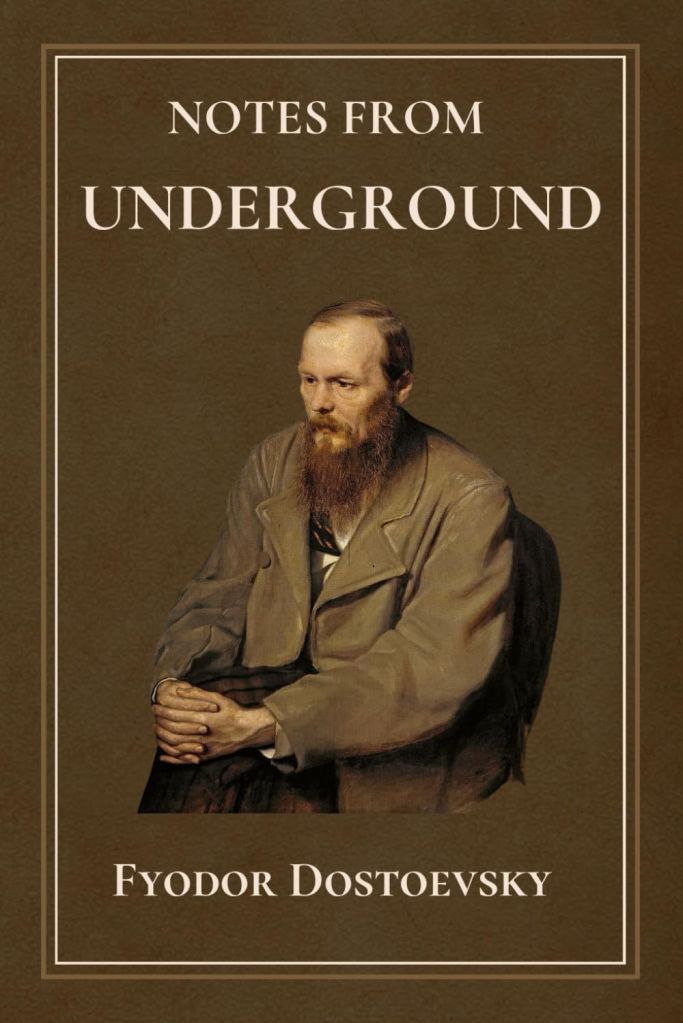
Notes from Underground and the Birth of Modern Consciousness
There is a reason Notes from Underground feels less like a novel than an exposure. It does not invite sympathy, nor does it offer development or redemption. Instead, it stages a consciousness that knows too much, feels too sharply, and cannot move without tripping over itself. What Dostoevsky gives us here is not a character to be understood, but a mode of being that would come to define modernity.
The Underground Man is not mad. He is not mistaken. He is, disturbingly, lucid. And it is this lucidity — corrosive, recursive, merciless — that makes him feel so contemporary. In him, Dostoevsky inaugurates a form of consciousness that no longer trusts reason, no longer believes in progress, and no longer experiences the self as unified or innocent. This is not the romantic self, nor the rational Enlightenment subject. It is something darker: a self conscious of its own consciousness, and trapped inside it.
Hyper-consciousness as Illness
“I am a sick man… I am a spiteful man.”
The opening declaration is not metaphorical. The Underground Man’s illness is not physical, nor even psychological in the clinical sense. It is excess awareness. He feels everything too much, thinks everything too far, anticipates every possible humiliation before it occurs. Action becomes impossible because action would require simplification, and simplification feels dishonest.
This is the first crucial break Dostoevsky introduces: consciousness is no longer a tool for clarity, but a source of paralysis. To be aware is not to be free; it is to be immobilised by competing motives, imagined judgments, and retrospective shame.
The Underground Man knows the reasons for action — and knows equally well the reasons against them. Every impulse is instantly undermined by reflection. Every desire is followed by contempt for having desired at all. What remains is inertia, accompanied by an inner monologue that never rests.
Modern consciousness begins here: not with doubt, but with self-surveillance.
The Collapse of Rational Optimism
Dostoevsky is writing against something very specific: the 19th-century belief that human beings, if shown their true interests, will act rationally and morally. The Crystal Palace — the utopian symbol of perfect rational organisation — looms in the background as an unspoken antagonist.
The Underground Man refuses this vision with fury.
He insists, scandalously, that human beings will choose suffering over happiness if happiness is imposed. That they will act against reason simply to prove they are free. That two times two equalling four is not liberation, but a wall.
This rejection is not philosophical abstraction; it is existential. A life governed entirely by rational calculation leaves no room for unpredictability, contradiction, or desire. It reduces the human being to a mechanism. The Underground Man’s spite is, at its core, a protest against being explained away.
Here, modern consciousness announces its rebellion: I would rather be wrong than reduced.
Freedom as Negativity
What is striking about the Underground Man is that he does not advocate an alternative system. He offers no better ethics, no new social arrangement. His freedom is purely negative. It exists only as refusal.
He will not be cured.
He will not be reconciled.
He will not be made happy by force.
This is not heroic resistance. It is ugly, self-defeating, often cruel. But it is recognisably modern. Freedom is no longer experienced as harmony between self and world, but as the ability to say no — even when that no leads to suffering.
The Underground Man prefers conscious misery to unconscious contentment. At least misery belongs to him.
This is a profound shift in the understanding of agency. Freedom becomes inseparable from self-sabotage. Choice is validated not by outcomes, but by its capacity to negate expectation.
Memory as a Weapon Turned Inward
If hyper-consciousness paralyses the Underground Man in the present, memory tortures him endlessly. He does not remember selectively; he remembers obsessively. Every slight is preserved, replayed, reimagined. Past humiliations are not digested — they are cultivated.
This is not nostalgia. It is a form of self-harm.
The Underground Man rehearses conversations that ended years ago, sharpening insults that were never delivered, reliving moments of shame with increasing cruelty toward himself. Memory becomes a private theatre of accusation, with the self as both defendant and prosecutor.
Here, Dostoevsky anticipates something deeply modern: the inability to let experience settle. The past does not recede; it accumulates. Identity becomes a sediment of unresolved moments.
Modern consciousness, in this sense, is haunted consciousness.
Self-Knowledge Without Consolation
What makes Notes from Underground so unsettling is that the Underground Man is rarely wrong about himself. He sees his own pettiness, his cowardice, his cruelty — and this insight does not redeem him. It merely adds another layer of contempt.
This is not the Socratic faith that self-knowledge leads to virtue. It is its inversion. Knowing oneself can deepen despair. Reflection does not heal; it corrodes.
Dostoevsky refuses the comforting arc in which awareness leads to growth. Instead, he presents consciousness as a closed circuit, feeding on itself. The Underground Man is not deluded — he is incapable of forgetting himself.
In this, Dostoevsky anticipates the crisis of modern subjectivity: when introspection no longer promises salvation, only endless recursion.
The Birth of the Anti-Hero
Before the Underground Man, literature gave us rebels, sinners, romantics, outcasts — but rarely this. This is not rebellion against society, but rebellion against coherence itself. The Underground Man does not want to belong, but neither does he want to escape. He wants to remain underground, where contradiction can be preserved without resolution.
He is not admirable. He is not instructive. He is not tragic in the classical sense. He is something new: an anti-hero whose defining trait is consciousness itself.
From this figure will descend a lineage of modern voices: fractured narrators, unreliable selves, interior monologues that expose rather than clarify. The Underground Man marks the moment when literature stops reassuring us that understanding leads somewhere better.
Why He Still Disturbs Us
The enduring discomfort of Notes from Underground lies in its refusal to distance the reader. The Underground Man does not represent a pathology safely contained in fiction. He articulates impulses we recognise and would rather deny: the pleasure of resentment, the intimacy of grievance, the strange comfort of self-inflicted misery.
He speaks from a place that modern life continually reproduces: the isolated self, over-informed, over-aware, inwardly verbose, outwardly inert. A consciousness flooded with explanations but starved of meaning.
Dostoevsky does not ask us to agree with the Underground Man. He forces us to acknowledge that this form of consciousness exists — and that it may be closer to us than we care to admit.
Conclusion: A Beginning, Not an Ending
Notes from Underground is not a diagnosis and not a prophecy. It is a beginning. With it, Dostoevsky cracks open the modern self and refuses to close it again.
The Underground Man is what remains when rational optimism collapses, when faith is wounded, when freedom turns inward and becomes destructive. He is the cost of consciousness without transcendence, awareness without grace.
In giving him a voice, Dostoevsky does not solve the problem of modern consciousness. He names it. And once named, it becomes impossible to ignore.
The underground is not beneath us.
It is within us.