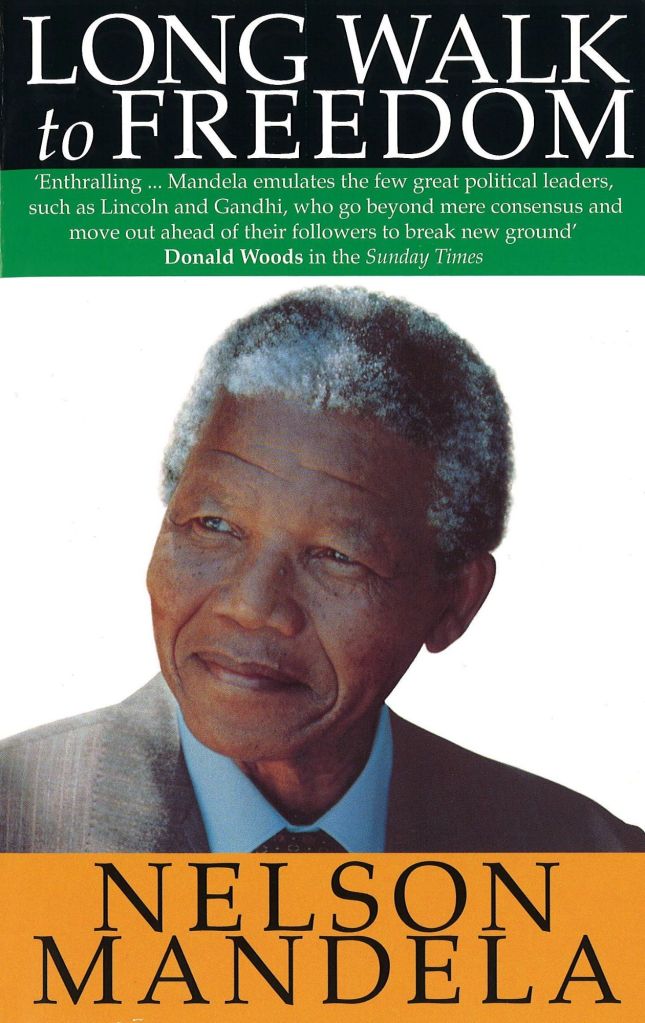
Long Walk to Freedom

The Discipline of Freedom: Nelson Mandela and the Making of a Moral Self

On Long Walk to Freedom

Freedom, in Long Walk to Freedom, is not an emotional breakthrough or a sudden awakening. It is not romantic, not impulsive, and certainly not easy. Nelson Mandela presents freedom as a practice—something learned slowly, through sacrifice, self-restraint, and moral clarity forged under pressure. What makes the autobiography remarkable is not simply the historical scope of Mandela’s life, but the way he narrates the construction of character under conditions designed to destroy it.

This is not a story of a saint born virtuous, nor of a rebel intoxicated by rage. It is the story of a man who learns—again and again—how much of himself must be surrendered so that something larger might survive.

From Tribal Belonging to Moral Consciousness

Mandela begins his story rooted in the Xhosa world of Thembuland, where identity is communal, hierarchical, and bound by custom. His early understanding of freedom is modest: the ability to tend cattle, to belong, to fulfill expected roles. What is striking is how unabstract this freedom is. It is not ideological; it is lived.

Yet education—first at missionary schools, then at Fort Hare—introduces a fracture. Mandela encounters Western ideas of justice, law, and individual rights, but he does not romanticize them. Instead, he experiences contradiction: a legal system that speaks the language of equality while practicing domination.

This tension becomes formative. Mandela does not reject tradition in favor of modernity, nor does he cling nostalgically to the past. Instead, he begins assembling a hybrid moral framework—one capable of holding both communal responsibility and universal justice.

Freedom, at this stage, becomes awareness: the recognition that the world one has inherited is unjust, and that obedience is no longer morally neutral.

The Law as Both Weapon and Illusion

Mandela’s decision to become a lawyer is often read as strategic, but it is also deeply symbolic. Law represents order, rationality, and the promise of fairness. Yet apartheid law exposes itself as a grotesque parody of justice.

What emerges in Long Walk to Freedom is Mandela’s growing realism. He understands that legality and morality have diverged. The courts may punish resistance, but they cannot confer legitimacy on injustice. This realization marks a crucial ethical shift: obedience ceases to be a virtue.

Still, Mandela is not reckless. He resists violence longer than many of his contemporaries, not out of fear but out of moral caution. The turn toward armed struggle is portrayed not as liberation, but as tragedy—an acknowledgment that peaceful avenues have been exhausted.

This is one of the book’s most important achievements: it refuses to glamorize militancy. Violence is framed as a grim necessity, not a moral triumph.

Prison as a School of the Self

Robben Island is the crucible of the autobiography. Stripped of movement, privacy, and dignity, Mandela confronts the central question of the book: What remains of freedom when the body is unfree?

The answer is not stoic detachment, but discipline.

Mandela learns that rage corrodes judgment, that impulsiveness invites manipulation, and that dignity must be enacted even when it is denied. He studies his jailers, learns their language, understands their fears. This is not submission—it is strategy. But it is also something deeper: a refusal to become morally smaller than one’s oppressor.

Unlike Dostoevsky’s underground figures, Mandela does not retreat into ressentiment. Unlike romantic revolutionaries, he does not cultivate martyrdom. He practices restraint as a form of power.

Prison teaches him that freedom without self-mastery is fragile. True authority, he discovers, comes from the ability to govern oneself under extreme conditions.

The Refusal of Hatred

Perhaps the most radical element of Long Walk to Freedom is Mandela’s rejection of hatred as a political resource. Hatred promises clarity and energy, but it narrows the future. Mandela understands that if South Africa is to survive, it must be built not on vengeance but on moral imagination—the ability to see the enemy as a future citizen.

This is not sentimental forgiveness. It is hard-earned realism. Hatred would imprison the victors just as surely as apartheid imprisoned the oppressed.

Mandela’s genius lies in recognizing that reconciliation is not weakness, but foresight. A nation emerging from systemic cruelty cannot afford the luxury of moral absolutism. Compromise, in this context, becomes an ethical achievement rather than a failure.

Freedom as an Unfinished Task

The autobiography ends not with triumph, but with sobriety. Mandela is free, apartheid has fallen, yet the work remains incomplete. Poverty, inequality, and historical trauma persist. Freedom, once again, reveals itself not as a destination but as a responsibility.

The final insight of Long Walk to Freedom is quietly devastating: liberation creates new obligations. To be free is to accept the burden of choice, restraint, and continued struggle—not against an external enemy, but against despair, corruption, and moral fatigue.

Mandela refuses the role of savior. He presents himself instead as a custodian—one participant in a collective effort that transcends any individual life.

Conclusion: Against Romanticism, For Character

In a literary landscape crowded with tragic heroes and existential rebels, Long Walk to Freedom stands apart. It is not a book about the beauty of suffering, nor about the ecstasy of rebellion. It is a book about character forged slowly, through patience, sacrifice, and ethical clarity.

Mandela’s life challenges the romantic notion that authenticity lies in impulse. Instead, he proposes a more difficult truth: that freedom requires discipline, and that dignity must be practiced daily, especially when it seems futile.

This is why Long Walk to Freedom endures—not as propaganda, but as a profound meditation on what it means to remain human in an inhuman system, and to emerge without surrendering one’s moral future.

Struggling Artist

Struggling artist

I have R100 and it has to serve me for the whole month. I need to be intelligent and allocate the capital in avenues that will deliver consistent payoffs. I need to stretch time and survive by the day. That’s the most in important thing, survival. Here’s my plan; buy brown bread from Shoprite, it costs R5 and then divide the bread for 3 days. White bread is expensive, it costs R9. Then buy “Crack a snack” 50 pack, it costs R30. Water is free, so that’s great. What I have left over is R65. My nigga Thato Katane, (great guy with enthusiasm and gratitude) showed me a couple of places where I can buy chips for R5. Imagine that R5! So cost effective, so economical. So practical and effective for when you are in survival mode. Salute mpinch ya ka, I love you and respect you, genuinely, thank you for all that you have taught me, I have internalized everything in my subconscious mind and some lessons form part of my persona; you’re my brother forever. You are the realest person I know and I appreciate you. When you first heard my music, you marveled and said I was talented, you were the first to see it, you made me feel good. Thank you. God bless you, may he grant you your hearts desires. But I digress. The product is great too. One place in particular, 6th Avenue, Johnbrant. I feel a bit guilty buying there because the chef adds so much value to those potatoes. He adds his time and expertise. Man, I hope the shop is profitable, the service and product helps so many people. God bless the shops that are serving people in that capacity, you guys are God sent. Anyways, I’ll buy a packet of chips every two weeks on a Tuesday – that’s R10. My Tuesdays are usually busy and so I have to be on my game. Every two weeks on Tuesdays will be my days when I ball out and spoil myself. This is good for morale; you cannot understate or underestimate the importance of morale, it is everything. That will leave me with R50. I bought a packet of chips this week when I bought bread and “Crack a snacks”. With R50 I can buy 10 loaves of bread during the course of the month. And because I only buy a loaf every three days, I have a good chance to make it through the month. That’s so positive. That’s great. Thank you God for keeping me going. Thank you Universe for this moment, this opportunity to grow and be better. We push, we stretch, we fight harder, in the end we will make it. Freedom is a state of being. We live life without any fears, we can take on anything. Our strength and confidence comes from within and so we are able to navigate this world effortlessly and conquer. We bend and distort reality to our liking. We never compromise on our values. We are consistent. Our victory is a mathematical certainty.

Buy the great man Coffee :https://www.buymeacoffee.com/Antakalipa

Little Township Boy

Little Township Boy

Your dreams are too impractical. You can’t be a pilot, dear boy that’s not how the world works. Choose something else, something in line with your reality, something in line with your environment. How about an Uber driver? No, that’s too steep. Let’s try a taxi driver operating somebody’s 16 seater. You have to remember that you have owners. You are not free, no one is free, in fact dear boy, there is no such thing as freedom. It’s all made up like your dreams of flying airplanes. Someone needs to bring you down to earth, having your head above the clouds is only metaphoric like shooting stars in the sky. And well, you are no star. The truth is that you are limited like prepaid data. The truth is that you’ll never amount to much. The truth is that your are doomed like insects in a corner. There is no way of maneuvering this, you are playing a rigged game and the cards have been dealt to you since your inception. There is no way to change hands just play the cards you have been dealt as best as you can. Don’t mess up the order of the world, don’t anger your owners, just do as you are told and don’t be a hero. Lower your expectations dear boy you are nothing but a pawn in this chess game called life. No one cares about you or your dreams. But that’s not such a bad thing, strive to make your owners rich and you’ll do better than most people. Dear boy, just stay in your lane and you’ll be alright.

Buy the great man Coffee :https://www.buymeacoffee.com/Antakalipa

Underground Railroad

Underground Railroad

The Underground Railroad series by Barry Jenkins is a masterpiece. It is uncomfortable, disturbing, difficult and painful. The depiction of slavery is earth shattering! Its so raw, exposed and unapologetic. The imagery evokes the feeling of dread and fear. The oppression is heavy as a 10 ton truck and the situation is just hopeless – it is what it is. Slavery is the most horrific event that has ever occurred in our history. It’s so barbaric and lacks any conscience. Our ancestors had it bad. It was brutal. From the whips that devour your bloody mince meat back. To the fires that consume the body turning it to a coal. The total disregard for human life is heartbreaking. How are you better than me as a human being because your hue is diluted? Why are you offended by my melanin tone? Why do you have to humiliate me and disregard my right to life? Why is your God prejudice and so selective? We see characters lose hope – it’s difficult not to lose hope, optimism is like aircon in hell. We witness suicide, we see hunger devouring the very essence of a man leading him to his death. Cause what’s the use? Why eat? For what? For who? I am tired of laboring in the name of slavery. I have made my peace with the Lord, they can’t do anything to my soul no more. They don’t care about you, you just a nigger, an animal with no reasoning faculties, genetically built to serve the white man. You just mere property like tools and we need you to procreate so we can sell your children to turn a profit. Don’t tell me about love, niggers don’t have that capacity, this is strictly mechanical and a white man will be present watching you as you lay pipe. You can’t even run away, they chase after you and once caught punishment in the form of flesh eating whips awaits. Suicide is difficult, you are always monitored, all they want is a daily dose of your spirit like concentrated syrup until it runs out. The hangings, the violence, the killings, the hate, the ignorance, the fear, the horror, the suffering, oh the suffering, each scene was like a dagger to my soul. It never got better too, the good hearted characters who assisted the protagonist on her journey always died horrific deaths because slave owners always win and slavery is justified. The good and heartwarming scenes never last, there’s always a shadow that ultimately engulfs the protagonists present turning her world into disarray and scrambling for survival.

I was relieved when Cora shot dead Ridgeway, he was a bad man and I hated him like a recurring nightmare. I don’t understand the hate in his heart, his father did his best to show him the way. We are all one, we are one spirit, try to see yourself in another person. Yes, there is a order and everybody has a role but what about your humanity? Why do you have to conform to the norm when you are haunted by it’s conditions? Maybe I will never understand, maybe he had a slave catcher mentality and being an observer of the series, I will never quite understand that psychology. I would have shot Homer dead too. To many times in the story he has been the difference. He is a loose end, he knows too much. Granted he was under Ridgeway’s frame and had to serve him but he was complicit, he knew what he was doing. He even committed murder to save Ridgeway. Still I understand the decision to spare his life, Cora didn’t have any beef with him and if she killed him she would be hanged and this time around the killing wouldn’t be justified. I feel sorry for Homer now that Ridgeway is dead cause what’s he going to do now? He is just a nigger kid, how’s he going to survive? He was dependent on Ridgeway in more ways than one. He was like a father to him. How’s he going to navigate the world alone? He is going to have to regress to a slave to make it through, now isn’t that poetic justice? Isn’t killing Homer mercy? Maybe not, we all deserve a chance at life and he is resourceful, just maybe he’ll be okay. Cora has showed us its possible time and time again.

I salute the makers of the craft, Barry Jenkins and his team delivered an absolute masterclass. I imagine it was difficult creating that, the mental strength required to play the role of Cora cannot be underestimated. Full credit to Thuso Mbedu for delivering perfection. I am pretty sure she had support, a psychiatrist, psychologist or some sort of professional had to be on site at all times. Playing a character with so much depth can be scaring and psychologically distressing. Who knows what’s hidden in the deep recesses of your subconscious. She had to go to dark places and inhabit them. She had to disconfigure herself and willingly go under the sword. She had to combat the shadows that were well hidden by time. She faced the monsters in her closet. She captured the essence of being a slave. She was a slave. She is just an amazing artist. But it’s not just her, everyone performed at such a high level. Unbelievably there was no weak link, everyone was a solid 10. The visuals, the pictures, the camera work, the slow motion takes, the deliberate use of silence, the costumes, the score, music and soundtracks, the fire, the singing, the slaves, the sets, the characters, the actors, the brutality, the violence, the beats, the dialogue, the sequences and the overall story – it is content on another level. The genocide scene at Indiana was hard but expected now that we were so late into the story, you can never really trust these white folks, they have never been friends, I was disgusted but not surprised by their actions, nothing they did surprised me anymore. Watching the show I became pessimistic and cynical, I learned true human nature. It was a difficult story to tell and execute and they excelled with flying colors.

Buy the great man Coffee :https://www.buymeacoffee.com/Antakalipa