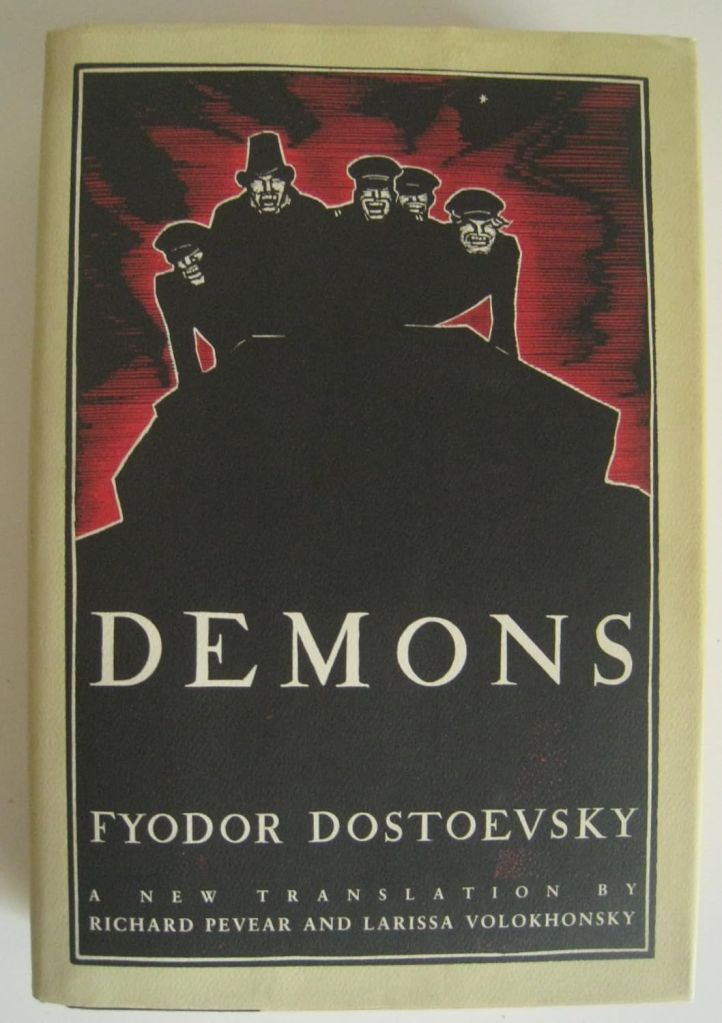
Demons

Stavrogin and Pyotr Verkhovensky: The Void and the Virus

Suicide, Silence, and the Refusal of God in Dostoevsky’s Demons

In Demons, Dostoevsky no longer asks why a man commits a crime or how guilt destroys the soul. He asks something far more terrifying: What happens when belief itself becomes diseased? The novel marks a shift from individual psychological collapse to collective possession. Here, ideas do not persuade—they infect. They hollow people out, animate them, and drive them toward destruction with mechanical inevitability.

At the center of this catastrophe stand two figures who never fully merge yet cannot exist without each other: Nikolai Stavrogin, the void, and Pyotr Verkhovensky, the virus. Stavrogin represents moral emptiness—the absence of belief, remorse, or commitment. Pyotr represents ideological contagion—pure movement without truth, manipulation without conviction. Together, they form Dostoevsky’s bleakest prophecy: a world where emptiness invites possession, and possession replaces conscience.

Stavrogin: The Terror of Moral Emptiness

Stavrogin is not a villain in the traditional sense. He does not rage like Raskolnikov, argue like Ivan Karamazov, or suffer like Prince Myshkin. What makes Stavrogin terrifying is precisely what he lacks: moral gravity. He does not struggle; he does not resist. He observes his own depravity with cold detachment, as though watching another man commit atrocities.

Everyone in Demons orbits Stavrogin. They project onto him leadership, depth, and power. Yet Stavrogin himself believes in nothing—not God, not humanity, not even nihilism as a cause. He is not a revolutionary; he is not a reactionary. He is an absence that attracts meaning, a blank screen onto which others cast their fantasies.

Dostoevsky understood something deeply modern here: emptiness can be more dangerous than conviction. A man who believes in something may still be restrained by doubt or conscience. A man who believes in nothing becomes infinitely adaptable. Stavrogin can commit evil not because he is driven by passion, but because nothing within him says no.

His silence is crucial. Stavrogin refuses confession not out of pride, but indifference. Even when he reveals his crimes, it is without repentance, as though truth itself has lost its moral weight. This silence is not peace—it is spiritual death.

Pyotr Verkhovensky: Ideology as Infection

If Stavrogin is empty, Pyotr Verkhovensky is full—but full of nothing substantial. Pyotr does not believe in revolution, justice, or equality. He believes only in movement, disruption, and control. Ideas are tools to him, interchangeable and disposable. Truth is irrelevant; effect is everything.

Pyotr understands that people do not need coherent philosophy—they need permission. Permission to destroy, to humiliate, to kill. He creates secret cells not to advance a cause, but to bind people together through shared guilt. Violence becomes the glue of community.

This is where Demons becomes prophetic. Pyotr anticipates the modern extremist: not a fanatic driven by belief, but a strategist who weaponizes belief in others. He spreads chaos not as an end, but as a method. Disorder creates dependency, and dependency creates power.

Pyotr does not create the void—but he exploits it. Stavrogin’s emptiness gives Pyotr legitimacy. Pyotr needs Stavrogin as a symbol, a silent authority who never contradicts him. In this sense, the virus requires the void. Ideology needs spiritually empty hosts to survive.

Kirillov and the Logic of Suicide

Running beneath Stavrogin and Pyotr is a darker philosophical current, embodied most explicitly in Kirillov. Kirillov’s suicide is not despair—it is metaphysics. He believes that if God does not exist, then the highest expression of human freedom is self-annihilation. By killing himself voluntarily, Kirillov seeks to become God.

This is the most chilling idea in Demons: suicide as theological rebellion.

Kirillov’s logic is flawless and horrifying. If there is no God, then there is no moral order beyond human will. If that is true, then death is merely another choice. Suicide becomes the ultimate assertion of autonomy. Freedom consumes itself.

Dostoevsky understood that when God is rejected, something else rushes in to fill the vacuum—not reason, but absolutism. Kirillov does not arrive at peace; he arrives at fanatic clarity. His death is not tragic because it is painful, but because it is meaningless while pretending to be profound.

Stavrogin’s Silence and the Failure of Confession

Unlike Kirillov, Stavrogin does not articulate a philosophy of suicide—but he embodies it. His final act is not a declaration, but a withdrawal. Where Kirillov dies loudly, Stavrogin dies quietly. His suicide is the natural conclusion of emptiness: when nothing binds you to life, life becomes optional.

Stavrogin cannot repent because repentance requires belief in moral order. He cannot love because love requires commitment. He cannot live because life requires purpose beyond self-will. His death is not an escape from guilt—it is the final expression of indifference.

Dostoevsky is merciless here. Stavrogin’s intelligence, charm, and self-awareness do not save him. On the contrary, they accelerate his destruction. Consciousness without faith becomes self-consuming.

The Possessed World

What Demons ultimately reveals is that the death of God does not lead to freedom—it leads to possession. When conscience disappears, ideology takes its place. When meaning dissolves, violence provides structure. When silence replaces prayer, chaos speaks.

Stavrogin shows us the danger of inner emptiness. Pyotr shows us how that emptiness becomes contagious. Kirillov shows us the final logic of absolute freedom. Together, they form a single system: void, virus, and self-destruction.

Dostoevsky was not warning against revolution alone. He was warning against a world where ideas are severed from the soul, where belief becomes technique, and where freedom is defined as the absence of restraint rather than the presence of meaning.

Conclusion: A Novel for Our Time

Demons is not a historical novel. It is a diagnosis. Stavrogin exists wherever moral detachment is mistaken for sophistication. Pyotr exists wherever chaos is mistaken for progress. Kirillov exists wherever autonomy is mistaken for transcendence.

The demons Dostoevsky describes are not supernatural—they are philosophical. They enter through silence, grow through emptiness, and destroy through certainty.

And once possessed, a society no longer needs tyrants.

It destroys itself.

The Brothers Karamazov

The Three Brothers as One Divided Soul: Psychological Fragmentation in The Brothers Karamazov

Dostoevsky did not write The Brothers Karamazov to tell the story of three brothers. He wrote it to expose the fracture at the heart of modern humanity. 

Dmitri, Ivan, and Alyosha are not simply siblings shaped by circumstance; they are embodiments of a single divided soul—passion, reason, and faith torn apart and forced to live separately. Their tragedy is not merely familial but existential: what happens when the human self can no longer hold its contradictions together?

Fyodor Pavlovich Karamazov, their father, is less a character than a moral vacuum. He bequeaths his sons not guidance or love, but chaos. In this absence of paternal authority—ethical, emotional, and spiritual—each brother develops one aspect of humanity in isolation. The result is not wholeness but extremity.

Dmitri: The Tyranny of Desire

Dmitri Karamazov is the most visibly alive of the brothers—and the least integrated. He lives in his body, in sensation, in appetite. His passions erupt uncontrollably: love and hatred, generosity and cruelty, ecstasy and despair coexist without mediation. Dmitri does not calculate; he confesses. He does not conceal his excess; he suffers it openly.

Yet Dostoevsky does not reduce Dmitri to mere hedonism. Beneath his sensuality lies a desperate hunger for moral purity. Dmitri longs to be redeemed even as he sabotages himself. He experiences guilt not as reflection but as torment. His conscience burns rather than instructs.

Dmitri’s tragedy is that his moral intuition is stronger than his self-control. He knows good and evil viscerally, but he lacks the inner structure to choose consistently between them. As a result, he becomes the perfect scapegoat. Society condemns him not because he is guilty of murder, but because he looks guilty. His chaos makes him believable as a criminal.

Dmitri represents what happens when desire is severed from reason and faith: passion becomes self-destructive, even when it yearns for goodness.

Ivan: The Sovereignty of Reason

Ivan Karamazov lives at the opposite pole. Where Dmitri is excess, Ivan is restraint. Where Dmitri erupts, Ivan withdraws. He seeks moral clarity through intellect, believing that if the world can be understood, it can be endured.

Ivan’s brilliance is undeniable. He sees through sentimental pieties and refuses easy consolations. His rebellion against God is rooted in compassion, not pride. He refuses a universe that demands the suffering of innocents as its price.

Yet Ivan’s reason becomes tyrannical. By isolating intellect from love and humility, he transforms moral outrage into metaphysical despair. His famous conclusion—“everything is permitted”—is not a declaration of freedom but a logical abyss. Without transcendence, moral law dissolves into personal will.

Ivan’s breakdown reveals the limits of reason when it bears the entire weight of existence. His hallucinations and conversations with the devil are not signs of superstition but of psychological collapse. Reason, when forced to answer questions it cannot resolve, turns against itself.

Ivan represents modern consciousness at its most honest—and most vulnerable. He exposes the cracks in rational morality but offers no shelter from the storm he unleashes.

Alyosha: The Courage of Faith

Alyosha Karamazov appears, at first, to be the least dramatic brother. He is gentle, attentive, and spiritually inclined. Yet this apparent simplicity is deceptive. Alyosha is not naïve; he is courageous. His faith is not inherited certainty but chosen vulnerability.

Alyosha does not deny the reality of evil. He witnesses cruelty, hypocrisy, and suffering without retreating into abstraction. Unlike Ivan, he does not demand cosmic justification. Unlike Dmitri, he does not surrender to passion. Instead, he responds with what Dostoevsky calls “active love”—a love that acts without assurance of success or reward.

Crucially, Alyosha’s faith is tested and nearly shattered. The corruption of Zosima’s body undermines the expectation of sanctity. No miracle intervenes. Faith survives not because it is proven, but because Alyosha chooses to remain open to love despite disappointment.

Alyosha represents the integration that the other brothers lack: faith that does not suppress reason or deny desire, but orders them toward compassion.

One Soul, Three Failures

Read together, the brothers form a psychological trinity. Dmitri is will without discipline. Ivan is intellect without mercy. Alyosha is love without domination. None is complete alone.

Dostoevsky’s genius lies in refusing to let any single brother represent the “correct” way to live. Dmitri’s passion contains moral sincerity; Ivan’s reason contains ethical rigor; Alyosha’s faith contains humility. Yet each, in isolation, fails.

The novel suggests that modern humanity suffers not from the absence of values, but from their fragmentation. We think too much without loving, desire too much without understanding, believe too much without acting—or act without believing. 

The result is inner civil war.

Patricide as Psychic Event

The murder of Fyodor Pavlovich is the novel’s central crime—but it is also a symbolic act. Each brother, in his own way, desires the father’s death. Dmitri through rage and rivalry. Ivan through intellectual detachment and moral abdication. Alyosha through spiritual transcendence.

Smerdyakov commits the act, but he does so as the embodiment of the brothers’ disowned impulses. He is their shadow—the consequence of fragmentation. When responsibility is divided, guilt becomes collective.

This is Dostoevsky’s most unsettling insight: when the self fractures, moral agency disperses. No one feels fully responsible, and evil becomes easier to commit.

Toward Wholeness

The Brothers Karamazov is not a novel about choosing between faith, reason, or passion. It is a novel about the necessity of holding them together. Wholeness, Dostoevsky suggests, is not purity but integration.

Alyosha points toward this possibility, but even he is not its completion. The novel ends not with resolution, but with a call—to remember, to take responsibility, to love actively in an imperfect world.

The three brothers are not rivals; they are fragments searching for reunion. And in recognizing ourselves in each of them, we confront the deepest question Dostoevsky asks: can the modern soul survive its own division?

Faith

Faith

If I could just see Faith just one last time. Yes, definitely in my top 5. I met her through a friend. Easily the greatest pass of all time. Thank you mpinch, I am eternally grateful. I really needed that pass. It was difficult with Faith. I never would have gotten that close to her without my boy. It was impossible. What made Faith a mission was the fact that she didn’t live in Gomora, she came here to visit her grandparents. She was a cheese-girl. She grew up here in Gomora and that’s how my boy knew her. When they were younger, they had this kids romance thing. I first saw Faith in 2010, I remember it was game day and Argentina was playing Nigeria. Argentina won courtesy of a Heinze header in the 6th minute. I wasn’t particularly impressed with that performance. Messi or Higuain didn’t score and I expected better. After the game I went out to get some air and there I saw her. It was as if time stopped for a while, everything proceeded in slow motion. It was like I was in a Scorsese movie looking at the girl of my dreams. She was absolutely perfect. She had a million dollar body. Great ass, good thigh to ass ratio. Flat stomach, she was fit like Serena Williams. Yellow bone in complexion. She had frickles on her face. That day she had just done her hair so she was brand new. She was a stunna! I remember looking at her and thinking “Nah, not today, Argentina had a bad game. Messi didn’t score. I can’t do anything today, I am useless”. Of course, I was rationalizing the whole situation. The truth is that heartburn set in and I didn’t think I’d be able to talk to her. What was I going to say to her? After that I always thought about her, thinking about how I missed a great chance and how I’d do anything for another chance. It was a while since I saw here again, I think I saw her again after a year. I was with my boy and it was like 8pm and we saw Faith walking with her friend. I flipped, I was like “Yoh mfana, here’s this girl again”. The showoff enquired “You mean her?” and I said “Yes, do you know her”. He said “Sure, follow me.” I couldn’t believe my luck. We approached the two girls and hey what do you know he did know her. We talked and we exchanged names. Mxit was a dying technology but I knew that I’d be able to get Faith’s number indirectly through that medium. So I asked and she gave it to me. I also asked her friends number for some diversion. The whole interaction needed to be neutral. I deleted the friends number when I got home and started work on Faith. We started chatting on Mxit and it was good for a while, so we took things to the next level and went to Whatsapp. I am really not a social media guy so it was all for her. I asked to see her in the flesh and I told her that I liked her and gradually things started happening. We spent a lot of time together when she came visiting. She made my heart beat like bass. We would go on dates. It was great. On the second date I screwed up, I don’t know why I did that. I kept talking about this girl I had a crush on in Primary who attended school with her. The girl I was referring to was a stunna and Faith knew her even though she down played it. Next thing I heard was how she didn’t like how I spoke because used a lot of “Tsotsi taal” in my language like “Why don’t you speak properly?”. I was confused but I realized I was trouble like “that’s how I talk, I can’t change”. She hinted I was too ghetto for her. She started drifting away from me. The more she pulled back, the more I advanced. It didn’t look good. I came across as needy and insecure. I ended up letting her go. Lesson learned never talk about another girl when you are with a prospective. It’s a simple one, I don’t know how I missed that one. I wanted to make her insecure, it backfired; a fools failed attempt. I did some Introspection. Man, Faith was great, she was beautiful, smart, had a great sense of humor, banging body and her laugh was incredible. She made me feel like Superman every time she laughed at my jokes. She was top quality.

Buy the great man Coffee :https://www.buymeacoffee.com/Antakalipa