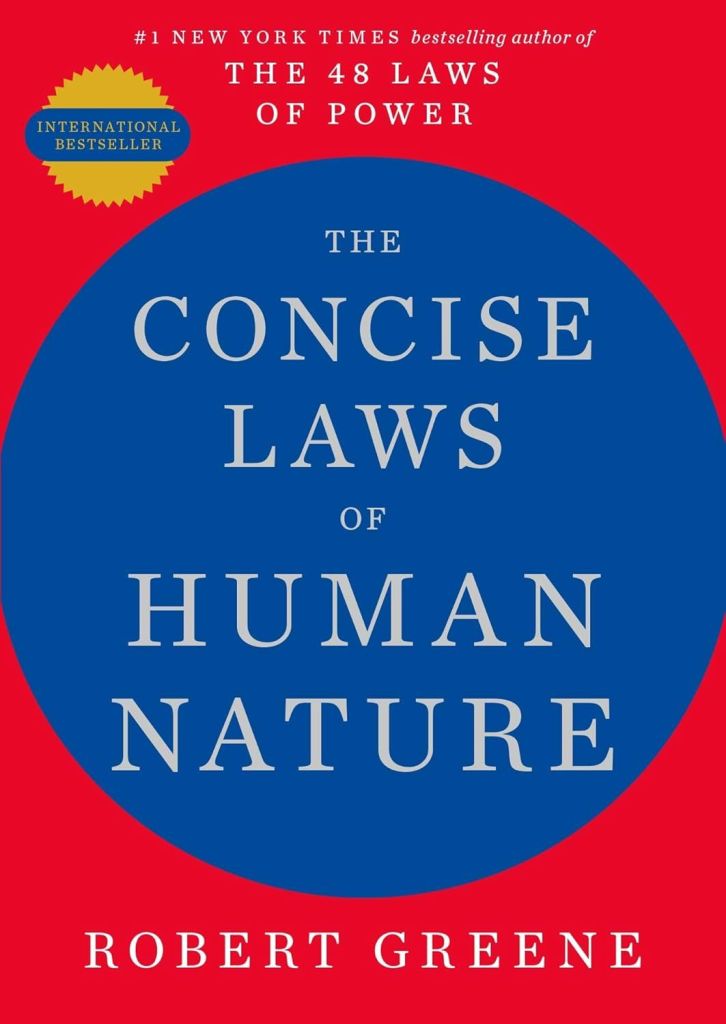
The Laws of Human Nature

The Laws of Human Nature: Narcissism, Envy, and the Illusion of Reason

Robert Greene’s The Laws of Human Nature is often misread as a guide to manipulation or personal advantage. In truth, it is something more unsettling: a diagnosis of the psychological forces that quietly govern human behavior while we insist—often passionately—on our own rationality and moral clarity. Greene’s central claim is not that people are evil, but that they are profoundly self-deceived. The greatest danger does not come from cruelty or malice, but from unconscious patterns masquerading as reason.

At the core of Greene’s psychological framework lie three forces that shape nearly all human interaction: narcissism, envy, and irrationality. These are not pathological exceptions; they are the default conditions of the human psyche. Civilization merely teaches us how to disguise them.

The Myth of the Rational Human Being

Greene begins by dismantling one of modernity’s most cherished illusions: that humans are fundamentally rational actors. We imagine ourselves as thinking creatures who occasionally feel too much. Greene reverses this assumption. We are emotional beings who occasionally think—and mostly think in service of our emotions.

Reason, in this view, is not a guiding faculty but a post-hoc narrator. We feel first, act second, and explain ourselves third. The explanations sound coherent, ethical, even logical—but they are stories we tell to protect our self-image. This illusion of rationality is especially dangerous because it blinds us to our own motives while sharpening our judgment of others.

Greene’s insight echoes Freud’s model of the ego as a mediator rather than a ruler, but he strips away clinical neutrality and replaces it with social consequence. Irrationality is not merely an inner problem; it is the engine of conflict, misunderstanding, and power struggles. The more convinced people are of their rationality, the less control they have over themselves.

Narcissism: The Hidden Center of the Self

Among Greene’s most penetrating contributions is his treatment of narcissism, which he reframes not as a personality disorder but as a spectrum on which nearly everyone falls. Narcissism, in Greene’s definition, is not vanity—it is emotional self-absorption. The narcissist is not someone who loves themselves too much, but someone who cannot see beyond themselves clearly enough to love others at all.

Healthy narcissism allows for self-cohesion and ambition. Unhealthy narcissism, however, emerges when early emotional needs go unmet, producing adults who constantly seek validation, control, or admiration to stabilize a fragile inner world. Such individuals are hypersensitive to slights, obsessed with status, and incapable of genuine empathy—not because they are cruel, but because they are perpetually defending themselves.

Greene’s warning is subtle: narcissists are not always loud, charismatic, or obvious. Some appear selfless, moral, even sacrificial. What defines them is not ego display but emotional hunger. They take more than they give, drain energy from relationships, and unconsciously bend reality to serve their needs.

More disturbingly, Greene insists that narcissism is contagious. People orbit narcissists hoping for approval, meaning, or reflected importance, slowly surrendering their own emotional autonomy. In this sense, narcissism is not merely an individual flaw but a social phenomenon—one that shapes institutions, movements, and even moral crusades.

Envy: The Emotion We Refuse to Name

If narcissism is the gravitational center of the self, envy is the emotion that corrodes it from within. Greene treats envy as the most denied, most dangerous of human emotions precisely because it is so socially unacceptable. Anger can be justified. Fear can be admitted. Sadness can be shared. Envy, however, must be disguised—usually as moral judgment.

Envy arises not from lack, but from comparison. It flares most intensely among peers—friends, colleagues, siblings—where differences feel personal rather than abstract. The success of someone close threatens not only status, but identity. It raises the unbearable question: Why them, and not me?

Greene’s insight is that envy rarely announces itself. Instead, it mutates into criticism, passive aggression, false concern, or sudden moral outrage. We do not say, “I envy you.” We say, “You’ve changed,” or “You don’t deserve this,” or “I’m just worried about you.”

In Greene’s psychological universe, envy explains betrayals that seem disproportionate, conflicts that erupt without clear cause, and the peculiar pleasure people take in the downfall of those they once admired. Envy is not loud; it is patient. It waits for weakness.

What makes envy so corrosive is that it operates beneath conscious awareness. People sincerely believe in the justifications they invent. The moral mask is not strategic—it is self-protective. To admit envy would collapse the self-image of fairness, generosity, and rational judgment.

Irrationality and the Tyranny of Emotion

Narcissism and envy feed into a broader force Greene sees as inescapable: irrationality. Human beings are pattern-bound, emotionally reactive, and deeply resistant to change. We mistake consistency for character and habit for truth.

Greene identifies recurring emotional traps: compulsive behavior, confirmation bias, emotional contagion, and the tendency to repeat unresolved childhood dynamics in adult relationships. These patterns persist not because people are foolish, but because the psyche seeks familiarity over growth. Pain we recognize feels safer than uncertainty.

Irrationality also explains why intelligence offers no immunity. Highly educated individuals often rationalize more skillfully, constructing elaborate frameworks to justify impulses they do not understand. In this sense, intelligence can deepen irrationality rather than dissolve it.

The tragedy is not that humans are irrational, but that they refuse to accept it. This refusal produces moral arrogance, political extremism, and personal blind spots. Greene’s realism is bleak but consistent: self-deception is not a flaw we overcome—it is a condition we manage.

Empathy Without Illusion

Greene proposes empathy as both remedy and risk. True empathy requires seeing others as emotionally driven, wounded, and inconsistent—not as villains or heroes. This kind of empathy is demanding because it strips away comforting narratives. It requires patience, restraint, and emotional distance.

Yet Greene’s empathy is not sentimental. It does not ask us to excuse destructive behavior or sacrifice ourselves to it. Instead, it asks us to understand patterns so we are not unconsciously drawn into them. Empathy becomes a form of self-defense.

This approach introduces an ethical tension that Greene never fully resolves: does understanding people make us kinder, or simply more effective at navigating them? The answer depends less on Greene’s framework than on the moral maturity of the reader.

Power, Freedom, and the Cost of Clarity

Ultimately, The Laws of Human Nature is not about domination, but freedom from illusion. Greene does not promise happiness, harmony, or moral purity. He offers something more austere: the ability to see clearly.

But clarity has a cost. To recognize narcissism in oneself is unsettling. To detect envy in one’s judgments is humiliating. To accept irrationality as permanent rather than temporary is destabilizing. Greene’s realism dismantles comforting myths about progress, virtue, and self-knowledge.

In contrast to romantic literature, where suffering deepens the soul, Greene suggests that suffering more often entrenches patterns. Trauma does not ennoble; it conditions. Without awareness, people repeat what they hate.

A Psychology for a Disenchanted World

Greene’s work resonates because it speaks to a cultural moment defined by performative virtue, emotional reactivity, and moral certainty. In such an environment, the refusal to acknowledge narcissism, envy, and irrationality becomes socially rewarded. Outrage replaces introspection; identity replaces self-examination.

The Laws of Human Nature stands apart by insisting that the most dangerous lies are the ones we tell ourselves. It offers no redemption narrative, only responsibility. To understand human nature is not to transcend it, but to move through it with humility, restraint, and awareness.

Greene does not ask us to be better than others. He asks us to stop pretending we already are.

Receipts II

Receipts II

I am a cool guy, I ain’t got beef with anyone. I serve up what you give out. If you treat me good and with respect you’ll receive that a thousand fold, but if you an asshole I am happy to dish out shit. No excuses, no privileges, control yourself. I am a pro at your passive aggressive antics – what? Did you honestly think that you were smarter than everybody else? Funny guy, out of sync, you ain’t shit. I see through disguises too, masks can’t fool real eyes. If you want beef I am happy to serve it on a platter. If you organizing a hit, make sure it sticks cause if you botch it, I am coming for your soul. I am tired of being humble, I am the greatest of all time, come close and I’ll show you, anytime, any place. Receipts, receipts, receipts I am happy to reflect your tastes. If you want a battle, I am happy to oppose you. Words don’t count, it’s your actions that are gold. I am a fucked up person too and I am ready to exercise my repressions. Receipts, apologies don’t mean much prepare yourself for my comeback. I hold grudges, I never forget and I am coming for your ass. Receipts, don’t start wars you can’t finish. No negotiations, no treaties, everything will end up in fire and smoke. Cause I don’t give a shit, I am narcissistic, grandiose, egotistic, irrational and envious, so please give me an opportunity to exercise my nature. Receipts, cross the line please, I am begging you! Disrespect me, slander me, make me the scapegoat and I’ll show you why I am the goat. Receipts, receipts, receipts you on an imaginary pedestal, time to take you down and humble ya. Receipts, cause I also don’t care, I am after power, I am merely a reflection of you.

Lord Jesus Christ

Lord Jesus Christ

Lord Jesus Christ is one of the few people in history who had a consciousness that calibrated at 1000 energy level. He was an enlightened man. He preached the word of love and peace. Even when death stared him right in his face, he embraced it and mastered the art of dying. On the cross, when he was tortured and beaten ceaselessly he prayed for the forgiveness of man – he prayed for mankind. He didn’t feel sorry for himself. He didn’t ask God why me. He didn’t ask for God to save him, he never asked God to show himself. He was accepting of his fate. I think that’s remarkable. He had reason. He had willingness. He was wise. Socrates another enlightened individual who was killed for supposedly corrupting the youth of Greece shared the personality traits of Jesus Christ. When he was trialed, he refused to defend himself. He just let things be. He had a willingness about his fate. He was accepting. He had reason and he perfected the art of dying. He was at peace with everything. He was happy and ready to die. He had done everything he could do for humanity. He shared his wisdom. He made people aware and self-critical of themselves. He got people thinking and talking about their ideas. He knighted Plato and Aristotle with his wisdom and knowledge and still had the presence of mind to state that the wise man is the man who admits that he does not know anything. Incredible insight! He also preached love and peace for humanity. It seems as though humanity has a problem with enlightened figures.

Life is energy. Life is information. It seems as though Jesus Christ and Socrates had the right frequency. They were one with life. They were grounded in the reality of life. Psychoanalyst Carl Jung stated that the “psyche” which means spirit or soul comprises of the consciousness, personal unconsciousness and collective unconsciousness. Collective unconsciousness is the spirit of everything in life, it is the pulse of life, it is the culture and period we are born in to, it is the different ecosystems of the world, it is our collective consciousness as life that is hidden but dictates everything that we do unconsciously every minute and moment of life. Figures like Jesus Christ and Socrates understood this fundamental aspect of the reality of life and that enabled them to have courage. Through courage, they learned to stay neutral and open, seeing and experiencing life with new eyes every day. Now that they had courage and neutrality they had the confidence of partaking in life, they had the willingness to live and share their experiences with life. They grew to understand and accept being with all of its conditions and structures. Through acceptance they learned how to reason. Through reason they discovered the most fundamental aspect of life – namely love, for love nourishes the soul of the universe. Love has a positive frequency that exuberates when emitted. Love unites. Love is the one single force that has the power to change the world. They understood that only love brings true joy and fulfillment in life. Through love and joy, you can find peace. Peace is a beautiful phase to reach because it entails that you are one with the pulse of life. Peace entails freedom. At the conscious level of peace, death is not repressed but rather in the open. You are aware that it might happen any day and you are content with it. Peace is an encounter with pure and unadulterated happiness. And through peace, you find enlightenment. The world follows people like Lord Jesus Christ, Socrates and Lord Buddha among others because of their status of being enlightened – and it’s useful because they make us better individuals, they bring us solace, they lift the burden of existence from our shoulders. Their lives are dedicated to the salvation of all humanity.

Existence is a burden. Existence is a challenge. Life consists of suffering, boredom and death. This is a fact, it is a fate we all share. Depression and nihilism are and have always been the epidemics of the world. We see this in the 20th century, where people like Adolf Hitler, Joseph Stalin and Mao ran totalitarian regimes. It was bad. We came close to extinction. People were killed for entertainment, for fun, to generate statistics. Joseph Stalin, once stated “one death is a tragedy, but a million deaths a statistic.” These were men with no moral compasses. They tortured human beings for experiments. They tortured human beings for their amusement. They were men overly intoxicated with power. They were egotistical and narcissistic men. They were men with deep underlying insecurities. The world was run by Pride and pride calibrates at a conscious energy level of 175. Pride is dangerous. Pride is critical. Pride is blind. Pride is Shame. Pride is guilt. Pride is confusion. Pride is fear. Pride is hatred. Pride is hopelessness. Pride is falsehood. The lack of a campus resorts in a man operating in the lower levels of consciousness. Life starts when you operate at a conscious energy level of 200. The level of 200 is courage. Below the conscious energy level of 200, is all things run by the amygdala, it is survival and fear driven. War generated this atmosphere of dog eat dog world – a world where nobody was save.

It seems as though Christianity is a good idea. Lord Jesus Christ dedicated his life for the betterment of humankind. He was an enlightened man and his ideas calibrated at 1000. Christianity managed to do the impossible. It proclaimed that every man is equal regardless of status positioning, wealth, gender and race. It gave women rights in a world where they had none. Somehow, it managed to level us all. It preached the importance of love and the idea of sharing. The concept of sharing is a very sophisticated idea for it teaches one about the delay of gratification. The idea that if I had two pieces of steaks and only needed one, I can give one steak to my neighbor with the realization that one day in the future my neighbor might give me a piece of steak when I had none. It is a concept that teaches you how to negotiate with time. Through the crucifixion of Christ, it taught us that life is suffering, it taught us about love and gave us the assurance that everything will be alright. It taught us peace and taught us how to embrace life and death. It even created a Utopia, a heaven to help us with the process of dying and to give solace. Christianity taught us how bring our hopes and dreams into the world by means of praying. Praying is another sophisticated concept where you concentrate all your forces and energy into something in hopes of bring it to life. Energy is involved in the process of praying so it brings it out into the universe, into life, the world. Because you prayed for it, it exists in the world – all you need to do is to put some more energy into it and it will reflect on to the world. Praying is the law of causality – isn’t it a beautiful concept? Christianity and the ideas of Lord Jesus Christ should be practiced for the improvement and perfection of one’s soul. Christianity is an extremely subjective practice. Its insistence is on the spirit of the individual. If a few individuals are regulated and fulfilled, it generates a ripple effect by virtue of association making everybody happy and fulfilled. A positive wave length is contagious!

There is a story in the bible about brothers Able and Cain. They are the children of Adam & Eve. The first humans ever. Adam and Eve were created by God whereas Able and Cain are the byproducts of Adam and Eve. It tells the story about how God was happy about one brother’s (Able) contribution and unhappy about another’s (Cain). Cain does everything to impress God but he does it in vain as he is met with Gods disapproval. Whereas his brother Able impresses him with ease, without much effort. This makes Cain grow resentful and angry towards his brother Able. Worse, is that Able is genuinely a good person, everyone likes him and women always want to be around him. Cain cannot find fault with him, his authentic and perfect and that makes him grow even more resentful and angry towards his brother. His resentment and anger leads him to Satan and he is drawn to Hell. Cain overpowered by emotions of envy, jealously and anger decides to kill Able. He does it to spite God, to spite the world by killing everything he wants to be. How did things become so rife? Everyone has a contract with God and you fulfill your contract by being you, by doing the things that come natural to you, by being authentically individualistic. By being yourself, you honor God and it pleases him, he becomes happy about your contributions. Cain was so envious of his brother that he didn’t honor his contract with God. He was not an individual. He lacked a self-campus. He wanted to be like his brother and that displeased God because he didn’t create a replica of Able. God also wanted Cain to be himself, to self-actualize, to impose himself on the world and show his true character and virtues. God wanted Cain to honor him by becoming himself. However, Cain’s heart was tainted and impure. Once he started having resentful thoughts about his brother, they took a life of its own. By continuously having these thoughts, he fed the beast until it lead him to a point of no return, Satan – Hell. Satan is not a red beast with horns on his forehead just like how Hell is not a place filled with fires and demons. Hell is a state of mind and you get there by feeding negative emotions. Negative emotions are not conducive to life. They are destructive and inhospitable. One must always aspire to go to Heaven. Heaven is a fertile place for growth. Love lives in heaven and there’s progression and growth. Heaven is stimulating and conducive. Heaven is the state of mind we should all strive to be in.

The two brothers were in two completely separate wavelengths. They were in two different worlds. One brother was in Heaven while the other was in Hell. One brother was with God while the other was with Satan. It is a useful story because it educates us about envy and self-actualization. Envy calibrates lower than 200 energy level. It is primitive and destructive. Envy is vain and self-sustaining, it feeds off other negative emotions and energy levels. Envy is unintelligible and insecure. Envy is prideful and hopelessness. Self-actualization on the other hand is above the conscious energy level of 200. Self-actualization is courage. Self-actualization is learning. Self-actualization is willingness. Self-actualization is reason. Self-actualization is freedom – the ability to embrace God and thank him for the gifts that he has bestowed upon you. Self-actualization is enlightenment, the process of knowing your purpose in life and fulfilling it. Self-actualization is the most beautiful thing God has given to us. We should strive to become who we could be and negate the external factors of the world. We should be truthful to ourselves at all times. That’s how we give praise to God. That’s how we show him that we are grateful for the gift of life. That’s where Christianity comes in, God has given us his son Jesus Christ to teach us about the virtues of life. He gave us Jesus Christ to enlighten us, to make us pure, to give us hope, and to complete that void in our hearts. I am not talking about organized religion, organized religion has made a mockery of the Christian doctrine, it has polluted and stained its ideas, it is the reason for the nihilism and depression in our world, it is the reason we are devoid of goals! I am talking about subjective Christianity, Christianity for your spirit and soul as an individual, for yourself. I am talking about Christianity as an ideal we should strive for!

Energy Level Calibrations:
Energy Level: 20 Shame
Energy Level: 30 Guilt
Energy Level: 50 Apathy
Energy Level: 75 Grief
Energy Level: 100 Fear
Energy Level: 125 Desire
Energy Level: 150 Anger
Energy Level: 175 Pride
Energy Level: 200 Courage
Energy Level: 250 Courage
Energy Level: 310 Willingness
Energy Level: 350 Acceptance
Energy Level: 400 Reason
Energy Level: 500 Love
Energy Level: 540 Joy
Energy Level: 600 Peace
Energy Level: 700 – 1000 Enlightenment

Buy the great man Coffee :https://www.buymeacoffee.com/Antakalipa