
Midnight in Parys: A Meditation on Life, Death, Compassion and the Human Heart
There are evenings in the theatre that entertain. There are evenings that impress. And then there are evenings that stay with you long after the curtain call, following you home, lingering in your thoughts, demanding reflection and conversation.

Midnight in Parys, the latest play by South African theatrical giant Paul Slabolepszy, belongs firmly in that final category.

Presented at the intimate Studio Theatre of Pieter Toerien’s Montecasino Theatre complex and directed with precision and sensitivity by Bobby Heaney, this production is a triumph of writing, performance and humanity. Starring Bianca Amato and Paul Slabolepszy himself, Midnight in Parys is at once thoughtful, witty, heartbreaking and profoundly compassionate. It is a play that refuses easy answers while offering something perhaps even more valuable: understanding.
For those fortunate enough to have attended the opening performance, the experience felt less like watching a play and more like being invited into the private lives of two deeply complex individuals whose stories slowly unfold before us.
And what stories they are.
The Master at Work
Paul Slabolepszy occupies rare territory within South African theatre.
Over decades he has built a body of work distinguished not by spectacle or gimmickry but by his unwavering commitment to character. His greatest gift as a playwright has always been his ability to write people rather than archetypes.
His characters breathe.
They contradict themselves.
They make mistakes.
They carry wounds.
They reveal truths accidentally.
They hide behind humour.
They speak the language of real human beings.
In Midnight in Parys, Slabolepszy demonstrates once again why he stands among the most important playwrights South Africa has ever produced. The play’s dialogue is rich with wit, observation and emotional intelligence. Every revelation feels earned. Every conversation feels authentic.
The script trusts its audience.
Rather than overwhelming viewers with exposition, it allows relationships to develop organically. We spend time with the characters. We learn who they are. We begin to understand what motivates them. Then, just when we believe we have figured them out, new revelations emerge that reshape everything we thought we knew.
This is writing of the highest order.
Not because it is flashy.
Because it is honest.

“Thabiso” – A Personal Beginning
The evening began with a moment that immediately established a unique connection.
Early in the performance, the name “Thabiso” is mentioned and explored.
“It means joy.”
For me, that moment landed with unexpected force.
I am Thabiso.
To hear my own name spoken from the stage, and to hear its meaning acknowledged, created an instant bond with the work. It felt personal. It felt intimate.
I was overjoyed.
I was smiling before the story had even properly begun.
And from that moment forward I was completely invested.
Theatre possesses a unique ability to make audiences feel seen. Sometimes this happens through grand themes. Sometimes it happens through a single word.
That brief moment reminded me why live performance remains so powerful.
The stage reached out and shook hands with my own life.
I was hooked from the very beginning.

The Characters: Strangers Who Become Family
One of the production’s greatest achievements lies in its patient construction of character.
As audience members, we do not merely observe these individuals.
We come to know them.
The play grants us access to their fears, regrets, humour and vulnerabilities. Through carefully structured conversations and revelations, layers are peeled away until the audience finds itself emotionally invested in every decision and every confession.
The brilliance of the script lies in the fact that neither character exists simply to advance a plot.
Instead, the plot emerges from who they are.
Their histories matter.
Their choices matter.
Their emotional scars matter.
Their hopes matter.
As the evening progresses, the audience moves closer and closer to them until certain revelations provoke genuine gasps. Not because the twists are sensational, but because they carry emotional weight.
We care.
And because we care, the discoveries hit harder.
Exploring Euthanasia, Dignity and Moral Complexity
At its heart, Midnight in Parys grapples with profound questions.
Among the most significant is euthanasia and the difficult moral territory surrounding end-of-life decisions.
These are not simple issues.
Nor does the play pretend that they are.
Instead, Slabolepszy approaches the subject with remarkable empathy and intelligence. The script explores the tension between suffering and dignity, autonomy and responsibility, compassion and consequence.
It asks difficult questions.
Who gets to decide when suffering has become unbearable?
What does mercy truly mean?
Can helping someone die ever be an act of love?
Where do morality and compassion intersect?
The play offers no simplistic verdict.
Instead, it trusts audiences to wrestle with these questions themselves.
That trust is one of the work’s greatest strengths.
Self-Defence, Survival and Human Choice
The production also explores the concept of self-defence and the circumstances that push ordinary people toward extraordinary actions.
Again, Slabolepszy avoids easy judgement.
His characters are not symbols in an argument.
They are human beings confronting impossible situations.
The audience is invited to consider how individuals respond when placed under pressure and what choices become possible when survival is at stake.
The result is a work that feels deeply humane.
Rather than asking viewers to condemn or excuse, it asks them to understand.
Bianca Amato: A Performance of Extraordinary Depth
Having previously witnessed Bianca Amato in A Doll’s House, Part 2, I arrived with high expectations.
She exceeded them.
Amato delivers a performance of remarkable intelligence and emotional precision. Every line feels considered. Every silence carries meaning. Every gesture reveals character.
She possesses that rare ability to command attention without demanding it.
Her performance unfolds gradually, allowing emotional truths to emerge naturally rather than being forced upon the audience.
As revelations accumulate, she navigates the shifting emotional landscape with extraordinary confidence.
There is tremendous technical skill on display, but what audiences ultimately remember is the humanity.
The character feels real.
Completely real.
And that is perhaps the highest compliment one can offer an actor.

Paul Slabolepszy: The Playwright as Performer
Seeing Paul Slabolepszy perform his own work is a special experience.
The words carry an additional resonance because they originate from the very person speaking them.
Yet what makes his performance memorable is not the novelty of the playwright appearing on stage.
It is the quality of the acting itself.
Slabolepszy brings warmth, vulnerability, humour and emotional authenticity to the role. Decades of theatrical experience are evident in every moment.
His command of timing is masterful.
His understanding of silence is impeccable.
His ability to move between comedy and pathos feels effortless.
This was my first opportunity to watch him perform live.
It was an honour.
It was a privilege.
And it offered a powerful reminder that great playwrights often possess a profound understanding of performance because they understand people.
Bobby Heaney’s Direction
A script this rich requires direction that understands restraint.
Bobby Heaney provides exactly that.
His work never overshadows the material.
Instead, it elevates it.
The pacing allows tension to build naturally. Emotional moments are given room to breathe. Revelations land with impact because the production understands the value of patience.
The direction trusts both the actors and the audience.
In an age where many productions fear stillness, Heaney embraces it.
The result is a production that feels confident, mature and deeply engaging.

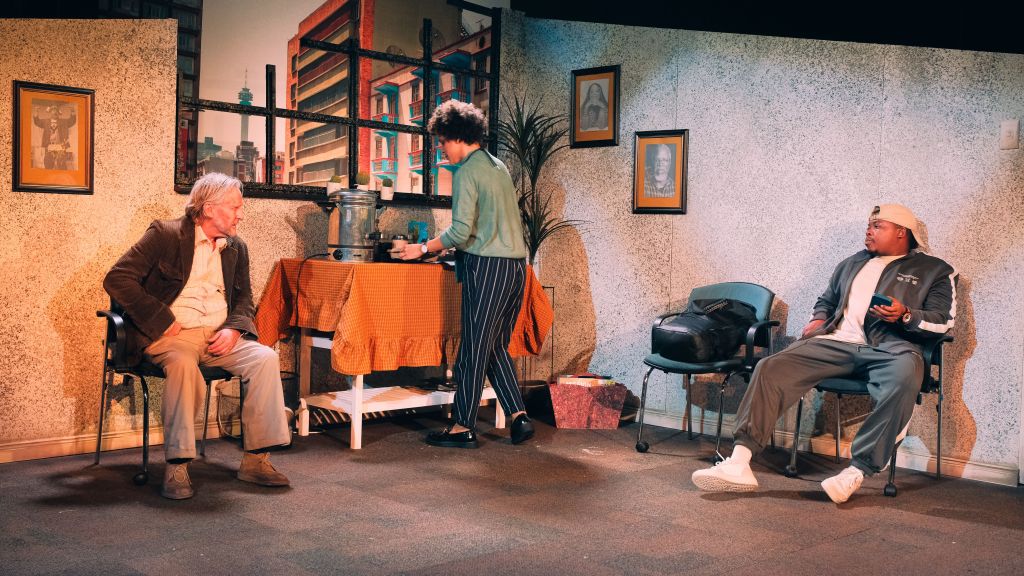
The Set: Intimacy as Strength
The Studio Theatre at Pieter Toerien proves the perfect home for this production.
The intimate environment creates a sense of closeness rarely achievable in larger venues.
There is nowhere to hide.
Not for the actors.
Not for the audience.
Every expression becomes visible.
Every shift in emotion becomes meaningful.
Every silence becomes palpable.
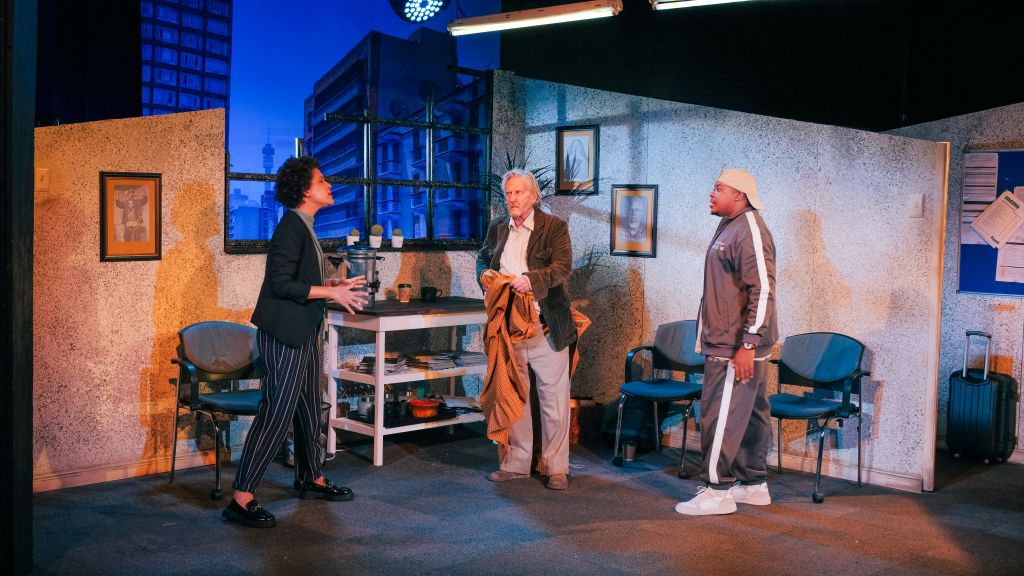
The set design complements this intimacy beautifully.
Rather than distracting from the story, it serves it. The environment feels lived in, believable and emotionally resonant.
The audience is not simply watching a location.
They are inhabiting it alongside the characters.

Lighting and Atmosphere
The lighting design deserves special praise.
Subtle and purposeful, it shapes mood without drawing attention to itself.
Changes in tone and emotional temperature are reflected through carefully considered lighting choices that guide the audience’s experience almost subconsciously.
The result is an atmosphere that feels immersive and emotionally textured.
Combined with the intimacy of the venue, the lighting helps create a world that feels simultaneously theatrical and deeply real.

A Play That Understands Humanity
Perhaps the greatest achievement of Midnight in Parys is its empathy.
The play understands people.
It understands loneliness.
It understands fear.
It understands regret.
It understands compassion.
Most importantly, it understands that human beings are rarely simple.
The work does not divide the world into heroes and villains.
Instead, it presents flawed individuals doing their best within circumstances that are often messy and painful.
There is healing in that perspective.
There is comfort in being reminded that complexity is part of being human.
The play feels.
The play listens.
The play understands.
And in understanding its characters, it understands its audience as well.
A Night to Remember
The opening performance of Midnight in Parys was more than an evening of theatre.
It was an encounter with great writing.
Great acting.
Great direction.
And great humanity.

It reminded me why Paul Slabolepszy remains one of South Africa’s theatrical immortals.
It confirmed Bianca Amato’s place among the country’s finest performers.
It showcased Bobby Heaney’s skill as a director of intelligence and restraint.
Most importantly, it demonstrated the enduring power of theatre to bring strangers together and allow them, for a few precious hours, to share in the emotional lives of others.
I attended the performance with SamSays, whose name fittingly appears in the credits, and together we witnessed something special.
Not merely a play.
An experience.
One of the finest days I have spent in a theatre.
A production that challenged, moved and inspired.
A production that left me thinking long after the final bow.
A production that reminded me exactly why we keep coming back to the theatre.
Because sometimes, in a darkened room, surrounded by strangers, we find pieces of ourselves reflected back from the stage.
And when that happens, theatre becomes something more than entertainment.
It becomes joy.
It becomes understanding.
It becomes healing.
It becomes unforgettable.
Congratulations Bobby Heaney for a great show and a deserved standing ovation.
📸 : SamSays



 antakalipa