BULLY – DELUXE

BULLY – Deluxe: Kanye West’s Symphony of Contradiction

There has never been an artist quite like Kanye West. Every album arrives burdened with expectation, controversy and impossible standards. Yet BULLY (Deluxe) refuses to compete with his previous classics. Instead, it exists as a meditation on survival. It is less interested in proving greatness than exposing humanity. The deluxe edition expands upon that vision, adding new collaborations, richer textures and emotional weight while preserving the album’s core identity. It is a record that breathes through silence as much as sound, finding beauty in restraint before exploding into moments of overwhelming intensity.

From the opening notes, BULLY feels cinematic. The production is spacious, often minimalist, allowing every drum hit, synthesizer swell and vocal inflection to linger in the air. Gospel harmonies sit comfortably beside distorted basslines. Soulful melodies dissolve into industrial textures. Rather than chasing radio trends, Kanye builds an atmosphere that feels suspended between heaven and Earth, where faith wrestles constantly with ego, vulnerability and ambition.

The production throughout the album is exceptional. Rather than overwhelming listeners with layers upon layers of instrumentation, the beats often leave deliberate gaps, allowing emotion to occupy the empty spaces. The result is an album that rewards repeated listening. Every return uncovers another harmony, another subtle keyboard line or another vocal detail hidden beneath the surface.

“KING” opens the album like a declaration of intent. The instrumental carries enormous weight without becoming cluttered. Kanye sounds determined, almost defiant, confronting public perception while reclaiming ownership of his own narrative. The song establishes one of the album’s recurring themes: the complicated relationship between power and isolation.

“THIS A MUST” immediately raises the energy. Heavy percussion drives the song forward while sharp synthesizers cut through the mix. The record feels urgent, as though every verse must be delivered before time runs out. Lyrically, Kanye projects confidence, yet beneath the bravado lies anxiety. It becomes apparent that BULLY is less about victory than perseverance.

On “FATHER,” Travis Scott proves why he remains one of hip-hop’s most effective collaborators. His atmospheric vocals complement Kanye rather than competing with him. Together they explore fatherhood, legacy and responsibility. The production feels expansive, almost celestial, with echoing vocal effects creating the sensation of voices travelling across an endless sky.

“ALL THE LOVE” is among the album’s warmest moments. André Troutman’s soulful presence softens the edges of Kanye’s delivery. Rich harmonies float over understated percussion while the lyrics reflect on forgiveness, gratitude and the complicated nature of unconditional love. The song demonstrates that vulnerability can possess its own quiet strength.

Then comes “PUNCH DRUNK,” where emotional instability is translated directly into music. The rhythm stumbles intentionally, melodies drift unexpectedly and distorted textures create an atmosphere of psychological exhaustion. Rather than seeking perfection, Kanye embraces imperfection, allowing discomfort to become part of the artistic experience.

“WHATEVER WORKS” strips everything back. Minimal instrumentation places every word under a microscope. The mood is reflective rather than hopeless, suggesting that survival sometimes requires compromise. The restrained production allows emotion to speak louder than volume ever could.

“MAMA’S FAVORITE” introduces Nine Vicious in a performance filled with warmth and sincerity. Childhood memories, family influence and nostalgia dominate the emotional landscape. Gentle keyboard progressions and layered harmonies create one of the album’s most comforting listening experiences.

“SISTERS AND BROTHERS” broadens the album’s perspective from personal reflection to collective identity. Gospel influences become more pronounced, transforming the song into something resembling a communal prayer. Voices intertwine beautifully, reinforcing themes of unity, compassion and resilience.

The title track, “BULLY,” confronts Kanye’s public image head-on. Featuring CeeLo Green, the record balances confrontation with introspection. CeeLo’s unmistakable soulfulness provides emotional gravity, while Kanye examines power, conflict and the emotional armour built through years of public scrutiny. The production shifts constantly between aggression and calm, mirroring the psychological tension within the lyrics.

“HIGHS AND LOWS” perfectly captures emotional fluctuation. The arrangement rises and falls naturally, moving between moments of triumph and melancholy. Rather than presenting stability, Kanye embraces contradiction. Happiness and despair exist side by side, often within the same verse.

If there is one song that defines the Deluxe edition, however, it is “I Can’t Wait.”

Ms. Lauryn Hill’s appearance is nothing short of extraordinary. Her voice carries a wisdom earned through experience, adding a timeless quality to the composition. She does not overpower Kanye; instead, she completes him. Their performances feel conversational, each voice answering the other with remarkable emotional sensitivity.

The production surrounding Lauryn is deliberately understated. Warm keyboards, restrained percussion and subtle harmonies allow her vocal phrasing to become the emotional centrepiece. Every note feels intentional. Every pause carries meaning. The song explores longing, hope and emotional patience, becoming less about waiting for another person than waiting for personal healing. Lauryn’s contribution elevates the song from excellent to unforgettable, reminding listeners why she remains one of music’s most respected artists.

“WHITE LINES” returns to darker sonic territory. André Troutman’s haunting vocals drift through an atmospheric landscape filled with uncertainty. The production feels dreamlike, reflecting themes of temptation and blurred moral boundaries.

“CIRCLES” is built upon repetition both musically and emotionally. Chord progressions loop continuously, reinforcing the idea that people often repeat the same mistakes despite recognising them. The song becomes an exploration of emotional cycles from which escape proves remarkably difficult.

Then arrives “PREACHER MAN,” unquestionably the spiritual spine of BULLY.

Everything about the record feels sacred. The measured pacing resembles a sermon delivered before a silent congregation. Gospel influences are present without overwhelming the composition, while Kanye’s restrained delivery communicates conviction more effectively than shouting ever could. The production leaves enormous spaces between musical phrases, allowing every word to resonate. It is a song about accountability, redemption and the constant struggle between earthly ambition and spiritual purpose. Even within the Deluxe edition, where new songs compete for attention, “Preacher Man” remains untouchable.

“BEAUTY AND THE BEAST” explores love through contradiction. Tender melodies coexist with unsettling production choices, reinforcing the idea that beauty and destruction frequently occupy the same emotional space.

“DAMN” is among the album’s rawest moments. Stripped-back instrumentation exposes every crack in Kanye’s performance. Rather than hiding imperfection, the song embraces it, creating one of the record’s most emotionally honest experiences.

“LAST BREATH,” featuring Peso Pluma, introduces fresh melodic textures while reflecting upon mortality and legacy. The collaboration succeeds because both artists understand restraint, allowing atmosphere to speak as loudly as lyrics.

“THIS ONE HERE” feels almost conversational. Without relying on spectacle, Kanye delivers one of the album’s most intimate performances, demonstrating that simplicity can often be more powerful than excess.

Don Toliver’s appearance on “OK” injects a sense of optimism into the closing stretch of the album. His melodic instincts complement Kanye beautifully, producing a hypnotic record filled with warmth and subtle emotional uplift.

The closing track, “MISSION CONTROL,” serves as a fitting finale. The futuristic production evokes the sensation of leaving one world behind in search of another. It concludes the album not with certainty, but with possibility.

The Deluxe edition also benefits from an impressive roster of contributors. Travis Scott, Ms. Lauryn Hill, André Troutman, Don Toliver, CeeLo Green, Peso Pluma and Nine Vicious each leave distinct artistic fingerprints on the project. Behind the scenes, Kanye’s production continues to blend gospel, soul, hip-hop, industrial music and electronic minimalism into a cohesive sonic identity. Throughout the album, carefully selected samples and interpolations honour earlier musical traditions while transforming them into something unmistakably modern.
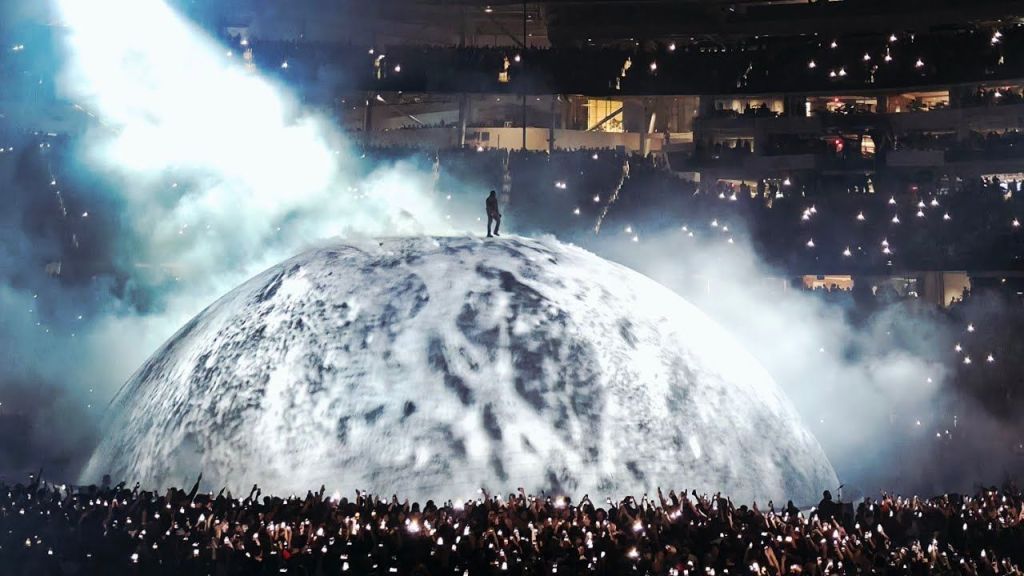
Beyond the studio recordings, BULLY found its ultimate expression at SoFi Stadium. Before more than eighty thousand spectators, Kanye stood atop a massive illuminated globe suspended above the stage, creating one of the most visually striking concert productions of the decade. The globe symbolised perspective, isolation and universality all at once. Every movement across its surface felt choreographed with cinematic precision.

The concert itself unfolded like a theatrical production rather than a conventional hip-hop performance. Towering visuals, immersive lighting, smoke, fire and panoramic projections surrounded the audience, creating an experience that blurred the boundaries between music, fashion, architecture and performance art. Guest appearances from collaborators enriched the spectacle, while songs from BULLY sat comfortably alongside classics from The College DropoutGraduation808s & HeartbreakMy Beautiful Dark Twisted FantasyYeezusThe Life of Pablo and Donda. Rather than relying solely on nostalgia, Kanye demonstrated how every chapter of his career contributes to one evolving artistic vision.

Ultimately, BULLY (Deluxe) succeeds because it refuses easy answers. It is confident without becoming arrogant, vulnerable without becoming sentimental and experimental without abandoning musicality. The Deluxe edition strengthens an already compelling project through carefully chosen additions rather than unnecessary excess.

Most importantly, it leaves listeners with two unforgettable pillars. “Preacher Man” remains the album’s moral and spiritual foundation, a record that anchors the entire journey in faith and introspection. “I Can’t Wait,” meanwhile, becomes its emotional summit. Ms. Lauryn Hill’s remarkable performance transforms the song into something timeless—a reminder that true greatness often arrives not through spectacle, but through sincerity.

Like the man who created it, BULLY (Deluxe) is imperfect, provocative, ambitious and endlessly fascinating. Whether embraced as hip-hop, gospel, performance art or autobiography, it stands as another compelling chapter in Kanye West’s extraordinary career.

BULLY

Bully: Reverence for Ye, or The Art of Loving a Villain

There is no clean way to love Kanye West anymore.

There is no neutral position, no safe distance, no polite cultural posture that allows you to consume the music without also inheriting the chaos that trails behind it like smoke from a burning cathedral. To press play on Bully is to knowingly enter a contradiction — to nod your head to brilliance while your conscience shifts uncomfortably in the background.

And yet… the music plays.

And it is undeniable.

I. The Return of the Architect

Bully does not feel like a reinvention. It feels like a convergence. Kanye is not searching here — he is assembling. This is not the frantic futurism of Yeezus, nor the maximalist confession of My Beautiful Dark Twisted Fantasy. This is synthesis. A man pulling from every era of himself — the soul-sampling disciple, the Auto-Tuned romantic, the industrial provocateur, the gospel convert, the digital warlord — and compressing them into a single, volatile body of work.

It is Kanye as archive.

And more importantly, Kanye as refusal.

Refusal to be contained. Refusal to be corrected. Refusal to be forgiven on anyone else’s terms.

II. Preacher Man — The Gospel That Survived

“Preacher Man” stands as the album’s spiritual spine. The fact that it survived the revisions, the deletions, the re-uploads — that it endured — feels symbolic. It is the one moment where Kanye sounds less like a provocateur and more like a vessel.

The production breathes. Organs swell like confession. The drums don’t knock — they testify.

He sounds weary, but certain. Like a man arguing with God in real time:

“I was talkin’ to the mirror, but the mirror talked back / Said you built your own cross, now you carry that”

There is something almost cruel about how beautiful it is.

Because it reminds you: this man can choose grace.

He just doesn’t always.

And maybe that’s the tension that makes the song feel sacred — not purity, but proximity to it.


Track Breakdown I — Opening Run

1. King
The coronation — or self-coronation. Kanye opens Bully not asking for the throne but declaring ownership.

“They tried to exile me, I built a kingdom in the fire”

The production is triumphant but uneasy. Victory with smoke still in the air.

2. This a Must
Urgent. Declarative. This feels like survival music.

“This a must, I don’t move unless it’s God-touched”

Minimal drums, sharp cadence — Ye rapping like he has something to prove again.

3. Father (feat. Travis Scott)
Dark, cinematic, generational. Travis floats like a ghost in Ye’s lineage.

“Generations in my bloodline, I don’t die, I multiply”

The production feels ancestral — drums like ritual, synths like memory. The video elevates it into mythology.

4. All the Love
Deceptively warm. Soulful textures.

“All the love I gave came back fractured”

A meditation on reciprocity — and how love mutates under fame.

III. Heil Hitler — The Sound of Transgression

Let’s not pretend.

“Heil Hitler” is the moment everyone will point to — the line that gets quoted, the clip that circulates, the justification for outrage. And they will not be wrong.

But musically? It is a monster.

The beat lurches forward like a war machine. The bassline feels militarized. His delivery is cold, detached, almost theatrical — like a man fully aware that he is stepping into villainy and choosing to lean in.

“Say the name they fear, now I own the fear / Turn the hate to power, make the whole world stare”

It is uncomfortable to admit that it sounds this good.

But that discomfort is the point.

Kanye has always understood that transgression sells louder than confession. Here, he weaponizes that understanding. He dares you to enjoy it. He forces you to confront the possibility that you do.

And in doing so, he implicates the listener.


Track Breakdown II — Descent into Villainy

5. Punch Drunk
Disoriented, hazy. The drums stagger.

“Too many hits, I don’t feel straight”

Fame as concussion. Success as disorientation.

6. Whatever Works
Cold pragmatism.

“Morals bend when survival talks”

This is Ye justifying methods — messy, effective, unapologetic.

7. Mama’s Favorite
A return to soul. Warm samples, almost nostalgic.

“Mama said I’m special, the world said I’m a problem”

The duality begins here — loved at home, hated outside.

8. Bully (Title Track)
The thesis. Heavy drums, minimalistic but aggressive.

“I don’t need your crown, I designed the throne”

He positions himself not as participant in culture — but architect of it.

IV. The Chaos Outside the Music

You cannot talk about Bully without talking about everything surrounding it — because Kanye refuses to separate the art from the spectacle.

The anti-Semitic remarks.

The alignment with figures like P. Diddy.

The vile, unnecessary comments about Jay-Z and Beyoncé’s children.

The spiraling public unraveling.

The black KKK-style outfit in that DJ Akademiks interview — a visual that felt less like rebellion and more like provocation for its own sake.

The confession — bizarre, uncomfortable — about his cousin.

The loss of billionaire status.

And then, almost paradoxically, the public apology — a paid ad extended to the Jewish community, an attempt at repair that felt both sincere and insufficient.

This is not just controversy.

This is contradiction as identity.

Kanye West does not oscillate between extremes — he lives in them.

V. Family, Fracture, and Control

There is a quieter violence that threads through Bully, and it lives in the subtext of family.

His fractured relationship with Kim Kardashian.

The public battle over access to his children.

The sense — whether perceived or real — of being shut out, controlled, managed.

You can hear it in the music.

Not always in direct lyrics, but in tone. In aggression. In defensiveness.

In the need to assert sovereignty at all costs.

“No one controls Ye.” That has become both mantra and prison.

VI. The “Father” Visual — Resurrection as Spectacle

The “Father” video — featuring Travis Scott and directed by Bianca Censori — is not just a music video. It is a statement of aesthetic dominance.

It is excessive. Stylized. Almost mythological in its presentation.

“Generations in my bloodline, I don’t die, I multiply”

And then there is the audacity — the digital resurrection, the evocation of Michael Jackson.

Not imitation.

Not homage.

Resurrection.

Kanye does not reference icons — he absorbs them, repurposes them, reanimates them into his own mythology.

It is blasphemous.

It is brilliant.


Interlude — Spectacle as Language

Even outside the music, Kanye continues the performance.

The Grammys appearance — Kanye West and Bianca Censori stepping onto that stage of global scrutiny, with Bianca in a sheer, near-invisible dress — was not fashion.

It was confrontation.

A living headline.

A statement about control, gaze, autonomy, provocation.

The world reacted exactly as expected: outrage, fascination, discourse, obsession.

Kanye understands something fundamental — attention is currency, and controversy is leverage.

The same instinct that fuels “Heil Hitler” sonically fuels moments like this visually.

He doesn’t just make music.

He orchestrates reaction.

VII. Bully V1 vs The Revision — Fear and Faith

When Bully V1 disappeared from YouTube, it felt like sabotage.

Not from the outside — from Kanye himself.

Because Kanye has a history of overworking, of revising, of stripping and rebuilding until something loses its original soul.

There was real fear that he would ruin it.

That he would tinker the life out of it.

But the revision doesn’t diminish the album — it sharpens it.

The edges are cleaner. The sequencing feels more intentional. The chaos is still there, but it is directed.

And most importantly — the heart remains intact.

VIII. Reverence for Ye — A Love Letter with Teeth

There is something deeply personal about loving Kanye West as an artist in 2026.

It feels like defending a friend who keeps embarrassing you in public.

Like standing by someone who refuses to make it easy.

The words come out conflicted:

The anti-Semitic comments are too much.

The symbolism is too much.

The behavior is too much.

And yet —

The music is still undeniable.

There is a line that lingers:

“I think I am in a toxic relationship.”

Maybe that is the most honest way to describe it.

Because Kanye makes it difficult to hate him.

Not because he is innocent.

But because he is excellent.


Track Breakdown III — Emotional Core

9. Highs and Lows
Emotional oscillation.

“One day I’m a god, next day I’m a ghost”

The production mirrors the instability — rising synths, falling drums.

10. I Can’t Wait
Impatient, restless energy.

“Future calling me, I can’t sit still”

Feels like ambition refusing to age.

11. White Lines
Ambiguous — could be excess, could be highways, could be both.

“Dancing on the edge, don’t blur the lines”

There’s danger here. Controlled chaos.

12. Circles
Repetition as curse.

“Same mistakes, new melody”

A haunting admission that growth is not linear.

IX. The Philosophy of the Bully

Why call it Bully?

Because Kanye understands power.

He understands dominance — cultural, sonic, psychological.

A bully does not ask for permission.

A bully asserts.

A bully disrupts.

A bully forces the room to react.

And Kanye has spent his entire career doing exactly that.

Sometimes that disruption produces genius.

Sometimes it produces harm.

Often, it produces both simultaneously.

X. The Art vs The Man

This is the question that refuses to go away:

Can you separate the art from the artist?

Kanye’s answer is clear:

No.

He refuses separation.

He collapses the distance between creation and creator until they are indistinguishable.

Which means that engaging with Bully is not passive consumption — it is active participation in a moral paradox.

And everyone has to decide where they stand.

XI. The Sound of Falling in Love Again

There is a line that cuts through everything else:

“I haven’t felt like this about music since Late Registration.”

That is not nostalgia.

That is reawakening.

Because for all the chaos, for all the controversy, for all the damage — Bully does something rare.

It reminds you why you fell in love with music in the first place.

The textures.

The samples.

The layering of voice and feeling.

The sense that someone is not just making songs — they are building worlds.

“No ads in my sound, just the purity / stream my soul, that’s the real currency”

And Kanye, at his best, does not make albums.

He makes experiences.


Track Breakdown IV — Closing Run

13. Preacher Man
Still the spiritual core. Survived every version for a reason.

14. Beauty and the Beast
Duality embodied.

“They love the beauty, but they fear the beast”

Kanye splitting himself in real time — public vs private, art vs man.

15. Damn
Short, sharp, almost like an exhale.

“Everything I built, they tried to bury”

Feels like frustration condensed.

16. Last Breath
Heavy. Reflective.

“If this my last breath, let it echo forever”

Mortality enters the room.

17. This One Here
A closer that feels open-ended.

“This one here for the ones that stayed”

Gratitude, defiance, legacy — all unresolved.

XII. Final Verdict — Album of the Year?

Is Bully the album of the year?

If you judge purely on music — it has a case.

If you factor in everything else — it becomes complicated.

But maybe that is the wrong framework.

Because Kanye West has never been interested in clean victories.

He is interested in impact.

In conversation.

In disruption.

And by that metric?

Bully is already undeniable.

XIII. After the Noise

When the headlines fade.

When the outrage cycles move on.

When the interviews and controversies dissolve into cultural memory.

The music will remain.

That has always been Kanye’s final argument.

That the art outlives the moment.

That the work endures.

And maybe that is the most unsettling part of all.

Because it means we will still be listening.

Still debating.

Still conflicted.

Still moved.

Reverence for Ye.

Not because he is perfect.

But because he is impossible to ignore.

And somehow — against all logic — still impossible to quit.