
Giselle
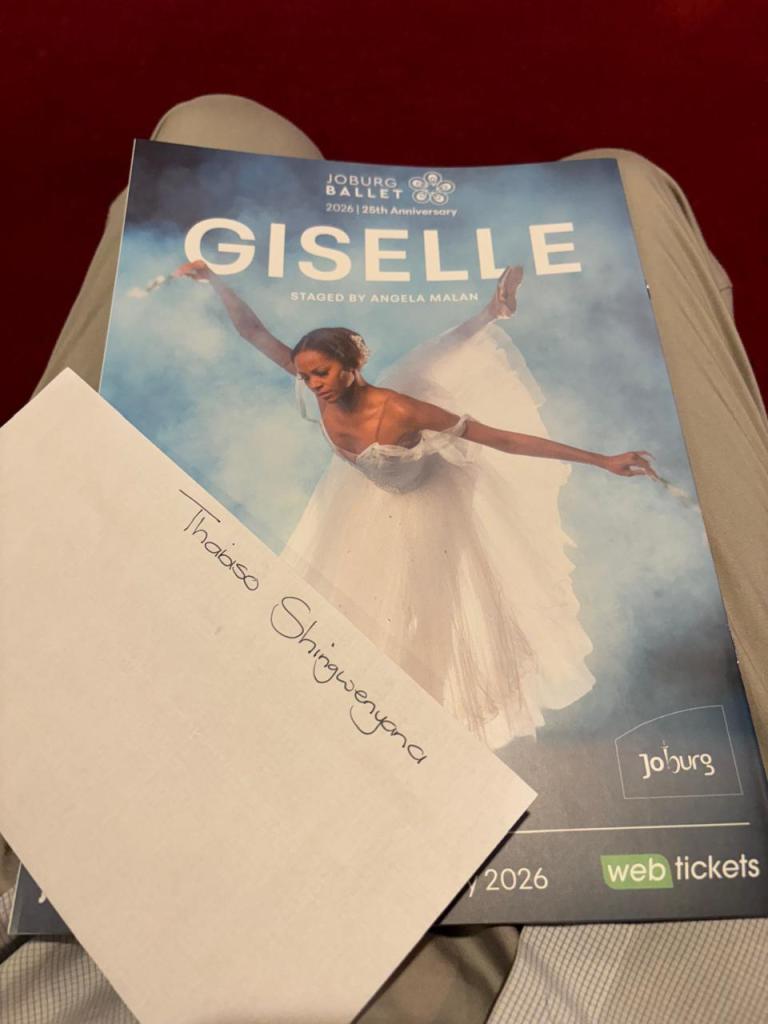
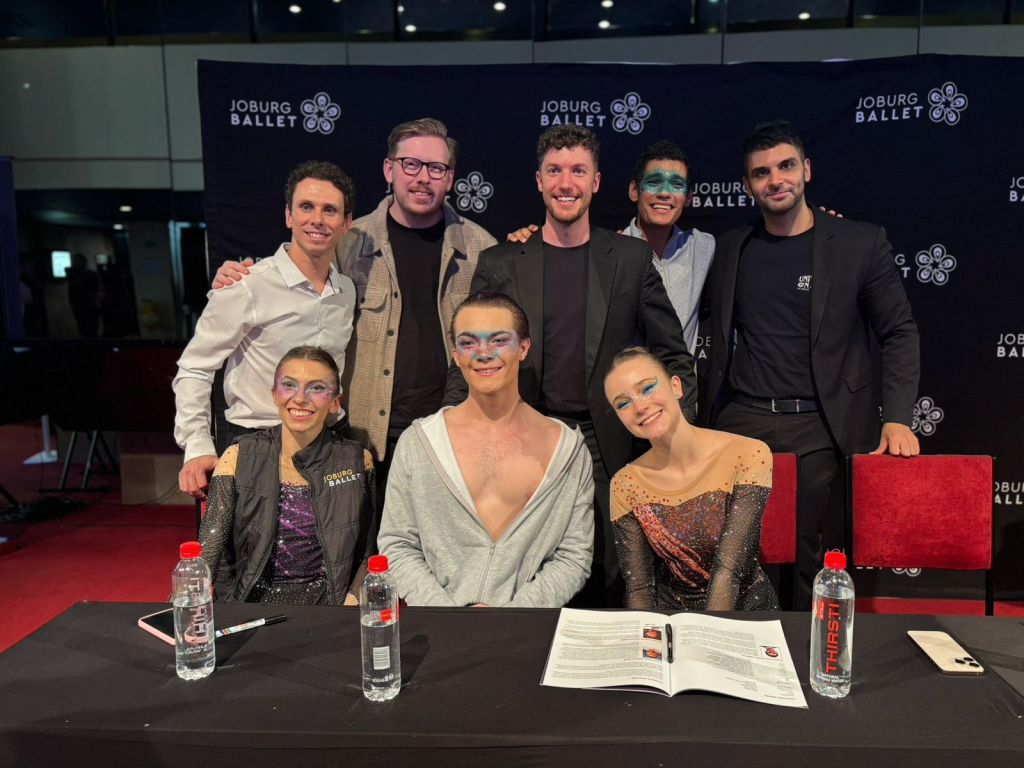
At the Joburg Theatre for the opening of Giselle. Angela Malan curated a masterpiece! I was thoroughly enthralled, the second act was mezmarrizing, Ryoko Yagyu was jumping on her toes, sticked the landing perfect, an impossible task she made look so easy and effortless. She takes my breath away. Monike Cristina is also there. All the dancers were unbelievable! So amazing. We also had a show at Interval, outside the auditorium, getting a drink, chilling, anticipating the final run. It was beautiful, in hindsight the costumes made sense. It was all there.

Happy 25th Birthday, Joburg Ballet!
There are evenings in the theatre when admiration quietly turns into awe — when what unfolds on stage transcends performance and becomes something close to revelation. Experiencing Giselle at the Joburg Theatre was one of those evenings. This cornerstone of Romantic ballet did not merely present technical excellence; it demonstrated the extraordinary capacity of the human body to transform into poetry, illusion, and emotional truth. Through its storytelling, staging, costuming, music, and — above all — the breathtaking commitment of its dancers, the production revealed why Giselle endures as one of ballet’s most cherished works.
Giselle tells a story of love, deception, heartbreak, and ultimately forgiveness — all conveyed through movement rather than spoken dialogue. The narrative unfolds across two acts that feel almost like different universes.
The first act introduces Giselle as a young village girl whose joy lies in dancing, despite a delicate heart. The setting is pastoral and sunlit — a community space where rustic celebration and youthful flirtation shape the choreography. Here, the ballet language is buoyant and playful. The movement vocabulary leans into petit allegro — quick, intricate footwork — and the sensation of ballon, that fleeting suspension where dancers seem to hang weightlessly in the air during jumps.
Through these qualities, Giselle’s innocence and vitality are expressed physically rather than verbally.
Her romance with Albrecht appears idyllic until the revelation that he is a nobleman disguised as a villager. The emotional rupture leads to the ballet’s famed mad scene, where classical structure dissolves into fractured gesture. Steps lose coherence, phrasing becomes unstable, and the choreography mirrors psychological collapse. This culminates in her death, closing the act in tragedy.
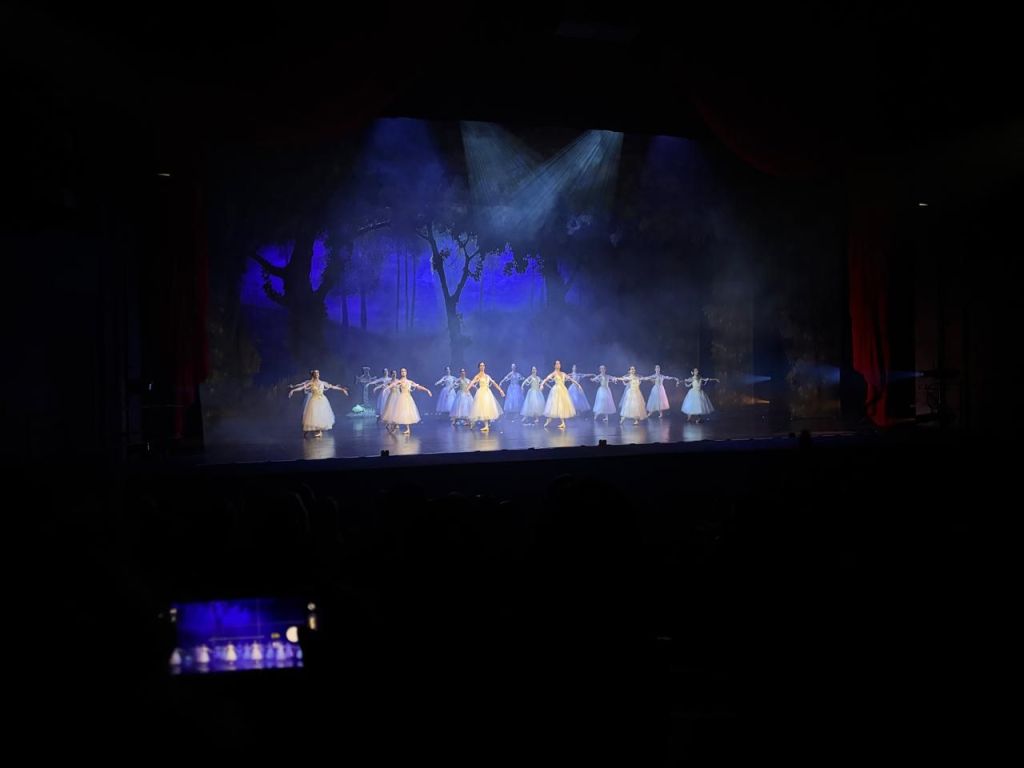
The second act shifts dramatically in tone and aesthetic. The warmth of village life gives way to a spectral forest inhabited by the Wilis — spirits of women betrayed before marriage. Their world is governed by eerie unity and relentless purpose: any man who enters must dance until death.
Giselle, now one of them, retains compassion and protects Albrecht when he arrives. Their duet unfolds as a dance of redemption — sustained, lyrical, and transcendent — lasting until dawn releases him and she returns to the realm of spirits.
For many viewers, this act stands as the emotional and visual pinnacle of the ballet. Its atmosphere is haunting yet exquisite — an embodiment of Romantic ballet’s fascination with the supernatural.
It is not an exaggeration to call it among the most sublime theatrical experiences imaginable. The unity of the corps de ballet, the stillness of the night setting, and the spiritual quality of movement create an almost hypnotic state. It is here that ballet moves beyond narrative and enters something sacred.
The production design reinforces these contrasts. Act I’s sets evoke rustic realism — cottages, earth tones, and a grounded sense of place that situates the audience in tangible human experience. Act II transforms the stage into a dreamscape. Moonlit forests, gauzy depth, and cool-toned lighting dissolve physical boundaries and evoke an intangible world where gravity itself feels suspended.
Costumes play a vital role in shaping this illusion. Peasant garments anchor Act I in reality, while the second act introduces flowing white Romantic tutus — long layers of tulle that blur movement and elongate line. Combined with pale lighting, these costumes make the Wilis appear almost immaterial, gliding rather than stepping. Pointe shoes, extensions of the dancers’ bodies, allow them to rise en pointe, redistributing weight onto the tips of their toes and creating the visual magic of floating motion.
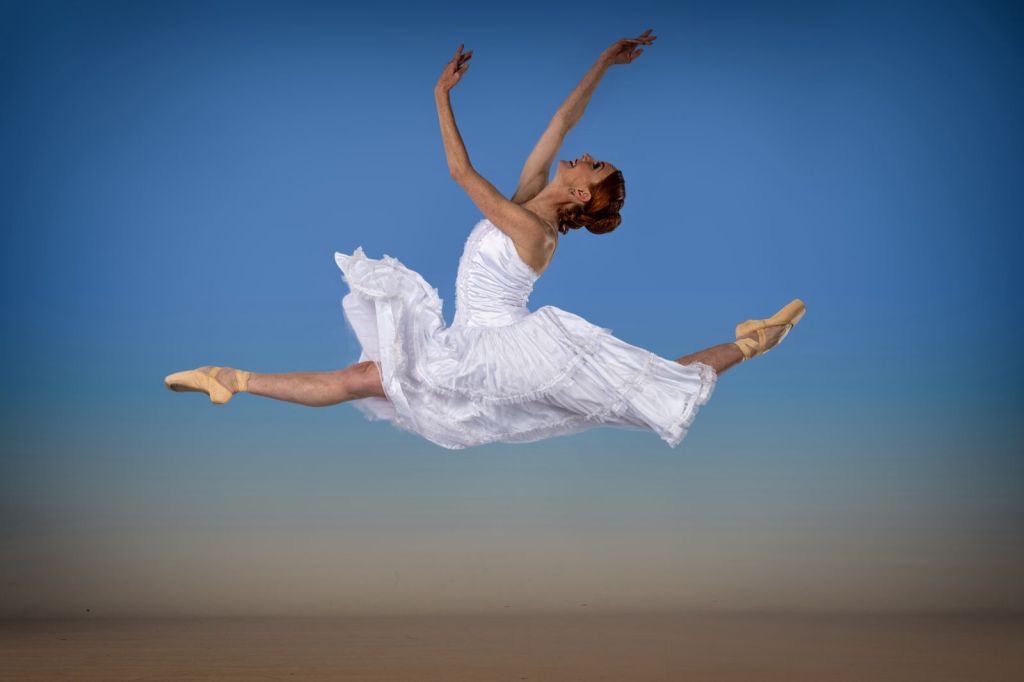
The performance of Ryoko Yagyu in the role of Giselle captured the essence of this illusion. Her physical commitment embodied the discipline behind the beauty. Moments of elevation — rising onto pointe with delicate control — conveyed lightness that seemed to defy anatomy. She appeared to skip and travel on her toes, supporting her entire body on one leg while the other extended cleanly upward at ninety degrees, likely a sustained développé or poised line reminiscent of an arabesque. Witnessing this balance firsthand challenges perception: what appears impossible becomes visibly achievable.
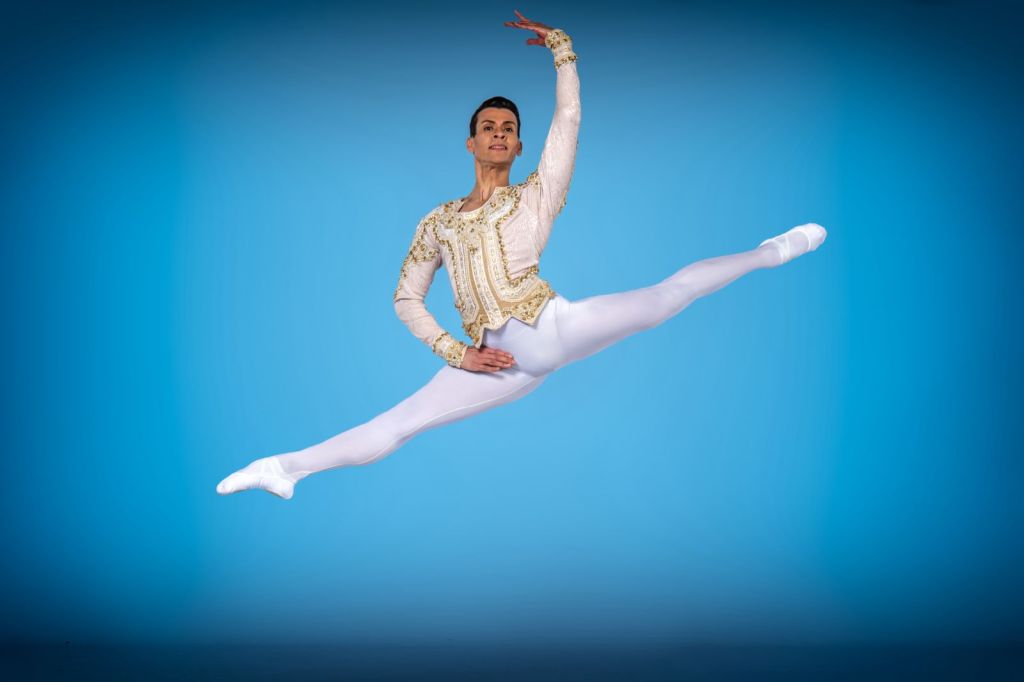
Across the stage, the technical arsenal of ballet unfolded in vivid detail. Pirouettes and chaîné turns carved circular momentum into space. Expansive grand allegro leaps stretched across the floor with amplitude and lift. Extensions opened into splits that emphasized line and flexibility. Yet what lingered was not virtuosity alone, but the seamless masking of effort. Classical ballet strives for the effacement of labor — the principle that difficulty must vanish beneath grace. The dancers’ poise, strength, finesse, and unwavering dedication transformed technique into pure sensation.
The music, composed by Adolphe Adam, binds all elements together. Its melodic warmth in Act I supports rhythmic vitality and pastoral charm, while the second act introduces sustained, atmospheric textures that cradle the choreography’s adagio flow. The score breathes with the dancers, guiding phrasing and emotional tone so completely that movement and sound seem inseparable.
Emotionally, the audience journey is layered. Initial admiration arises from witnessing technical mastery — the sheer athleticism of bodies sustaining elevation, balance, and precision. This admiration deepens into wonder as physical boundaries appear suspended. Ultimately, empathy takes hold through narrative — Giselle’s vulnerability, the Wilis’ haunting presence, and the closing act of forgiveness that leaves a reflective stillness long after the curtain falls.
To witness Giselle performed with such commitment is to be reminded why ballet holds its place in the performing arts canon. It is not simply about steps or spectacle. It is about transformation — of movement into story, of discipline into beauty, and of impossibility into lived reality before an audience’s eyes.
This production did justice not only to the legacy of the ballet itself but to the performers who embodied it. Their poise, strength, technique, and skill were nothing short of extraordinary. And in that moonlit second act — luminous, weightless, unforgettable — the art form revealed its highest potential. It was not merely beautiful. It was among the greatest theatrical moments imaginable.

The Cast
Giselle – Ryoko Yagyu
Albrecht – Ivan Domiciano
Hilarion, a forester – Mario Gaglione
The Duke of Courland – Nigel Hannah
Bathilde, his daughter – Monike Cristina
Wilfred, Albrecht’s Squire – Revil Yon
Berthe, Giselle’s mother – Anya Carstens
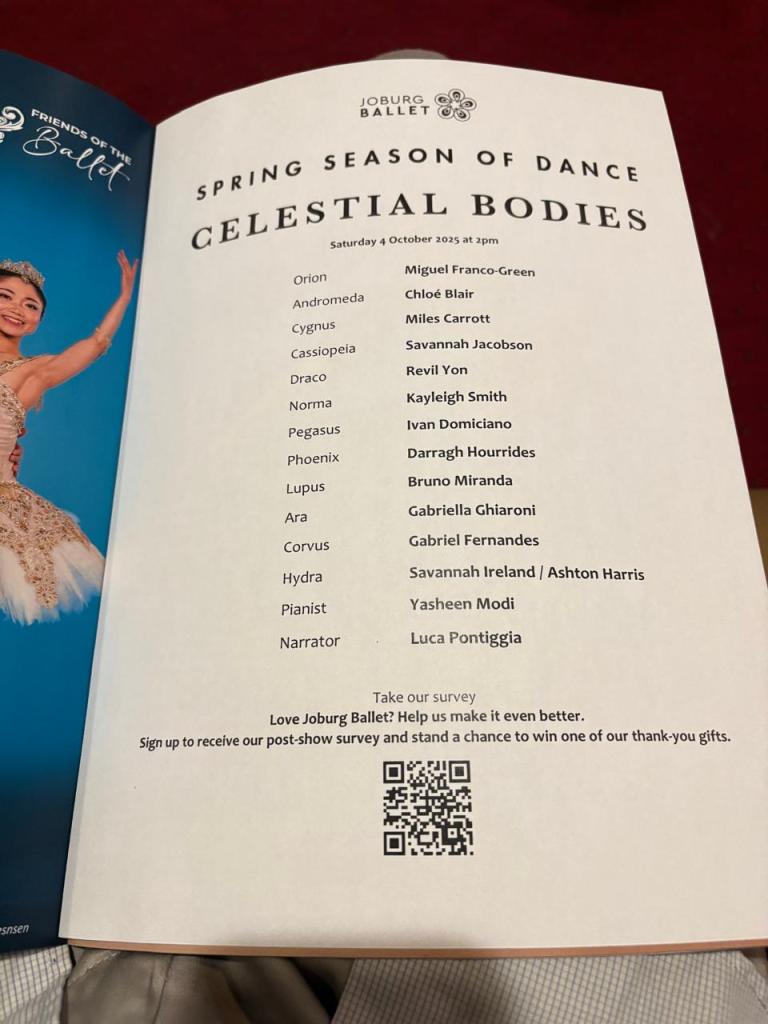
Peasant Pas de Quartre – Chloe Blair, Savannah Jacobson, Miles Carrott, Bruno Miranda
Myrthe, Queen of the Wills – Tammy Higgins
Moyna, attendant to Myrthe Cristina Nakos
Zulma, attendant to Myrthe – Gabriella Chiaroni
Peasants, Couriers, Wilis – Artists of Joburg Ballet

Congratulations Angela Malan and the whole team for a great show and a deserved standing ovation.
📸: SamSays

 antakalipa