An Ode to Motown

An Ode to Motown 

There is something quietly thrilling about seeing performers outside the frame that first introduced them to you. It disrupts familiarity. It redraws the boundaries of expectation. Sitting inside the theatre for the final dress rehearsal of An Ode to Motown, that disruption came early — and it came powerfully.

Lerato Mvelase was the first revelation. Known to many through the language of television — where her craft is contained within the borders of a camera lens — she arrived on stage as something altogether different. A vocalist. A narrator. A commanding presence. Her performance didn’t merely interpret the material; it carried it. She threaded the history of Motown through her voice with conviction and personality, revealing vocal depth and range that transformed surprise into admiration. On stage she expanded — larger, freer, and more electric — embodying the kind of theatrical vitality that only live performance can hold.

Opposite her stood Liesl Penniken, whose presence was striking before a single note landed. Beauty alone rarely sustains attention, but presence does — and hers commanded it. Watching her live felt immersive, as though the distance between performer and audience dissolved. Yet what defined the stage was not a singular spotlight but collective radiance: Tamara Dey, Hlengiwe Pearl, Anele Precious Mthethwa — artists whose elegance, charisma, and technical command recreated Motown’s romantic canon with confidence and swagger.

Their selections leaned into the emotional architecture that built the label’s legacy — love songs, yearning songs, songs of devotion and desire. Classics associated with Marvin Gaye and the Jackson 5 floated through the auditorium with warmth and familiarity. When “Lovin’ You” appeared — its softness and melodic intimacy filling the space — it reminded everyone present that the emotional centre of Motown has always been affection: romantic, communal, and nostalgic. These are songs designed to reconnect people with memory, and the audience responded instinctively, singing along without hesitation.

Seeing Tamara Dey return to the stage carried its own resonance — a reminder of artistic longevity and reinvention. Meanwhile, Hlengiwe Pearl and Anele Precious Mthethwa radiated vitality, balancing vocal strength with visual poise, demonstrating the precision and confidence that anchor ensemble work of this nature.

If the first act glowed with elegance and romance, the second shifted its gravitational centre. The entrance of the male performers altered the energy immediately — grounding the sound with bass, momentum, and physical dynamism. Familiar faces, possibly members of iComplete, stepped forward in tailored black attire that signalled cohesion and intent. Their presence sharpened the show’s rhythm, adding contrast and propulsion that elevated the production into full theatrical stride. It was here that the performance felt as though it truly lifted off — voices interlocking, choreography tightening, the atmosphere thickening with collective electricity.

Beyond the performers themselves, the production design deserves equal recognition. Sequined costumes, sculpted wigs, and textured styling evoked the visual mythology of Motown without slipping into imitation. The aesthetic achieved suggestion rather than replication — conjuring an aura rather than recreating a museum piece. It allowed nostalgia to exist not as reenactment, but as living memory.

That nostalgia became the emotional undercurrent of the evening. The theatre transformed into a communal archive of sound, where audience members sang freely, recollected openly, and shared in musical remembrance. Motown’s catalogue transcends generational boundaries; it is social glue disguised as melody. The rehearsal space, even in its unfinished state, vibrated with this shared participation.

One of the production’s most intriguing gestures arrived through its intellectual layering — weaving philosophical and historical fragments into the musical journey. References touching on Nietzsche and the inclusion of Martin Luther King Jr.’s voice expanded the narrative scope beyond entertainment, situating Motown within broader conversations about identity, struggle, joy, and human aspiration. These insertions reminded viewers that the music emerged from a particular historical consciousness — one shaped by resistance, imagination, and collective hope.

Anchoring the entire production was the live band — exceptional in both sensitivity and precision. Their musicianship ensured that the show never drifted into pastiche. They did not merely accompany; they animated, guided, and textured every transition. Live instrumentation granted the music immediacy, breathing elasticity and emotional responsiveness into songs that have lived decades beyond their origins.

What ultimately lingers after witnessing An Ode to Motown is not a singular performance moment but a composite feeling. The show operates as tribute, celebration, and emotional time capsule simultaneously. It honours the past while energising the present. It invites memory while delivering immediacy. And above all, it affirms that Motown’s spirit — its romance, its confidence, its communal joy — remains timeless.

This production does not simply revisit the music.
It reminds audiences why it never left them.

Choreography: Lulu Mlangeni

Musical direction: Margaret Motsage

Live band

Mpho Kodisang – Piano

Earl Joseph Baartman – Bass

Urbano Bay Nobela – Guitar

Tshepa Diale

Congratulations James Ngcobo and the whole team for a great show and a deserved standing ovation.

📸 : SamSays 
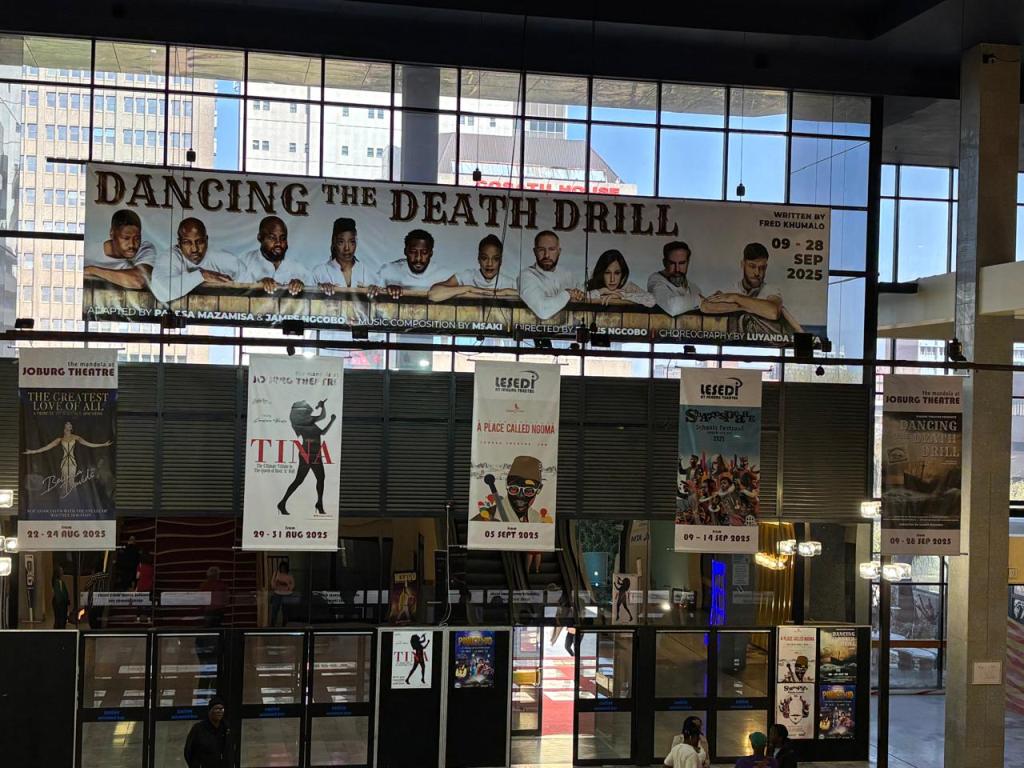
Dancing the death drill

Dancing the death drill

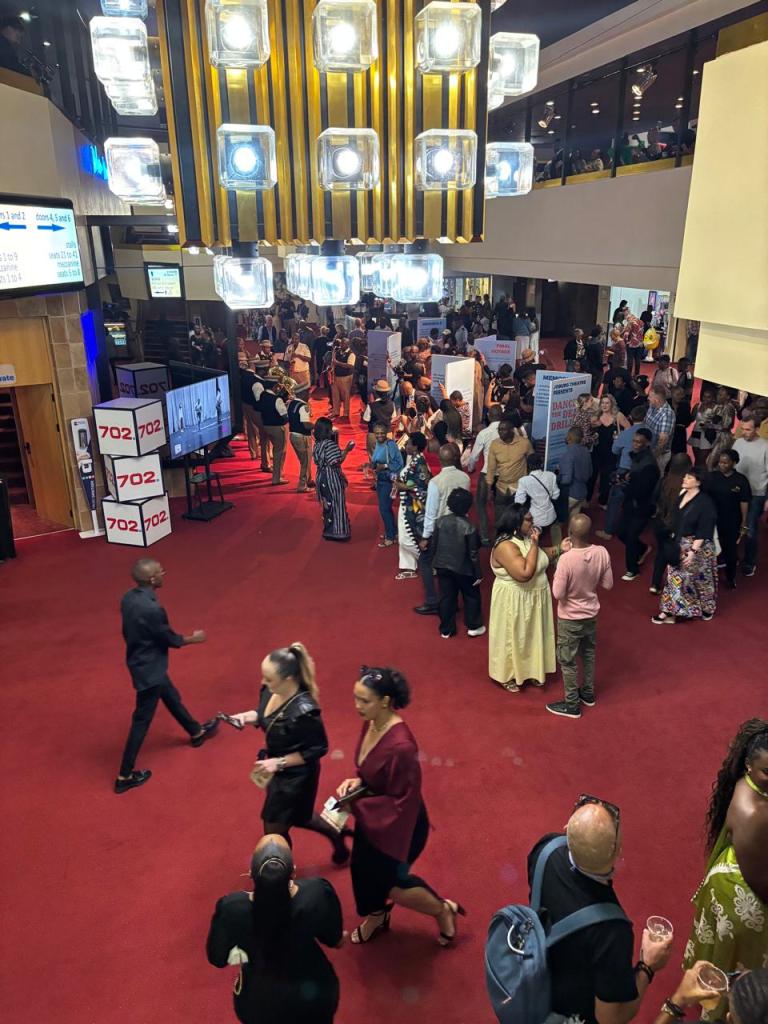
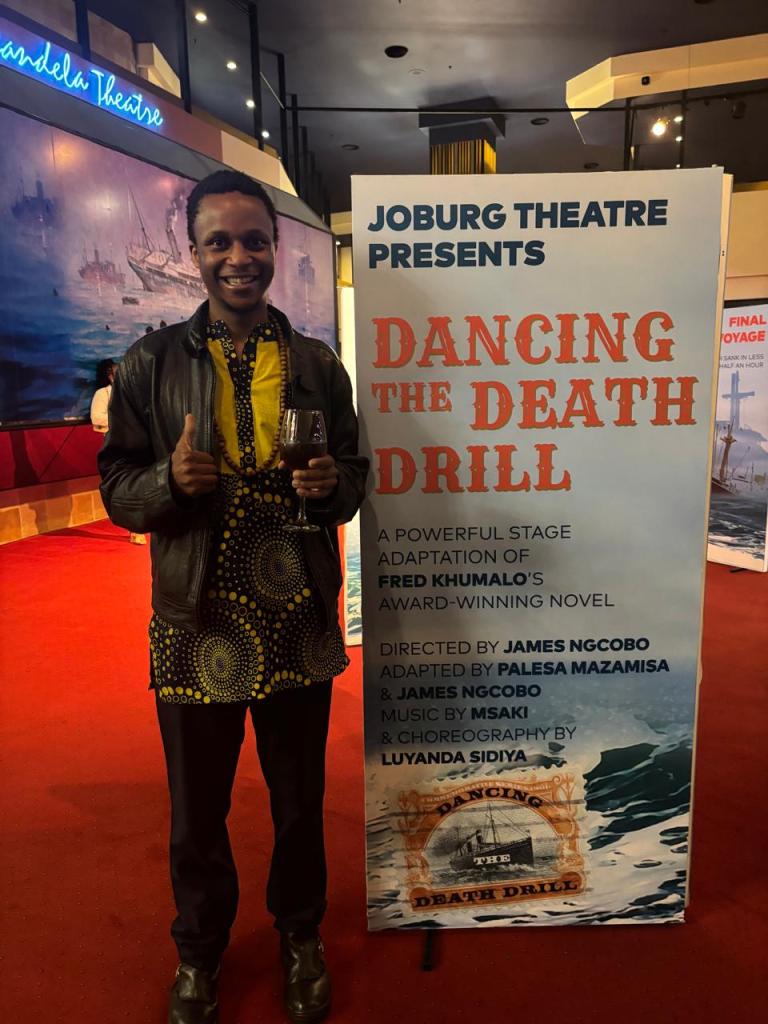
At the Joburg Theatre for the opening of “Dancing the death drill”, packed house, energy palpable, euphoric. So much excitement, there were even soldiers in uniform. My all time favorite performer stars in it, Sharon Spiegel-Wagner. A truly beautiful woman. She speaks French in this one, I rest my case.

What a wonderful theatrical production. I was ecstatic to see Thuli Thabethe, she used to star in a sitcom I used to love “City Sesla”. She played Phumzile, I used to have the biggest crush on Phumi. She plays Matshidiso in this one, the mother of the lead, Pitso Motaung. Her biggest contribution to her son is “don’t be a desserter like your father”. Pitso is a mixed breed, his father is white and his mother black but he identifies as a black Sesotho man. The play is in English but contains dialogue in Sesotho for realism. Clint Brink is a revelation, he speaks Sesotho so well. He plays a character who is accused of a double murder, he is in chains and he is interrogated.

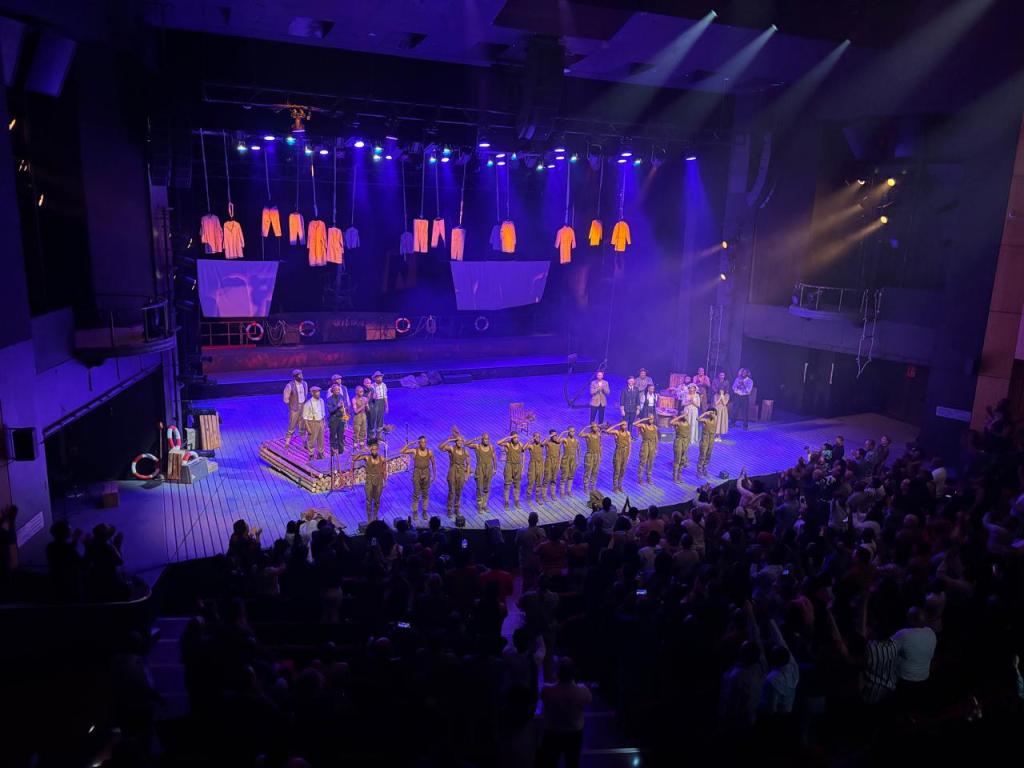
The play has three narrators and they take turns telling the story. They use language that is descriptive and evokes imagery. The monologues are passionate and full of life and personality.  iComplete are the band and they are simply irresistible throughout, the singing and backup is amazing. The violinist, Nakedi “Ace” Phenyo is mezmarrizing, he is in the background for most of the show and is not seen but heard. Towards the end, he comes on in the middle of the stage with the other performers while playing his violin, everyone has eyes on him, he is spellbinding, he had the audience standing up and applauding. However, It was the Luthando Arts Academy who stole the show. They dance with cohesion, chemistry and conviction. In sync, perfect choreography, they make full use of the huge Joburg Theatre stage to perfection, they are outstanding!

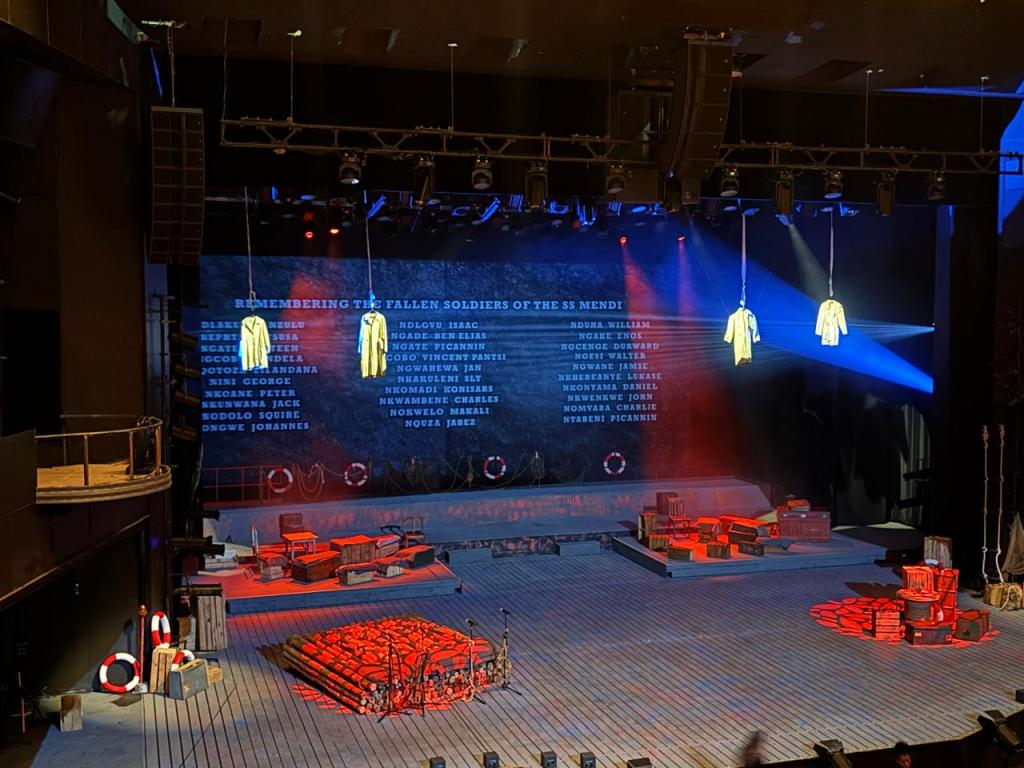
The play is based on the sinking of the SS Mendi in 1917, a British troopship carrying over 800 South African men. The ship sank in the English Channel after a collision, resulting in the deaths of over 600 men, many of them Black South Africans. Writer Fred Khumalo reimagines this tragedy through the eyes of Pitso Motaung, a fictional character who rises from a humble background in South Africa to become a soldier. The story is adapted for the stage by Palesa Mazamisa and James Ngcobo. The set is the SS Mendi, we are on a boat and Charlie Bougenon’s character Portsmouth is the captain. I cracked up when he instructed one of his men to lick off his spit on the ground and he did, talk about running a tight ship.

This is a wonderful production with a lot of enthusiasm. The lighting is awesome and the acting, singing, dancing and overall storytelling is just world-class.

Congratulations James Ngcobo and the whole team for a great show and a deserved standing ovation.

📷: SamSays

KENTE

KENTE

Spent the day as an observer for Sam, SamSays on the credits. She told me to check out the Gibson Kente lecture. I was enthused, Soweto theatre, of course, let’s go! Always wanted to come to Soweto but I hadn’t found probable cause, Sam put together content, theatre and Brenda Fassie to get me there, that my good man is an offer you can’t refuse – The Gibson Kente annual lecture. Before this I didn’t know much about Gibson Kente so I did my research and learned much about him. Legendary playwright, composer, director and producer born in the township like me 🙋🏽‍♂️, started a theatre in the township, collaborated with Caiphus Semenya and Letta Mbulu on his first play titled “Manana, The Jazz Prophet” – a play that depicted gangsterism. Sello Maake ka-Ncube called him the “Godfather of theatre” and he trained more than 400 artists including Brenda Fassie and Mbongeni Ngema. Let’s not forget wrote songs for Miriam Makeba and Letta Mbulu. Oh, thank you for the great pass Sam! It was an awesome day, I learned a lot, it was supreme, the Soweto theatre is beautiful, what a design, the colors, the outdoors vibe, the modern architecture is beautiful! The place is a piece of art. A great place to lose yourself, the sound is crisp, wonderful acoustics, I felt like I was in an oven being cooked but it wasn’t hell, it was pleasurable, like closing your eyes listening to your favorite music, theatre is wonderful, performance arts, an imitation of life, art, it makes life worth living because without it it’s just boredom and death. Definitely one of the best theatres I’ve been to, spacious and comfortable, accommodative and bakes you, temperature slow burning, chilled and relaxed. There is plenty of space for parking, it’s easy to get there, outside area to chill and great art to look at. The Soweto Theatre is pretty awesome! I enjoyed the lecture, it was insightful and educative, quite specular, I am inspired, Gibson Kente is a legend, 23 plays and I want to see them all! The subject matters he explored are about everyday living and life, the black experience, township life, human nature, hope, death. He dealt with what it meant to be human and alive, fought against apartheid and believed in freedom and human dignity. It was an experience and enthusiasm reigned, people connected, energy flowed, loved beamed, the lights emitted, the sound crisp and the stream of consciousness was oscillating in a high vibration. It was a day for theatre. All the theatre people were there, I am talking about directors, actors, legends, writers and producers. I also met a friend I was first acquainted with On the Square (Theatre on the Square, Sandton) who produced a show titled “From Soweto with smiles” Mojalefa Mogagabe, a talented creative I was happy to engage with. Kente, the father of black theatre, SamSays on the credits.

I usually come in an hour before the show, to prepare my mind for the experience, take in everything, be comfortable with the scenario, acquaint yourself with the environment and it was not any different this time. I came in nice and early to Jabulani, I love the fact that the theatre is in the township. I made friends. I was home. When you travel all around you realize that people are the same, we are motivated by the same things, we all want the same things, we wear the same things and we even look alike. The faces are different but we still connected, we could still be friends. I even got myself a Kota, what I eat when I am at home. The township (Kasi) is amazing, it’s the people, the community, diverse cultures, all crammed into one, we may be different but we co-exist as one, the pulse is one because all of humanity is one. Soweto is a breeding place for stories, content and inspiration roams all around, it is the place that made Gibson Kente, he told his peoples’ stories, he brought solace to those who needed it, he reflected and made sense of reality, he was a pillar, he entertained, he made people forget, he inspired, he is forever, Kente, the father of black theatre.

Dr. Andile Xaba the lecturer of the program is a great teacher, knowledgeable, prepared, articulate, passionate and has a lot of love for the arts. He grew up in Soweto and knew Gibson Kente, he was influenced and inspired by him. I learned a lot from him. It was a great lecture that covered Kente’s whole life. It was thorough and informative. iComplete and the band were amazing, heavenly voices, sharply dressed in all black, they were the tempo of the day, smooth and sophisticated. The violinist, Tshegofasto Matabane blew me away! She is so talented, showed so much focus and attention when she was playing the violin, it sounded so beautiful. Shoutout to the Artistic Director of the show James Ngcobo, the program was wonderful, it was an incredible day. It was an experience, my taste, while we chilled outside waiting for the lecture to commence we were treated to some wonderful Jazz music, it was a treat. Counselor Lubabalo Magwentshu provided the Keynote Address. Nomathemba Matu a student of Gibson Kente was the guest speaker sharing entertaining stories about his mentor. She shared life lessons with the audience. She is an amazing storyteller and I was engaged, I took what she had to say to heart. Her perspective humanized Gibson Kente, she made him a person. She was relatable. Soweto is awesome! I enjoyed the performances, everything was masterfully executed. The whole event was well coordinated and professional. One word to describe the event, “Masterpiece”. It was honestly the best day of my life. Kente, the father of black theatre, SamSays on the credits.

The great man
ANTAKALIPA